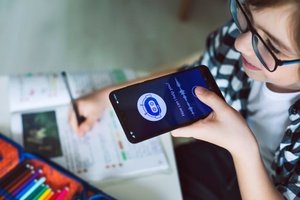


And where devices are used, they must be used intentionally, the Government stipulated.
“This might look like using whiteboards or paper, group debates, practical experiments or performances instead,” a statement noted.
One experienced secondary teacher, who welcomed the reforms, told EducationHQ that her classes involving devices were typically full of disruptions, with students usually very unwilling to close them and put them away when asked.
This was a ‘constant battle’ in many classes, the teacher said.
“They’re like jack-in-the-boxes, the lids keep popping up.”
There is the sense of a growing awakening within education around the negative impact of edtech more generally, she added.
“It’s interesting that a lot of the younger teachers are reverting to using pen and paper in the classroom.
“It’s hard though, because a lot of the textbooks we use are online. So, we’re pushing them towards [the devices] while also trying to limit their use of them.”
As part of other reforms slated for Term 1 next year, primary students in Years 3-6 will also have their screen time limited to 90 minutes a day in a bid to limit the amount of time they spend on laptops – a trend the Government says has accelerated since the pandemic.
Minister for Education Ben Carroll conceded it was “a massive shake-up for the education system” but said the move would “save parents money and it will also improve outcomes for kids”.
“We want an education system that fosters critical thinking, creativity and collaboration,” Carroll said at the time.
“A reliance on screens is having a big impact on behavioural issues, having a big impact on our students’ concentration in the classroom.
“These are really important reforms in the digital age. We know children born today are digital natives, but we want them to have a childhood as well, be out in the playground, be fostering those social relationships,” he added.
From Term 1, 2027, Labor will introduce device-free time in secondary school classrooms. Helping student engagement and attention, and only using devices with intention.
— Ben Carroll (@BenCarrollMP) June 15, 2026
In April, it was announced that mobile phones, smartwatches and other wearable devices will be banned in all Victorian schools from 2027, as the ‘nation leading’ legislation was extended to include independent and Catholic schools.
The new requirement for secondary schools builds on this work.
“We know that screen-free time is important to help students engage with their learning, so we’re asking schools to include it in their curriculum,” Carroll said.
Prominent educational neuroscientist Dr Jared Cooney Horvath has warned that we risk further eroding children’s cognitive development if the expansion of edtech into classrooms continues as it is currently.
“Over the past two decades, the cognitive development of children across much of the developed world has stalled and, in many domains, reversed.
“Literacy, numeracy, attention, and higher-order reasoning have declined despite increased school attendance and expanded public investment,” Horvath flagged in a written testimony to the US Senate Committee on Commerce, Science, and Transportation.
The expert noted that although digital tools now consume a significant share of instructional time, assessment, homework, and student attention, the evidence to date from international assessments and sweeping research studies shows that increased screen exposure in classrooms is actually linked with poorer learning outcomes.
“Over half of our children now use a computer at school for one to four hours each day, and a full quarter spend more than four hours on screens during a typical seven-hour school day.
“Unfortunately, studies suggest that less than half of this time is spent actually learning, with students off-task for up to 38 minutes of every hour when on classroom devices,” Horvath elaborated.
While in some limited circumstances digital tools can bolster ‘surface-level’ skill acquisition, in most academic contexts screens only slow learning, diminish depth of understanding and weaken retention, he added.
This is primarily because digital platforms are engineered to capture attention, fragment our focus and speed up task switching, Horvath said.
“This is not a debate about rejecting technology. It is a question of aligning educational tools with how human learning actually works,” he clarified.
“Evidence indicates that indiscriminate digital expansion has weakened learning environments rather than strengthened them …
“Our responsibility is not to maximise screen exposure, but to maximise the cognitive capacity and long-term flourishing of the next generation.”
Meanwhile, emerging research is building a stronger case against the inclusion of digital tools in the foundational years, with a new study finding that handwriting provides ‘distinct advantages’ over typing during the early stages of reading acquisition.
Although there is evidence that typing has a negative impact on children's learning of letters, the researchers flag that it remains unclear how writing letters and words, either by hand or typing, affects reading acquisition.
They suggest that this could be because typing weakens the recruitment of phonological recoding processes inherent in writing.
To address this question, 50 Kindergarten children were split into two groups: one learned a set of novel letters and words by copying them by hand while listening to their pronunciations, whereas the other group learned the same letters and words by typing them.
Both groups were assessed on three abilities reflecting different stages of reading acquisition: (a) naming the learned letters, (b) decoding novel words composed of the trained letters, and (c) visually identifying the novel words.
Children in the handwriting group showed better performance in the letter naming, word decoding, and visual word identification tasks, and only in this group were phonological skills associated with learning outcomes.
These findings have practical implications for teachers, the researchers stated.