NAPLAN results are released. Headlines declare standards are falling. Politicians propose solutions. Education experts debate phonics, explicit teaching, curriculum, funding and classroom practice.
This year has been no different.
Around one in three Australian students are not meeting expected literacy and numeracy standards, while around one in ten require additional support if they are to catch up with their peers. Those figures should concern every Australian because behind every statistic is a child whose future opportunities may depend on the support they receive today.
Before we ask why Australia’s NAPLAN results have changed, perhaps we should ask a different question.
Have we been measuring student achievement in the same way all along?
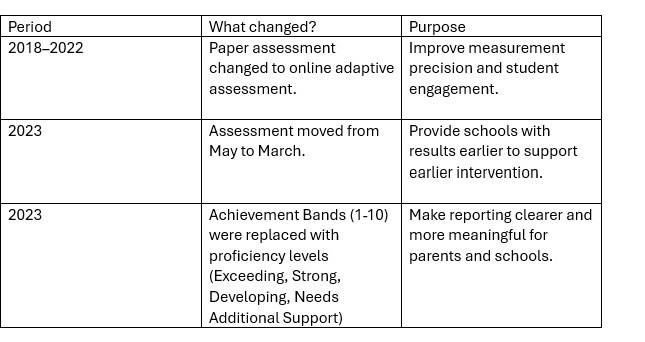
Over the past eight years, Australia’s national literacy and numeracy assessment has undergone a series of significant changes.
Between 2018 and 2022, NAPLAN transitioned from a traditional paper-based assessment to a fully online adaptive test. In 2023, it moved from being administered in May to March. At the same time, the familiar achievement bands were replaced with an entirely new proficiency framework.
Each of these changes was introduced with a clear rationale.
According to the Australian Curriculum, Assessment and Reporting Authority (ACARA), online adaptive testing provides more precise estimates of student achievement than a fixed paper assessment. Moving the assessment to March allows schools to receive results earlier and intervene sooner, while the new proficiency categories are intended to be easier for parents to understand than numerical bands.
Viewed individually, each of these changes is entirely reasonable. Collectively, they raise a much bigger question.
How has NAPLAN changed over the last eight years?
If we’ve changed how students are assessed, when they are assessed and how their achievement is reported, how much of what we’re seeing reflects changes in student learning? How much reflects changes in the way we measure it?
Consider a Year 5 student.
Until 2022, that student completed NAPLAN in May after almost a term and a half of Year 5 learning. Today, the same student completes the assessment in March after only a few weeks of classroom instruction.
That student is also sitting a fundamentally different assessment. Rather than completing identical paper questions alongside every other student, they now undertake an adaptive online assessment that changes according to their responses. Their results are then reported using a different proficiency framework from the one that existed during NAPLAN’s first fifteen years.
ACARA itself advises that results reported from 2023 onwards should NOT be directly compared with those reported between 2008 and 2022 because of significant changes to the reporting framework.
When the annual results are released, discussion quickly turns to whether phonics is working, whether curriculum reform has succeeded, whether funding has delivered improvements or whether teaching practice needs to change.
Perhaps we should first acknowledge that the assessment itself has evolved considerably. Educational measurement is not as simple as comparing one year’s results with another.
The way an assessment is designed, administered and reported influences the conclusions we are able to draw from it.
Too many students continue to struggle with literacy and numeracy. Significant disparities remain between metropolitan, regional and remote communities. Schools are responding to increasingly complex student needs while teachers continue to work under extraordinary pressure.
NAPLAN provides an important snapshot of student achievement at a specific point in time. It helps identify where students may require additional support and informs important conversations about school improvement.
Student outcomes are shaped by teaching quality, attendance, wellbeing, family circumstances, school culture, leadership, resources and countless other factors that no single assessment can fully capture. For that reason, NAPLAN on its own cannot explain why results change.
Attributing changes in national performance to a single teaching method, curriculum reform or government initiative without considering the broader context risks oversimplifying a far more complex picture.
Each of these reforms may have strengthened NAPLAN as an assessment. What is less clear is how we interpret long-term achievement trends. I suggest that needs to be independently evaluated.
Such a review would strengthen confidence in the assessment, improve public understanding and ensure future debates about Australian education are grounded in the clearest possible evidence.
The conversation about Australia’s education future is too important for us not to be on the same page about what a key national assessment measures and what conclusions we can reasonably draw from it.