

Led by former secondary teacher and now PhD candidate Jessica Colleu Terradas from ACU’s Centre for the Advancement of Literacy, the research highlights the foundational role morphological knowledge plays in adolescent literacy – both as a significant contributor to spelling performance and an enabler of fluent writing.
Colleu Terradas says she’s seen limited evidence of time poor secondary teachers explicitly teaching spelling and morphology in classrooms, and yet we know that once students hit Year 7 they are confronted with texts littered with morphologically complex words (words with multiple meaningful parts).
She notes that academic and subject-specific texts make up an estimated 60-80 per cent of all secondary school reading materials.
“What I realised is that in high school, there’s a shift from narrative to non-fiction text.
“And a lot of those words that high school kids encounter might not have already been encountered in their previous reading experiences – or they might not appear in their spoken everyday conversation.
“We know that in order to access the curriculum content [students] would need to be able to identify and know those words, and know how to spell and use them in their writing, for instance,” the researcher tells EducationHQ.
Involving 266 Year 7 students drawn from seven schools across NSW and the ACT, the study found a strong correlation between morphological knowledge and performance on spelling tasks.
For the data-hungry amongst us, morphological knowledge accounted for 26 per cent of the variance in overall spelling performance.
Students’ spelling ability was also strongly correlated with NAPLAN writing scores, Terradas flags, a finding consistent with longitudinal studies involving primary-aged students.
The researchers point to McCutchen’s (1996) capacity theory of writing, which proposes that when lower-level skills like spelling are not mastered to the point of automaticity, they consume working memory resources that are needed for higher order writing processes such as planning, organising and revising.
“I think there are promising signs that morphology has a role to play, [and that it] could be integrated into instruction in a high school setting,” Colleu Terradas says.
As morphemes are essentially the smallest unit of meaning within a word, they can unlock the meanings behind a larger bank of words that derive from the same ‘family’, she explains.
“And those words could be encountered across multiple learning areas and across year levels … [knowing a given morpheme means they could] technically deduct or predict the meaning of the bigger word by kind of pulling it apart…”
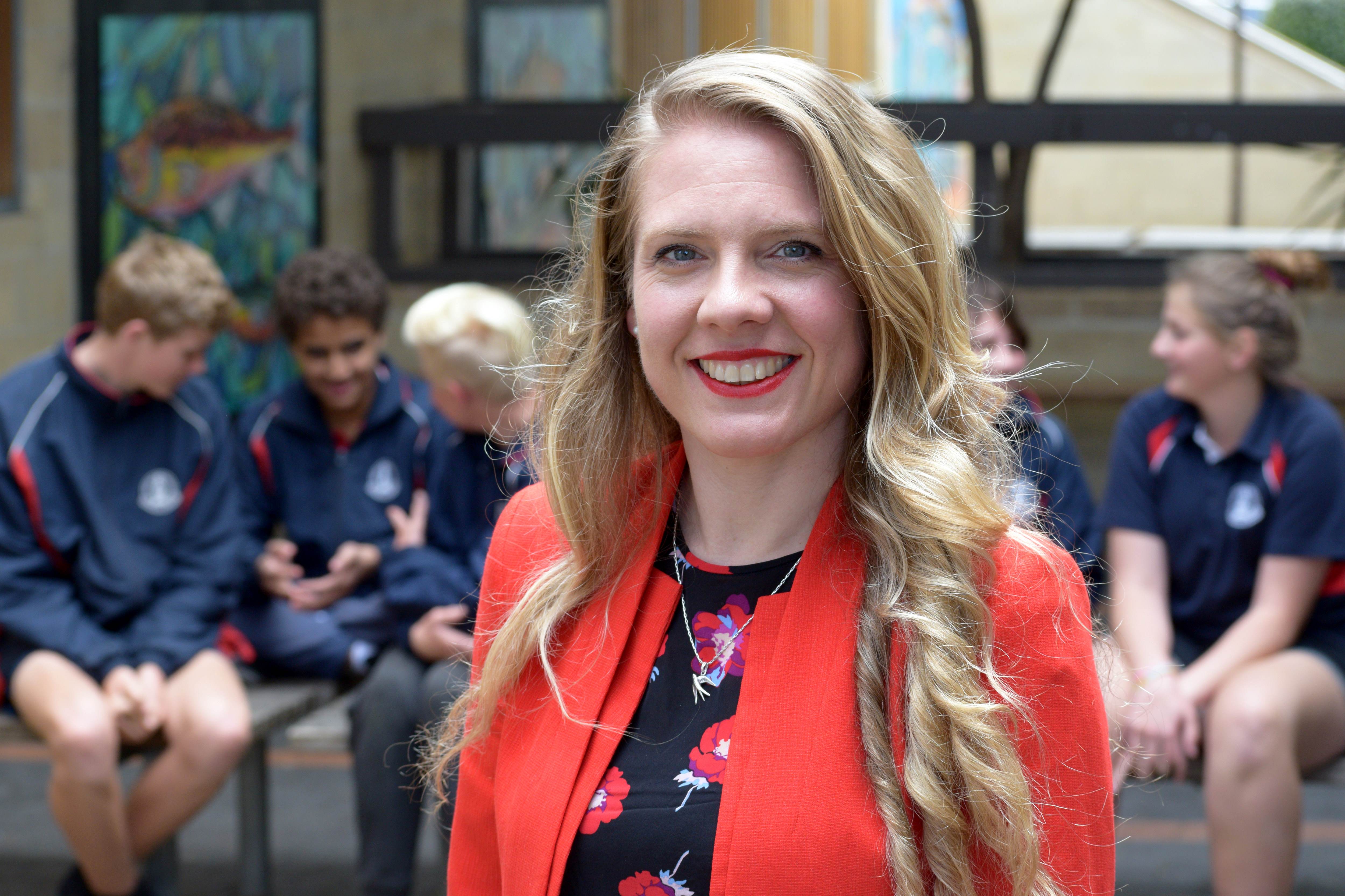
Jessica Colleu Terradas is keen to advance further research unpacking the strong links between morphological knowledge, spelling and writing at the secondary level.
In content-heavy subjects like science, Greek and Latin morphemes (microscope or physiology, for example) are common yet often unfamiliar for many students.
Knowing key morphemes could prove highly beneficial here, Colleu Terradas suggests.
“…I wish that we could integrate some more morphological instruction through the teaching of vocabulary across learning areas, and maybe ensuring that students have multiple encounters across learning areas by looking at those more highly predictive words,” she adds.
Drawing on cognitive science, it’s clear that stronger morphological knowledge hands students greater access to more academic and technical words as well, Colleu Terradas says.
“There’s some benefits in the sense that being able to break up the words into smaller manageable chunks helps reduce the cognitive load rather than learning the word by memorisation as a long chunk of letter strings.”
The literacy specialist has long maintained that there is a clear lack of research and experts to guide literacy interventions post-primary school.
“And there’s not much guidance from departments, ever, about what to do when a Year 7 kid comes into your high school and they either can’t read – or read at a Year 1 reading level,” she told EducationHQ previously.
“I think there is a lot of misconception, or more assumption, that [students starting high school can read proficiently], but it’s not often the case.
“PISA results are showing that there’s a growing number of kids at risk in that area.”
Nearly one-in-five Australian students start secondary school at or below minimum standards for literacy.
Last year’s NAPLAN results show just 24.1 per cent of Year 7 students exceeded the expected proficiency level in spelling, with 88.4 per cent achieving results in the ‘developing proficiency’ level or above, ranging from 85.0 per cent in grammar and punctuation and 90.9 per cent in spelling.
Girls continue to outperform boys in literacy domains, particularly in writing.
Colleu Terradas has warned that for secondary schools, implementing literacy interventions via a Multi-Tiered System of Support (MTSS) presents an array of challenges.
Namely, siloed subject departments, unforgiving timetables, gaps in foundational skills and waning student engagement to name a few.
NAPLAN analysis conducted by AERO last year found the writing skills of Australian children are at an all-time low, finding many Year 9 students were writing at primary-school level.
“What we discovered was that there was a large number of students whose punctuation and sentence structure was what we would expect of students at a Year 4 level, so [it was] serious cause for concern because writing [is] such an important skill,” AERO CEO Jenny Donovan told ABC News last year.
Colleu Terradas says moves should now be made to evaluate morphology-based interventions in secondary classrooms to investigate their impact on spelling and writing during this critical stage of academic language development.