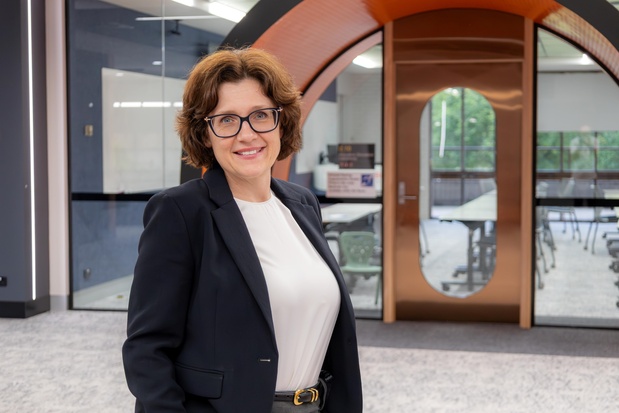
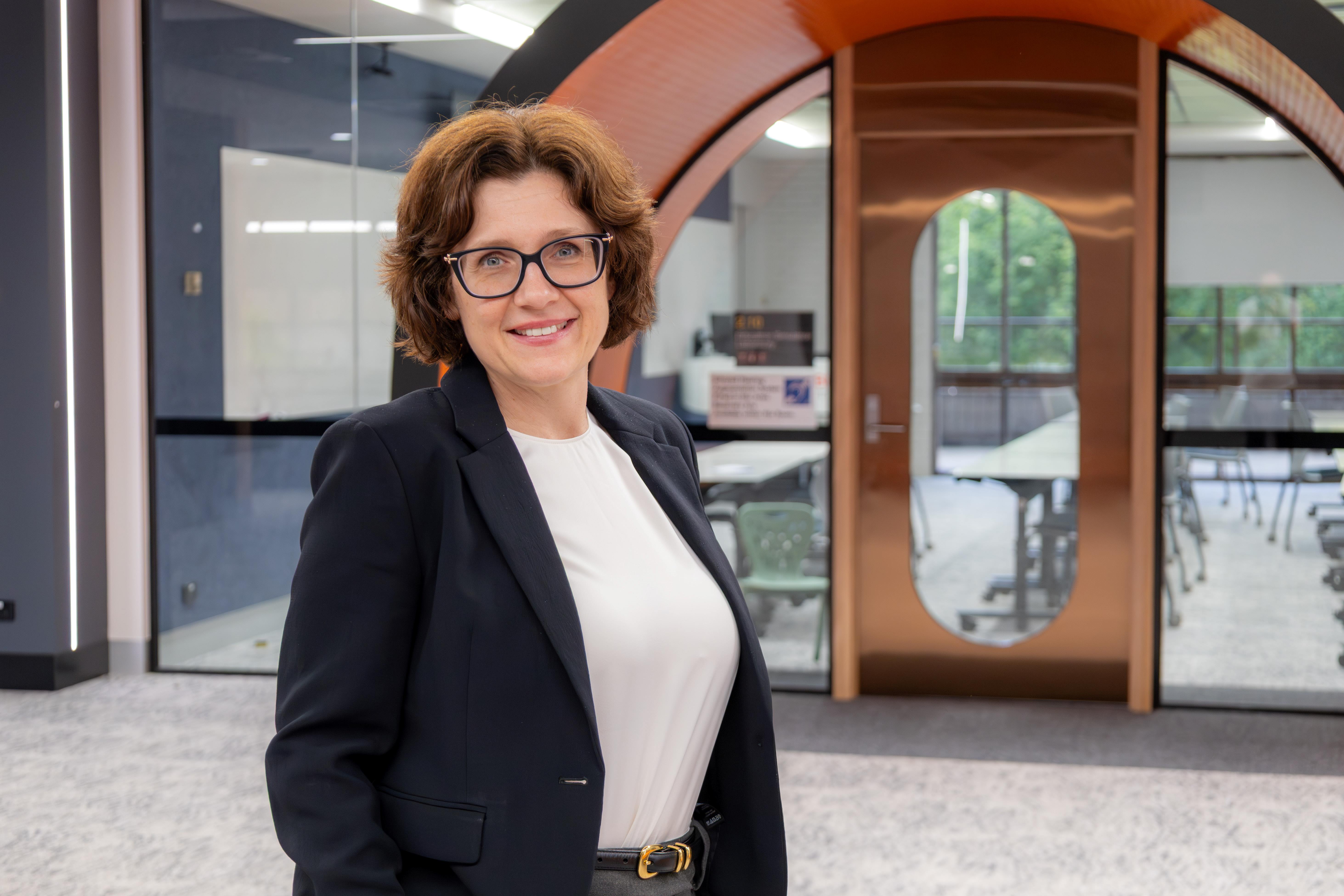
Canadian mathematics professor Anna Stokke, host of the popular Chalk and Talk podcast, is visiting Australia this week as part of her new role as La Trobe University’s Science of Mathematics Education (SOME) Lab co-director.
The expert from University of Winnipeg has been advocating for evidence-based maths instruction for some 15 years – a mission that took hold when Stokke and her husband realised their eldest daughter was not being taught foundational maths skills at school.
“It was around Grade 3, where we were just like, ‘this is not going well’,” Stokke tells EducationHQ.
From what Stokke could see, maths instruction involved teachers handing out a ‘problem of the day’ – despite students not having been taught the skills needed to solve it – and not much more.
“This was the tip of the iceberg,” the expert says.
“There was no systematic instruction going on. And so the kids were lost, they didn’t know how to solve these problems.
“Our daughter would come home, we’d show her how to solve them … they weren’t even being taught how to add numbers and columns, the traditional vertical algorithm for arithmetic – they weren’t taught that.”
Bizarrely, the school didn’t allow students to use the vertical algorithims in class.
“[My daughter] had a little notebook and she would write under the desk to do it.
“It was really crazy. And that was the way the curriculum was in my province, and how it was being interpreted.
“They weren’t being required to memorise their times tables. We were flabbergasted.”
Compelled to address the situation, Stokke and her husband started their own maths club for students in need of some solid instruction. The venture quickly snowballed.
“My daughter’s friends would all come over to our house after school and we would teach them maths.
“And then we made this into a bigger thing. So several mathematicians in the province got together and we founded a non-profit organisation, of which I’m the president. And my husband and I designed all the lessons,” Stokke says.
Part of the problem with how maths is taught in various school systems around the world, including those in Canada, is that there’s incredibly loose standards about what counts as evidence and what does not, Stokke contends.
“Every program says that it’s research-based, [so] educators don’t know who to believe – why should they believe one person over another person?”
Unlike in the medical field where scientific evidence holds a great deal of integrity, it’s an entirely different ball game in education, the expert suggests.
“When someone says ‘[this is evidence-based’] in education, it can mean anything.
“It could mean a blog post. It could mean an opinion piece. It could mean an anecdote. It could mean anything.
“It could mean that the person did a study and didn’t even test whether the students learned maths, right?”

Stokke believes LaTrobe's new SOME Lab has the potential to offer a model of maths teacher education that could be adopted around the world.
Further clouding the scene for teachers and school leaders are an array of popular figures who promote entirely ineffective practices in the maths classroom.
“And sometimes those influential educators [look like] they have a lot of credibility.
“They might work at, for instance, institutions like Stanford University, and it would be hard to believe that someone at Stanford would be promoting ineffective methods for teaching mathematics – but this is happening,” Stokke says.
Some educational research is simply not generalisable either, the expert flags.
“What I mean by that is there is a whole field of statistics where they know how to set up a study properly, so that you have a good design to perform a proper statistical analysis that can tell us whether we can generalise what was found in that study or not.
“And that’s the kind of evidence we need to be looking at more in education.
“Because if we’re just taking anything as evidence, that can actually do harm. It may not be effective at all.
“In fact, it may be quite ineffective.”
Almost half of Australia’s 15-year-olds failed to achieve national standards in maths in the latest PISA results (published in 2023), and the nation is more than four years behind Singapore, the world’s top-performing jurisdiction.
Stokke believes LaTrobe’s new SOME Lab has the potential to offer a model of maths teacher education that could be adopted around the world.
It follows the success of the university’s acclaimed SOLAR Lab, founded by Distinguished Professor Pamela Snow and Professor Tanya Serry, which was influential in Victoria’s system-wide shift towards explicit teaching.
“Professor Joanna Barbousas, the Dean of Education, wanted to do something similar for maths, which I really admire because a lot of people kind of leave maths out of the equation, so to speak,” Stokke says.
“There is a large body of work that informs us about how best to teach mathematics, so the primary goal of the SOME Lab will be to translate that research for teachers so that they know about effective practices for teaching their students maths.”
Stokke is encouraged by Australian teachers’ appetite for professional learning that hones in on evidence-based instruction.
It’s a driving interest that she says is not as evident amongst Canadian or US teachers.
“There is definitely an eagerness to adopt evidence-based instruction, and a genuine interest in learning more about explicit teaching in Australia, to a level that we absolutely do not see in Canada or in the US.
“As an example, in Canada I suspect very few teachers would have heard of Rosenshine's principles. They outline the components, say, of explicit instruction – very few teachers would have heard of that. Or retrieval practice, not many are using mini whiteboards – that wouldn’t be common.
“Definitely there’s something going on in Australia... just that willingness to engage with the evidence is ultimately what will drive improvement in maths education.”
There is huge momentum right now across the country on this front, the expert says.
“And this is not as widespread in North America. So, I think that’s really promising. I think Australia is headed in a great direction.”
This is the first of two articles canvassing Professor Stokke’s insights on maths education and effective instruction.