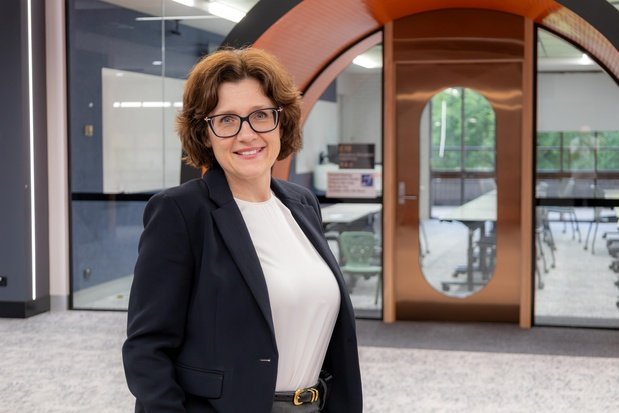
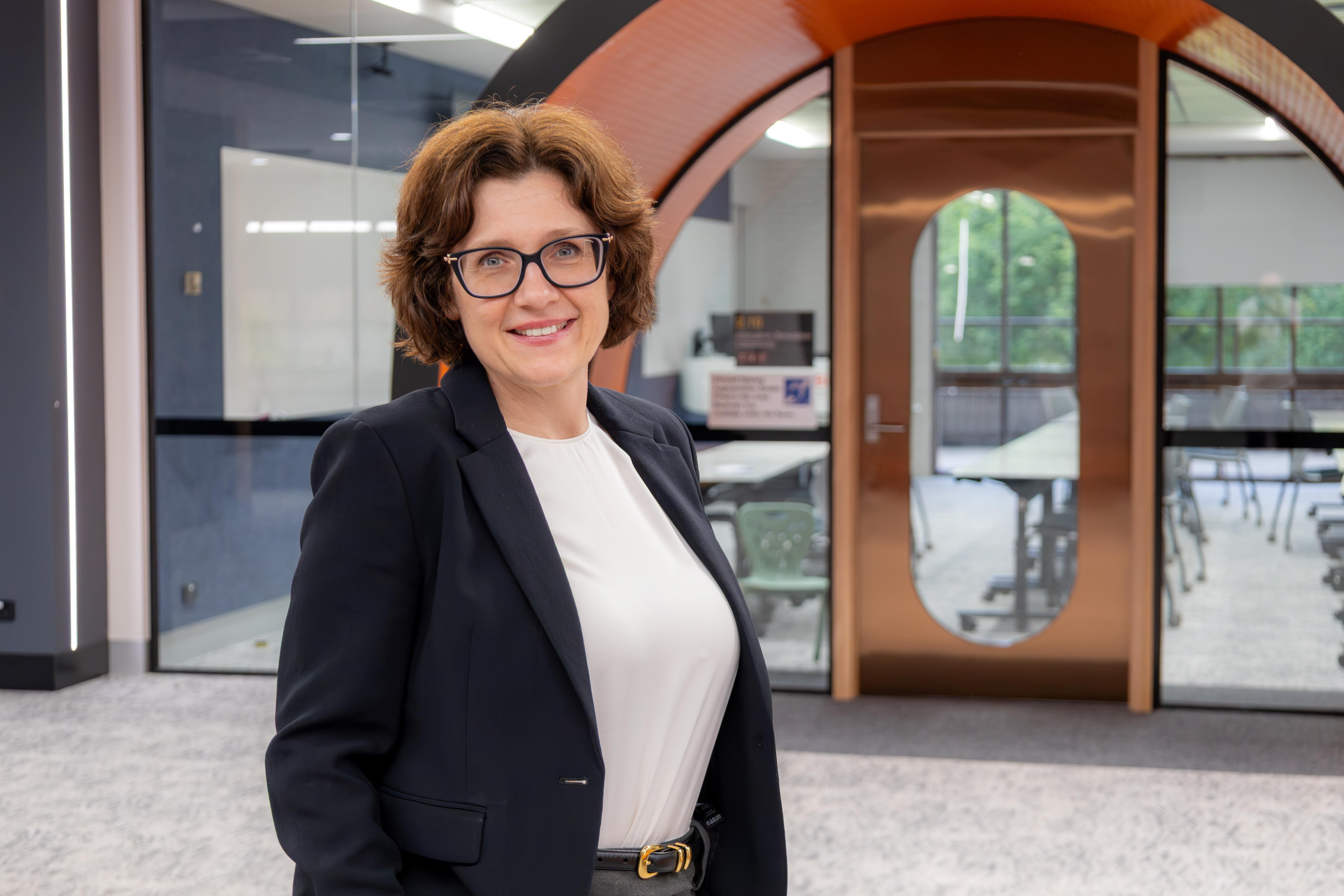
Canadian mathematics professor Anna Stokke, host of the popular Chalk and Talk podcast, was visiting Australia last week as part of her new role as La Trobe University’s Science of Mathematics Education (SOME) Lab co-director.
The expert from University of Winnipeg has been advocating for evidence-based maths instruction for some 15 years, and says maths teaching has suffered from a string of harmful approaches and fads that have led many students in school systems across the world to believe they are not good at maths – when in fact it’s their classroom instruction that’s failed them.
“There’s always the ‘new thing’, and sometimes, these things sound good,” Stokke tells EducationHQ.
“Like, people think, ‘okay, we want kids to problem solve – so we’re going to give them problems of the day’, with the idea being that they’ll learn how to problem solve.”
It simply does not work in this way, the expert says.
“In order to learn how to problem solve, you have to have foundational skills. You have to have a lot of knowledge to work with…”
Using engagement as a proxy for learning in maths is another terrible idea that’s taken hold, Stokke says.
“So, practice is really disparaged, because they have this idea that this turns kids off maths.
“This is backwards thinking, because you don’t want to do things you’re not good at, right? You want to do things that you are good at.
“And the way you get good at maths is through practice, so … [this idea has] been absolutely horrible for maths education.”
It’s widely reported that Australia is falling well behind on maths excellence.
Just 13 per cent of Year 4 students met the ‘advanced’ maths proficiency benchmark in the 2023 Trends in International Mathematics and Science Study, compared with 22 per cent in England and 49 per cent in Singapore.
The most recent NAPLAN data shows that around one in three Year 3 students are failing to reach challenging but achievable numeracy proficiency standards, and one in ten are in need of additional support.
While multiple factors have been attributed to driving our poor maths outcomes, including teacher preparation and the quality of instruction in primary schools, the national F-2 Curriculum has come under fire for being deeply unambitious.
“Despite being crammed with all sorts of elaborations and various thought bubbles generated by education bureaucrats, the actual mathematics it expects students to be able to master is deeply unambitious when compared with countries like Singapore,” Dr Greg Ashman, deputy principal at Ballarat Clarendon College in Victoria, recently told EducationHQ.
Stokke suggests the de-emphasis on teaching children foundational maths skills is another phenomenon that has stunted students’ progress and effectively locked them out from accessing maths at higher levels.
“The reason this is a problem, is maths is cumulative.
“So I often say it’s relentlessly hierarchical, which means that maths is kind of like a ladder, and if you’re missing rungs on that ladder it can be really hard to get to that next step.”
Take algebra, the ‘gateway to higher level maths’, Stokke offers.
“In order to be able to do algebra, you need to be able to do fraction arithmetic really well. And in order to be able to do fraction arithmetic really well, you need to be able to work with basic whole number arithmetic, and you need to know your times tables.
“So, when any rungs are missing on that ladder, the gaps just start compounding.”
It’s at this point that you might start hearing students say that they’re not good at maths, or not a ‘maths person’, which is not the case at all, the expert says.
“It’s not that they’re not good at maths, it’s that somewhere along that ladder they maybe received poor instruction, or they didn’t get enough practice and then they fell behind.
“And now when their teacher is teaching something that relies on that skill, it’s like the teacher is teaching in a different language – they can’t understand it.
“The prerequisite skills really, really matter.”
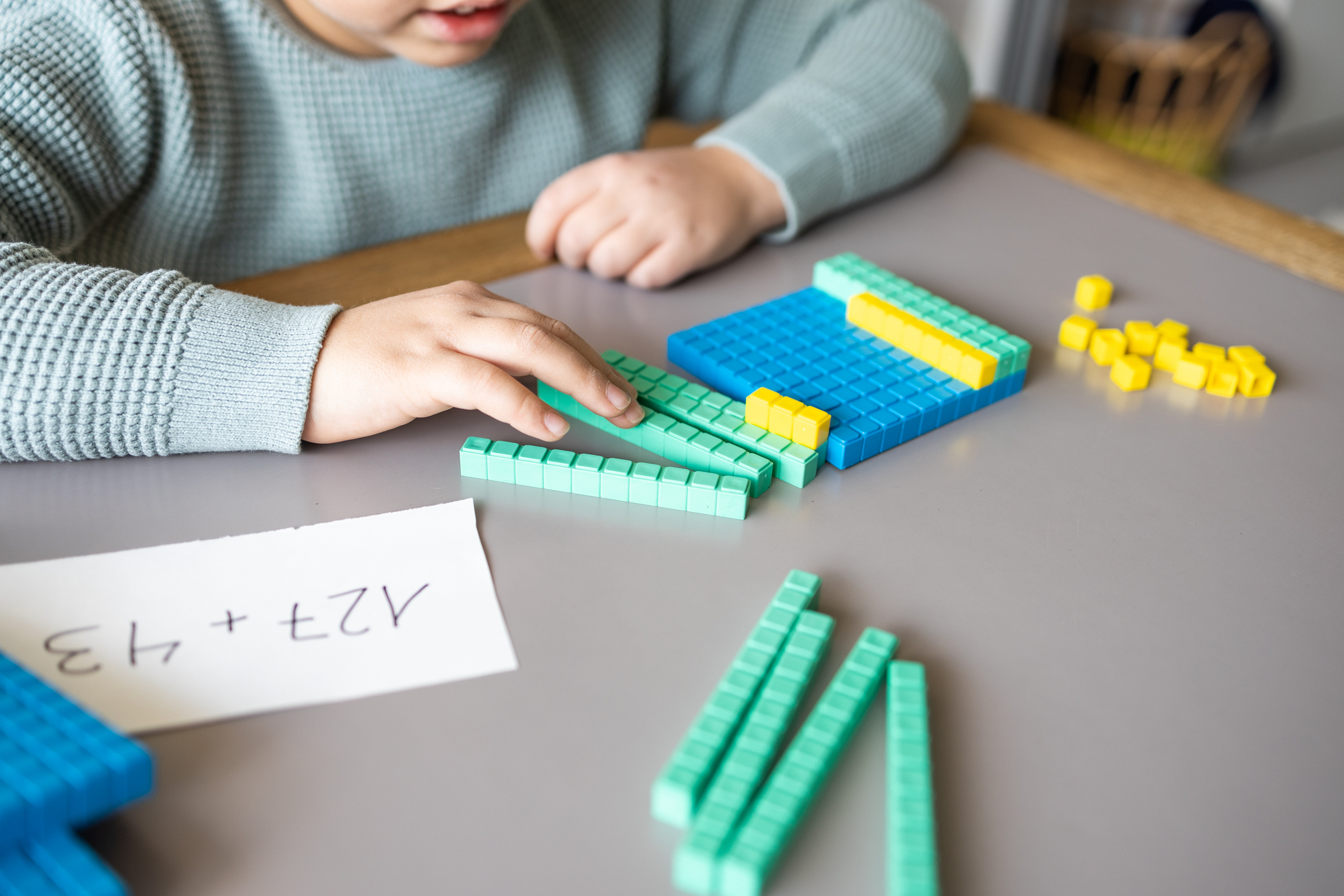
Novice learners are being taught multiple strategies for the four basic mathematical operations, including using base 10 blocks, leaving students confused and cognitively overwhelmed, Stokke says.
Another damaging approach, and one that is quite common in North America, is for novice learners to be taught multiple strategies for addition, subtraction, multiplication and division, Stokke flags.
“And some of those strategies are really ridiculous, [so] maybe using like base ten blocks as an actual method for doing arithmetic, which is absurd, because no one would do that,” Stokke says.
“But they’re taught so many different methods when they’re first learning that they become completely confused – it’s just a terrible way to teach. They get cognitively overload, they get confused.
“But unfortunately, this is very common.”
This also sucks of critical class time and means that students don’t get enough opportunity to practice one method and get good at it, the expert adds.
“What we need to do when we’re teaching someone something new in mathematics, we need to teach them the most effective method for doing that thing, and the method that’s going to be generalisable to other numbers.”
For example, in the case of addition, subtraction, multiplication or division, students must be taught the standard algorithms first, Stokke says.
It’s about the timing of instruction here, the expert adds.
“If there’s an occasion to teach other ways to do something, do it.
“But with a novice learner, teach them one way, get them to master it until they’re good at it, and then later, if you want to teach other methods … that’s fine.”
Despite the fads, ‘innovations’ and erroneous ideas that have plagued maths education, we do know how to teach maths effectively in the classroom, Stokke says.
“We’ve known for a long time, that research has been around for a long time. You know, we know what to do. It’s just not always known, and it’s not being followed.”
Read more about Professor Stokke’s insights on maths education and effective instruction here.