


Canvassing the insights of more than 250 principals, senior leaders and HR professionals across all sectors, PeopleBench’s latest State of the Sector report reveals an inherent contradiction now lies at the heart of their work.
That is, while the majority felt positively about their school’s culture and their workforce overall, significantly less felt the same about their own role.
Mike Hennessy, chief research & insights officer at PeopleBench, told EducationHQ that even though the work of leading within schools was deeply motivating and rewarding for people, the sheer unsustainability of the workload for those at the top was approaching a tipping point.
This is the ‘burnout paradox’ faced by school leaders, he explains.
“When we talk about burnout, the best way I think about it is in terms of a balance between the demands of a job and the resources people have available to do the job.
“So when we think about the demands of a school leader’s job, it’s things like the workload, the complexity of relationships with students, parents in the school community, how intense that workload is.
“And then on the resources side of the equation, it’s what kind of supports do those school leaders have to counterbalance the demands in terms of social support, peer networks, skill development opportunities, etc.”
The data shows the scales are now precariously unbalanced, Hennessy suggests.
“…people are really committed to [school leadership] still, but in spite of that, we still see signs that the demands are too high and it’s tipping the scales too far in that direction.
“So that’s the paradoxical nature of it: even though this work is clearly really motivating for people, it’s getting to a point where it’s apparently not sustainable for too many leaders.
“And that’s a big risk because we don’t have the pipeline of future leaders that we need to be able to backfill these positions as they become vacant over time.”
SOURCE: PeopleBench State of the Sector report.
Research released last year found principals felt caught between competing demands from parents, policy directives and the practical realities of running a school – a position that inflicted ‘profound emotional and moral injury’.
“[Participants] found themselves in situations where they had to decide between making exceptions for individual students, often at the insistence of vocal parents, or maintaining policies that ensured fairness across the school community,” lead researcher Dr Caroline Wade from Griffith University noted.
One secondary teacher told EducationHQ that many of her teaching colleagues had no desire to pursue a school leadership role.
“They look at these people – who are tired, stressed, largely underappreciated and yet still going a million miles and are across everything – and they think, why would I want that?” she said.
“I think this is under-reported, because people are kind of reluctant to admit they don’t aspire to progress up…”
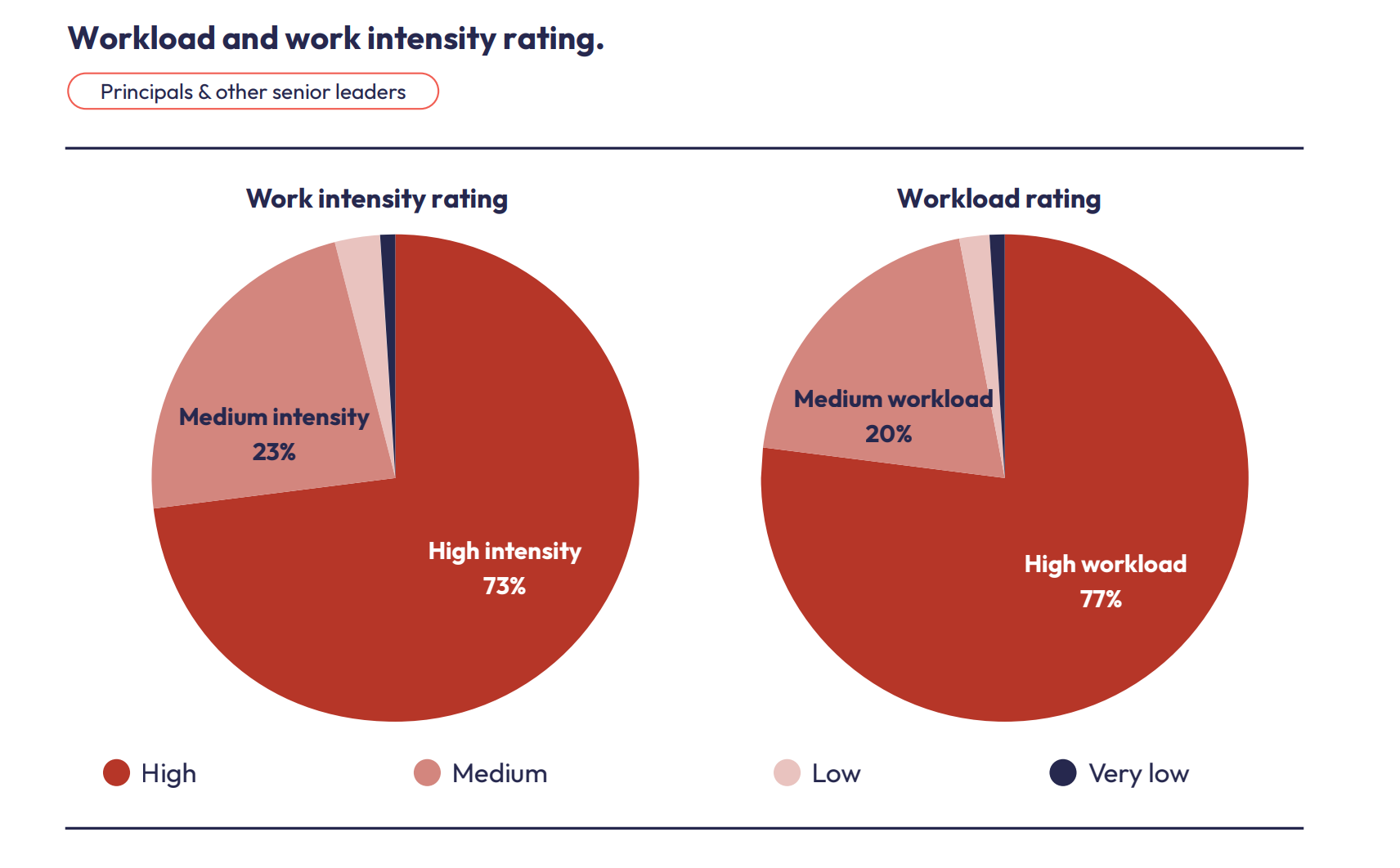
Indeed, 77 per cent of school leaders rated their workload as high, and 73 per cent rated the instensity of this work as such, the PeopleBench survey found.
The latest Australian Principal Occupational Health, Safety and Wellbeing Survey, compiled by ACU’s Institute for Positive Psychology and Education, also showed workload pressures are now reaching ‘critical’ levels, with principals working nearly 54 hours a week – a figure well above the OECD average.
“But the intensity piece that goes along with that, which is the subjective experience of doing that work, how complex it is, how emotionally laborious it is, how difficult it is, and how stressful it is, that is the piece that is particularly concerning – and that’s one thing that really stood out to us…” Hennessy says.
Researchers have long flagged concern over the perilous school leadership pipeline in Australian schools, warning attrition is at risk of outstripping supply.
The State of the Sector study found leaders of regional schools are significantly more likely to quit their role within the next year than their urban counterparts, with more than 15 per cent flagging their intention to leave within this timeframe.
Meanwhile, just over 11 per cent of metro school leaders reported having plans to leave within 12 months.
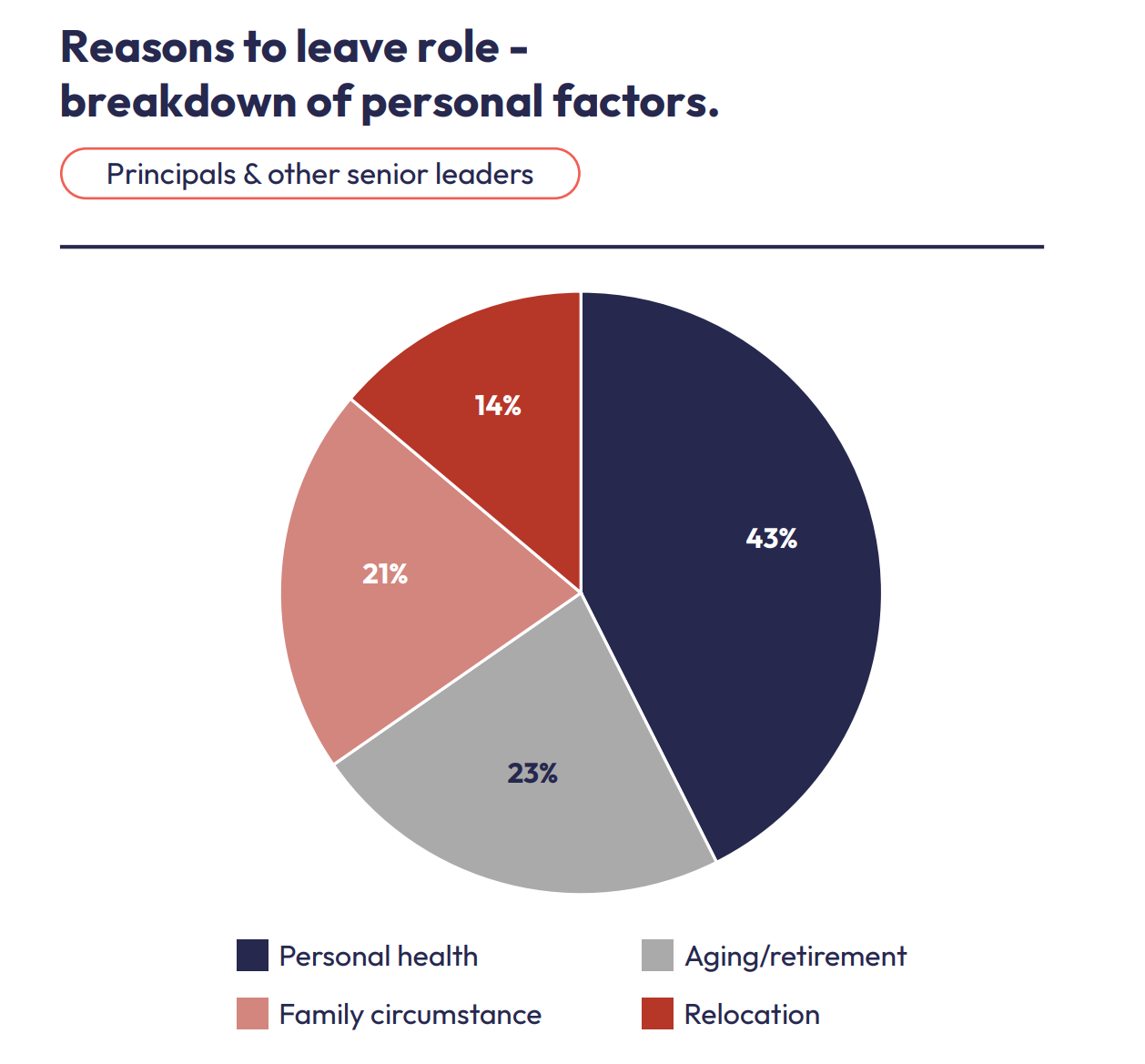
Personal health and wellbeing was found to be the leading reason leaders are eyeing the exit door, accounting for more than 42 per cent of responses.
“I think we can assume and surmise that there is some aspect of the work that’s potentially contributing to some of those health reasons, but we don’t have the data to speak to that in our dataset,” Hennessy cautioned.
“There are other sources of data that suggest that that is a pretty big and severe risk to keep an eye on, like the [ACU survey], for example.”
SOURCE: PeopleBench State of the Sector report.
The report warns that our school leaders are managing persistent staffing shortages while trying to protect their staff and students from the consequences.
Part of the problem here is that workforce planning in schools remains more operational than strategic, and well behind the standard set in other industries, Hennessy says.
For starters, roles with explicit responsibility for ‘big-picture’ HR work are relatively rare, and while leaders see the value of workforce data, only a minority use it in systematic way to plan for the future, the survey found.
Just over a quarter of respondents reported using workforce data to inform their leadership decisions and workforce development activities, and a mere 11 per cent said they used it as a critical part of school improvement and workforce strategy initiatives.
Some 9 per cent of school leaders said they did not use any workforce data at all.
In an industry that relies on people to drive positive outcomes for students, getting HR right is really very critical, Hennessy argues.
“[It] needs to be an area of focus and investment and development over the coming years, because the sector is changing and we need HR to keep up with that and become more proactive in its approach to dealing with workforce challenges.”
This involves moving from a focus on operational matters like recruitment, into more forward-thinking aspects of workforce planning “so that we're looking three to five years down the line instead of one term down the line”, Hennessy says.
The report advises school leaders to focus on using a manageable set of workforce metrics well.
“Focus on a handful of indicators that matter in your context (eg. turnover, early‑career retention, absence, culture), review them regularly with your leadership team, link them to concrete actions, and invite staff into implementing your response.”