Launched by the Heads Up Alliance – an ever-growing community of families who have opted to delay social media and smartphones for their children – the campaign has attracted close to 4000 signatures since going live on Change.org earlier this week.
Dany Elachi, co-founder and director of the Alliance, tells EducationHQ the move was driven by a number of teachers within the network who are seeing firsthand the alarming impact that edtech and AI are having on student learning in their classrooms.
After a working group engaged with emerging research from cognitive science and unpacked the insights from experts, the likes of educational neuroscientist Dr Jared Cooney Horvath in particular, the group have arrived at a clear stance on edtech and what they say is its highly questionable role in schooling.
Elachi suggests we haven’t been nearly vigilant enough about what we let into our learning environments on this front.
“We do want to see a return to the intentional use of technology and screens in schools,” he says.
“We think what’s happened over the last few years, much like how smartphones and social media kind of snuck up on us and it took us 15 years to realise, ‘oh, maybe this isn’t the healthiest thing for our children’.
“We feel that something similar has happened in education where we adopted a lot of these new shiny technologies, but without really asking for the evidence first: where is the evidence that this is going to improve reading? Where is the evidence that this is going to improve literacy, numeracy, writing, and so on?
“We just thought, because it’s new, because it’s an advance on the existing technology, that it must therefore be better.”
The Alliance is calling on all education ministers to implement what it calls the Five Principles for the Use of Screens and Technology in Australian Schools, one of which boldly states that generative AI ought to be removed as a learning tool entirely from schools and be scrapped as a means of completing schoolwork at home.
This is at least until we can develop methods of using the technology that “demonstrably add net value” to student learning in practice and not just in theory, the Alliance argue.
“There is no doubt that generative AI has immense potential, immense power. We just haven’t worked out how to harness that power without the downside,” Elachi says.
“At the moment what’s happening is we’re getting all the bad and very little of the good … that has come through very clearly from our teachers.”
The lure of AI as a means of avoiding going through the cognitive heavy lifting needed to master new knowledge and skills is simply too great for children to resist, Elachi indicates.
“It’s just too tempting for them to use it in a way that’s not effectively just shortcutting their thinking and creating shortcuts to their learning.
“And so it’s a worry. Teachers are really worried that the children are not building the skills [they need].
“In theory, we can say it ‘has the potential to do A, B and C’, but in practice, speak to most teachers, they’ll say it’s doing more harm than good.”
What might have ordinarily taken a class three hours of researching, collating information, ordering their thinking and then composing a written response, now “can be done in a matter of seconds”, Elachi laments.
“The question may be ‘well, how do we police that?’ But we don’t have those answers.
“We just know that as a principle, we need to at least set the standard.
“We should be telling our children that ‘we don’t want to sell you short – we understand this is really tempting for adults, but adults have gone through their education. You guys are still learning how to think, how to order, how to structure an argument and things like that, and you need to go through those difficult periods of effort, of work, to be able to do that effortlessly when you’re an adult’.
“I think we’re just selling them really short if we allow the use of generative AI, both in the classroom and at home.”
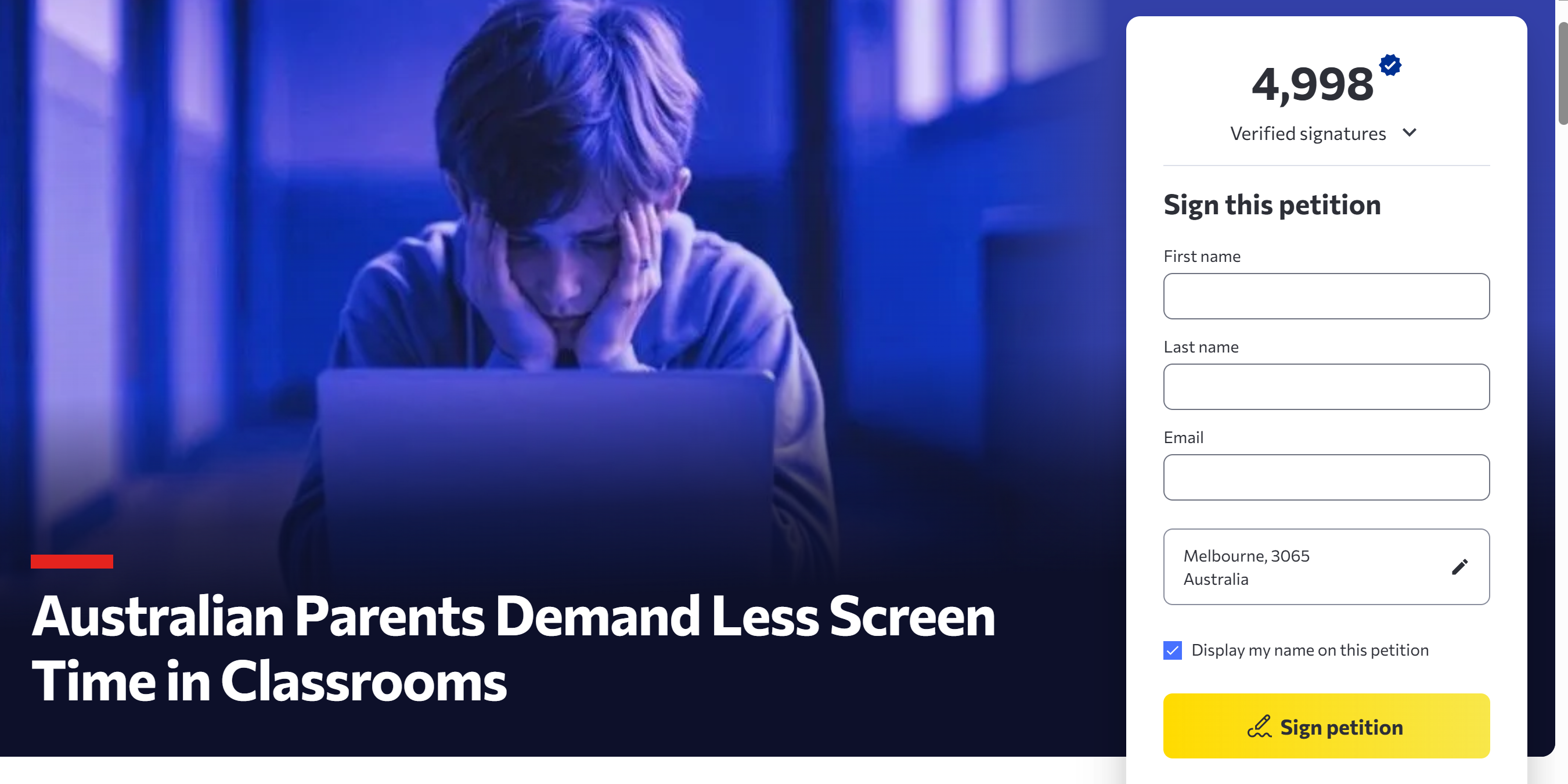
So far the petition has attracted media coverage via a slot on primetime TV, with signatures quickly accumulating once it went live.
The Alliance are also calling for primary classrooms to be completely free from student devices. It maintains that “foundational literacy and penmanship must be restored as core educational priorities”.
For secondary schools, the group argue the default mode of learning must be books, paper, handwriting and human relationships.
To this end the use of one-to-one student devices should be suspended, it contends, until there is “clear evidence that they are effective and deliver a net educational benefit to students”.
“One-to-one internet-connected devices such as laptops are an ever-present source of distraction for high school students, disrupting the focus needed to think deeply and learn new concepts,” the Alliance explains.
“Cognitive science is clear that divided attention undermines learning…”
Any apps approved by schools need to be independently proven as safe and effective, and free from any in-built gamification, manipulative design features, advertising and inappropriate content, the Alliance also urges.
Elachi says the big business of edtech should not given the power to dictate how our children learn.
“There’s always been money involved in education, and obviously some of these larger companies love to just get in there and have their products in the hands of school students so they become their consumers when they become adults – we can’t discount that.
“And we just hope that we can put those considerations to the side and ask the more important fundamental questions, which is ‘why are we using a screen in today’s lesson, and why are we using this particular app? Can it be done just as effectively [via] pen and paper?’“
So far the petition has attracted media coverage via a slot on primetime TV, and Elachi says more than 1000 signatures were amassed within the first 24 hours of its launch.
He’s urging teachers to vote with their feet.
“I would simply ask, if this is resonating with teachers, please support the petition.
“Because we are mainly a parent organisation, often it’s easy to dismiss what our views are because we’re not in the classroom, but I really want to stress the point that even though we are a parent organisation, it was the teachers within our movement who drove this.
“And so in many ways, it is very much also a teacher’s petition.”
Earlier this year Horvath put forward a written testimony to the US Senate Committee on Commerce, Science, and Transportation warning that if federal policy kept incentivising large-scale digital adoption in schools without demanding “independent efficacy evidence, privacy protections, and developmental safeguards”, then we risk long-term educational harm and may compound the damage already done to children’s brains.
“Over the past two decades, the cognitive development of children across much of the developed world has stalled and, in many domains, reversed.
“Literacy, numeracy, attention, and higher-order reasoning have declined despite increased school attendance and expanded public investment,” Horvath said.
The expert noted that although digital tools now consume a significant share of instructional time, assessment, homework, and student attention, the evidence to date from international assessments and sweeping research studies shows that increased screen exposure in classrooms is actually linked with poorer learning outcomes.
While in some limited circumstances digital tools can bolster ‘surface-level’ skill acquisition, in most academic contexts screens only slow learning, diminish depth of understanding and weaken retention, Horvath added.