Last Thursday the Government put a revised pay deal to the AEU in a bid to stop the strike action planned for July 23.
Education Minister Ben Carroll said the deal would see teacher, principal and education support staff salaries rise by at least 28.3 per cent over the next four years, starting with an increase of 12.75 per cent by October.
In real terms, it would mean that more than 90,000 teachers would receive $1000 more per month by October, and almost $3000 more per month by 2030.
But results of the online vote of members show 51.18 per cent are in favour of rejecting the offer.
More than 50,677 members took part in the vote, representing 90.2 per cent of those eligible to do so.
President Justin Mullaly said the outcome sends an undeniable message to the Premier and the Education Minister that they must fully fund the state’s public schools.
“AEU members have been telling the Victorian Labor Government for years that the under-resourcing of public schools in Victoria is making their work untenable.
“When just 3 in 10 public school teachers plan to stay working in public schools in Victoria, it is obvious there is a problem,” he said in a statement.
Mullaly has continually criticised the Government for labeling Victoria ‘the education state’, arguing this can’t be the case when it has ‘deliberately ripped $2.4 billion out of our public schools’.
“AEU members are asking the Premier and Education Minister to explain; how can you call Victoria the education state when our public schools are the lowest funded in the country?
“Why are teachers, school leaders and education support staff working an average 12 hours unpaid overtime every week if this is truly the education state?
“If Victoria was actually the education state, public school staff would have access to the funding and resources they need to deliver the education their students deserve.”
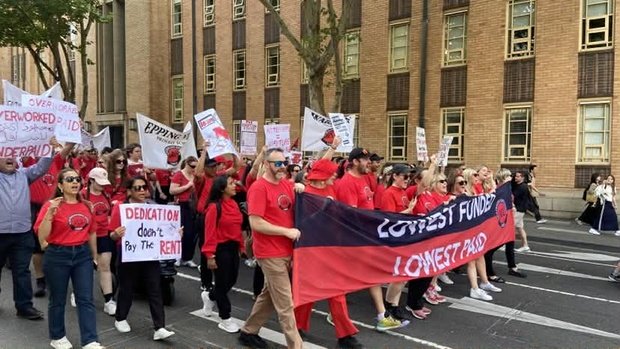
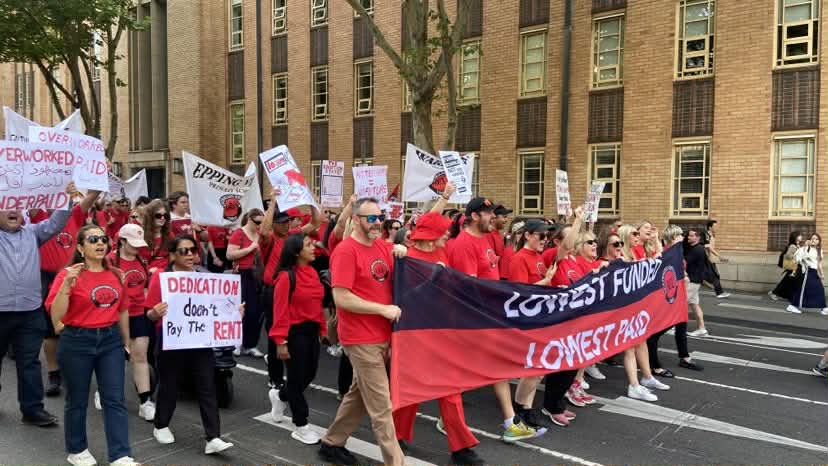
The union leader said this message would be delivered directly to the Government during the impending strike, when teachers will stop work for 24 hours and march to Parliament House.
Last Friday morning, the Victorian education department’s secretary Tony Bates emailed principals, assistant principals, teachers and education support staff directly with details of the proposed deal, which prompted the union’s angry accusation of “anti-union” behaviour.
“It’s time to reach an agreement. The longer it takes to reach an outcome, the longer you will go without the pay increases you deserve,” Bates said in the email, according to the Herald Sun.
“Given the Fair Work Act process, any further delay means that it is unlikely we can secure additional salary this year.”
As part of the revised deal, meetings would be halved from 80 hours per year to 40 hours.
Commenting on LinkedIn, Victorian learning specialist Shaun Brien said he was not in favour of this change.
“I cannot possibly fathom how leaders in government schools will be able to enact any possible meaningful change without these meetings,” he posted.
“I’m aware that in many schools meetings could essentially be emails because they’re just information delivery with no action, but this doesn’t actually fix that problem.
“In fact it’s likely to make it worse as now there’s even less time for staff to all meet together and discuss problems of practice and collaborate, as in my experience when you have unstructured time to rely on for implementation then it is the staff who are already going above and beyond that will do these things.”
Brien said he was concerned that if the agreement was accepted then the overall standard in Victorian schools would slide further, “as we struggle to move the needle on improving teacher knowledge and expertise in all areas of practice”.
Commenting on the post, Queensland deputy principal Luke Van Beuveren said his staff have around just one hour per week for meetings which has brought clearer intent to them.
“...I am originally from Victoria and had a similar concern but it has actually meant our meetings are more purposeful.
“Collaboration time is then scheduled during the school day and resourced by us as leaders, so we know what the priorities are, as each collaborative opportunity needs to be purposeful and have a success criteria with clear deliverables,” Van Beuveren shared.
Earlier in June fractures within the AEU Victorian branch emerged after its members voted down an earlier in-principle deal on pay and conditions, with some teachers reporting a pent up sense of animosity and resentment towards the union leadership fuelled their decision to vote no.