

Other students in country schools hoping to pursue medicine mostly get information about their future careers from TV dramas.
The pressure to achieve a university entrance score of 99 and above leaves some rural teenagers feeling hopeless as they compete with their well-connected and resourced city peers.
These are the kinds of barriers faced by young people educated in the bush, potentially turning talented students away from the rural health system that desperately needs them.
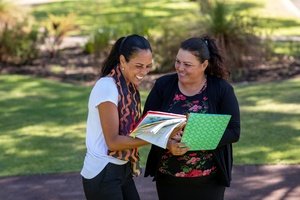
Rural medical students Eliza O’Sullivan, from Bendigo in Victoria, and Brooke McDonald, from Castlemaine, founded Rural Rounds to address these pervasive road blocks for medical school entry.
The founders mentor and coach regional and disadvantaged students on their university applications and career pathways.
“If you don’t see many people in the career, that certainly makes it harder to imagine how you could do it,” O’Sullivan said.
“You need someone in your corner.”
Rurally-raised medical students are a valuable cohort, with research showing they are more likely to stay in the regions and fill long-term doctor shortages.
But the regional health system battles complex policies that can force junior doctors out of rural areas in their final years of training.
Those structural issues are reinforced by STEM teacher shortages, leaving some country high school students to travel for science classes, learn via distance or forego it altogether.
Small town healthcare has also condensed and centralised over several decades, limiting work experience opportunities.
The women hope Rural Rounds can demonstrate how a country upbringing can also be an advantage.
“There are challenges, but it’s a strength,” O’Sullivan said.
“They’ve got great problem-solving skills, the ability to learn independently, and resilience.
“These things are really valuable ... and worth more than a few ATAR points.”
A regional background has not been a setback for O’Sullivan, whose path was informed by the work of her mother, a leading researcher in rural health systems and workforce.
The 23-year-old was in October named the Rural Doctors Association of Australia’s medical student of the year.
She is travelling to Uganda in December to work in outreach primary care clinics, before going to Oxford University in 2027 as Victoria’s Rhodes Scholar.
O’Sullivan will focus on public health while studying abroad, in the hopes of bringing extra knowledge back to Australia.
“Public health ... will complement what I want to do as a clinician and a leader,” she said.
“You need to get upstream to stop the bed blocks, stop ambulances ramping, and increase the supply of GPs to the regions ... so people can access timely, affordable care.”
AAP