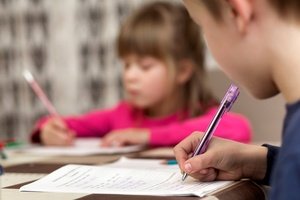


Amid a growing backlash against classroom technology, education ministers decided to return to pen and paper testing was preferable for the year group, with some who have called for the limiting of device use arguing the reversal does not go far enough.
August NAPLAN results showed reading scores were worse than in 2025 for every tested grade level. Year 5 students were the only group whose writing ability had improved.
NSW Education Minister Prue Car said Monday’s testing talks were productive.
“Education ministers across the country have agreed we work towards the Year 5 NAPLAN writing test being completed with pen and paper,” she said.
After August’s declining scores, federal Education Minister Jason Clare questioned whether screen-time was to blame.
“Some of the writing results make me wonder whether young people are spending so much time writing texts, short messages, rather than long-form paragraphs it’s having an impact on their writing,” he said.

NSW Education Minister Prue Car is pushing for Years 7 and 9 NAPLAN to also be pen and paper tests. “The evidence from our classrooms points clearly to the ongoing value of handwriting and its importance for student development and engaging a different way of learning,” she said.
Changing the tests would push teachers to enforce more off-screen learning in the classroom, ministers also hoped.
“Making sure the writing assessment is actually pen to paper will mean more classroom time being spent on pen and paper as opposed to on a computer,” Car said.
“There is a lot of evidence to suggest excessive screen time has been harmful for students and their educational outcomes.”
The NSW Government said its research found only about one-third of parents of primary-schoolers thought the benefits of using technology outweighed disadvantages.
The NAPLAN tests students in Years 3, 5, 7 and 9.
The tests were fully digitised by 2022 except for Year 3 writing exams and for students with special needs.
Virtual examinations were intended to improve the precision and speed of assessments.
August’s writing scores were a particular concern in Years 3 and 5. Less than 10 per cent of students exceeded national benchmarks.
Numeracy results improved for most cohorts since 2025, though the score for Year 3 had decreased.
Adjunct Associate Professor Noella Mackenzie, an independent literacy consultant specialising in literacy studies, early writing development, and teacher professional development, said the problem is not that students are using technology – it’s that many have never been properly taught or given the necessary time to practice either handwriting or keyboarding.
“While early years teachers introduce handwriting to young students, this instruction often stops in Year 3, before automaticity and fluency have developed,” she said in an opinion piece for EducationHQ.
We should give students the choice to write exams by hand or type on a computer, Mackenzie said.
“Research suggests that exam results are generally similar whether students handwrite or type, provided they are skilled in the method they use,” Mackenzie suggests.
“The debate should not be about handwriting versus typing – students need both. Whatever method is required, schools must teach it well and provide enough practice.”
Car is pushing for Years 7 and 9 NAPLAN to also be handwritten tests.
“The evidence from our classrooms points clearly to the ongoing value of handwriting and its importance for student development and engaging a different way of learning,” she said.
“We’re listening to teachers and families who want a sensible, balanced approach to technology use in schools.”
(with AAP)