
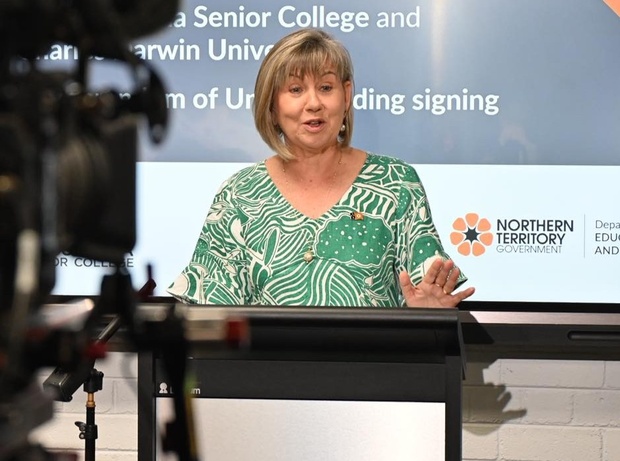
The move is part of a program to keep “chronically disengaged” kids on track and out of trouble on the streets, according to Territory Education Minister Jo Hersey, and families targeted will still be able to afford any essentials, she says.
Aboriginal and justice groups, however, have slammed the move and say income management is paternalistic, punitive, and fails to address the root causes that lead to childhood truancy.
Independent NT MP, Justine Davis, was highly critical of the announcement, saying “income management doesn’t work,” and that, “decades of evidence tells us this”.
“Multiple evaluations have shown it doesn’t improve child outcomes, doesn’t increase school attendance, and doesn’t reduce disadvantage,” she said on Monday.
“What it does do is stigmatise families, create barriers to accessing services, and add administrative burden without addressing the root causes of non-attendance.”
Davis said the Government was taking the “lazy approach” by punishing families instead of addressing systemic failures.
“You cannot income manage your way to better education outcomes,” she said.
It is understood that Commonwealth legislation allows state and territory child protection officers to refer individuals to enhanced income management.
Timed for the start of the final school term of 2025, the measure applies to families on government income support and comes on top of truancy fines of up to $370 introduced in 2024.
While the CLP government reintroduced school attendance officers in November last year to tackle the Territory’s shocking attendance statistics, schools attendance statistics remain grim, sitting at only 72.6 per cent in Term 2 this year.

Some have slammed the income management move, saying it is paternalistic, punitive, and fails to address the root causes that lead to childhood truancy. PHOTO: Jo Hersey/Facebook
Hersey said keeping young people in the classroom improved their chances of success, and was part of the CLP’s broader strategy to reduce crime and strengthen community safety.
“This is not about making sure that families don’t have money to put food on the table, but we must make sure that children get to school,” Hersey told reporters on Monday.
”If you don’t want to be income-managed and if you don’t want to be fined, get your kids to school.”
Hersey could not give any details on what percentage of income might be cut, and only that it would be on a case-by-case basis.
If children were not in school but out in the community committing crime they would not get the education needed for meaningful employment, she said.
It was a case of working with families to ensure they had enough for food and other expenses, but making sure their children go to school.
“Labor failed children and families by letting school attendance collapse, hiding kids on secret lists, and cooking the books instead of fixing the problem,” Hersey said.
“We know that children who regularly miss school are more likely to disengage, fall into anti-social behaviour and ultimately into crime.
She said the measure is about helping families meet their obligations and supporting young people to build a better future.
“If parents don’t want to be income managed, the message is simple: get your kids to school,” she said.
In November last year founding members of the National Network of Incarcerated and Formerly Incarcerated Women and Girls, Tabitha Lean and Debbie Kilroy, voiced their opposition to measures to fine parents.
“We are looking at a policy that disproportionately harms poor and Aboriginal families, already among the most targeted by the legal system,” the justice advocates said.
“This cycle will, predictably, lead to increased incarceration rates among people who, instead of being supported, are penalised for conditions rooted in socio-economic hardship.”
On Monday, Kilroy argued that if the Government “truly cared” about Indigenous children, they would “work with families and communities to make schools accessible, culturally safe, and welcoming, not impose economic punishment on already struggling households”.
“The answer lies in relationships, not retribution,” she said.
Community group and broader advocacy movement Justice not Jails (JNJ) has also criticised the policy.
“If the Crime Reduction Strategy recognises strong families are foundational to safer communities, then where is the focus on reducing poverty, ensuring stable and appropriate housing, increasing cultural representation and inclusion, and addressing the social despair that underlies harmful behaviours?” JNJ member Sarah Katz told the National Indigenous Times.
“Punitive, paternalistic measures are harmful – as evidenced by history. This is yet another way in which the CLP is using laws and policies to increase trauma, division and social inequality instead of addressing the real challenges of building safer communities.”
The Federal Department of Social Services had worked with the NT Government to instigate the income-management initiative through referrals by the education department, Hersey said.
Student Engagement Advisors will undertake the responsibility of income management referral for chronic absenteeism on behalf of the department.
The territory introduced school attendance officers in late 2024, with the government pointing to 6000 compliance visits leading to 328 students returned to classrooms.
(with AAP)