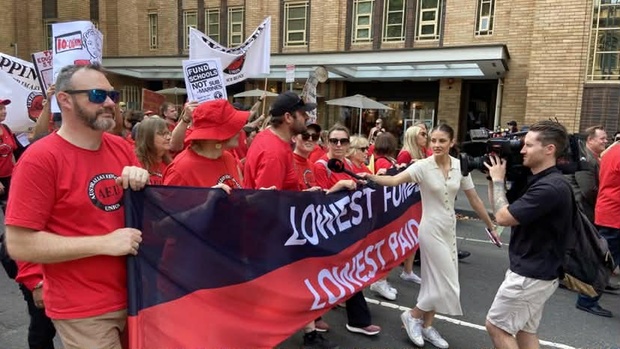
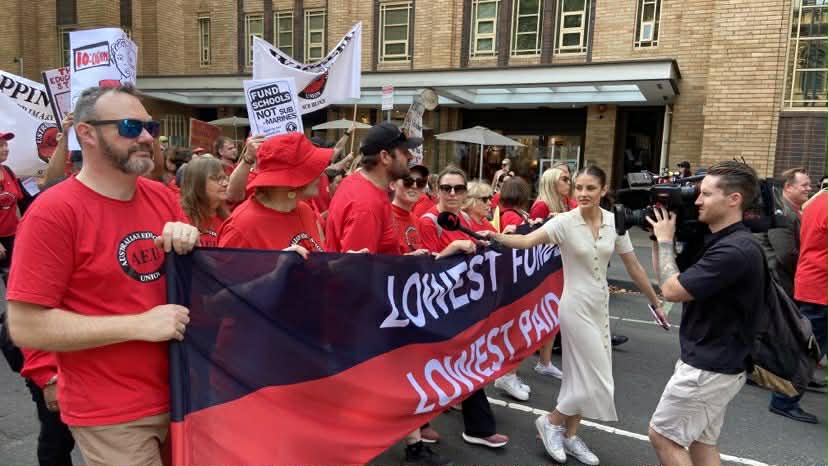
The union, which has been locked in negotiations with the Allan Government for almost a year, has been demanding a 35 per cent rise over three years.
It argues the state’s public education workforce is paid far less than those in other jurisdictions and has said it is laughable the Government claim Victoria to be ‘the education state’.
An in-principle agreement was struck last month for a pay increase between 28.3 per cent and 32.4 per cent over four years, but at the time many warned the proposal failed to deliver better working conditions and should be rejected. Teachers should hold out for a better deal, many implored online.
The union branch president Justin Mullaly, however, deemed the offer a win for all public educators across the state and said he believed it would be approved by members.
Last week a ballot vote involving around 60,000 educators and support staff saw 57.7 per cent vote against the draft proposal.
One secondary teacher from a Melbourne public school told EducationHQ the result came as no great surprise and that she had voted down the offer to send a clear message to both the AEU and the Government, with many of her teaching colleagues doing the same.
“It was a protest vote against the union. And this was a protest vote against the Government.
“So, this vote is about saying ‘no, you can’t roll over us like you have in the past. No, we’re not pushovers and we’re not people who are just into goodwill.
“We actually have to advocate for ourselves,” the teacher explained.
Speaking to the result last week, Mullaly conceded the Government’s latest offer “does not go far enough to address the concerns of the majority of union members” and called for a restart to negotiations.
“Through a survey union members will be able to have their say on the specific areas of focus for negotiations and particular campaign actions to be taken, including stopwork action,” he flagged.
The teacher we spoke to said a lot of animosity amongst teachers had built up since the union signed off on the current Victorian Government School Agreement some four years ago – a deal she said many felt sorely let down by.
“I think there’s a disconnect between the union leadership and us members. I think the union’s trying to win members back, but there’s not a strong sense that they are negotiating hard-line with the Government.
“I mean, they claim that they want to act in good faith with the Government – but the Government has never acted in good faith with teachers or the union.
“So in many ways, teachers see the union as quite weak in dealing with these negotiations. And this ‘No’ was a protest vote.”
Education Minister Ben Carroll has also accused the union’s leaders of being out of touch with members after endorsing the deal and then failing to get it over the line.
He warned the offer might not be as generous if a Liberal or One Nation government was elected in five months at the state poll.
“These are the best conditions in the nation with the best wages," Carroll told reporters.
“We do not have an inexhaustible supply of funds."
The teacher said she and her colleagues were mostly dissatisfied with the current offer because it doesn’t address what’s really at the crux of the ‘crisis’ within the profession.
“Teachers want to see the conditions being addressed, the poor working conditions. The fact is that we are losing teachers to other professions, we’re losing teachers to burnout, we’re losing teachers to over-administration.
“And this agreement doesn’t address the root cause of why teachers are actually suffering day to day.”

“[The Government] need to consider the actual, real workload of teachers, not the expected workload of teachers. And actually acknowledge that so much work is done outside of class,” one teacher implores.
The current pay offer of rises up to 32 per cent for four years is just a carrot on a stick, the teacher argued.
“I think the pay is just how they were going to sweeten the deal.
“But actually, in terms of the long-term future of teaching in Victoria, I think the pay can’t be the central thing. I think it’s the actual workload that needs to change significantly.”
There needs to be a huge shift in the professional culture and a lifting of so many of the unreasonable expectations that are now placed on teachers, the educator argued.
“I think there needs to be restrictions around, for example, administration requirements from the Education Department.
“I think that new initiatives of the school need to be conducted in work hours. I think the marking load and the requirement to do adjustments and modifications and differentiation needs to be acknowledged, and they need to build that into work hours.
“They need to consider the actual, real workload of teachers, not the expected workload of teachers. And actually acknowledge that so much work is done outside of class.”
In April, two Victorian secondary teachers warned many had become so swamped with marking requirements that some are turning to AI or taking days off to try and catch up.
AI has become the “bread and butter” means of dealing with Department bureaucracy, they suggested.
“I know some of my colleagues are using AI marking guides to mark students’ work, they’re using AI to mark assignments, they’re using voice feedback (tools), they’re using rubrics to tick boxes and they are outsourcing marking to other people and paying them to do it.”
Some teachers are also marking work while on lunch duty because they are so desperate, one noted.
There is only so much that teachers can take on before they break, the union member we spoke to about the ballot result, said.
“The Government need to remove this idea that we are consistently available and always able to give more of ourselves – we’re just asked for more without actually anything being taken away.”
The union’s industrial action campaign which was suspended during the voting period will recommence in Term 3, including bans on Labor politicians attending schools, bans on attending some meetings, responding to Department emails and providing written comments in student reports.
Mullaly has said more strikes were “certainly on the cards”.
“We must make sure that there is a very, very clear message, including through industrial action and stop-work action,” he said.
The teacher said she looked forward to a resolution being reached soon.
“This started in the last agreement where clearly teachers accepted a proposal in good faith with the union – but the union accepted a deal which was actually pretty sub-par.
“So I think this time teachers are unwilling to settle in the same way.”
The union’s next steps will be decided at a meeting on July 17.
In March, Victorian public school educators defiantly executed the first statewide teachers’ strike in 13 years, with tens of thousands bringing parts of Melbourne CBD to a standstill as they marched through the streets.
Victorian opposition education spokesman Brad Rowswell said teachers did not feel respected and deserved to be paid more, demanding Premier Jacinta Allan return to the negotiation table urgently.
“Frustration is felt not just by Victorian teachers, but by parents and increasingly students who are being impacted by the inability of the decision to get this deal done,” he told reporters.