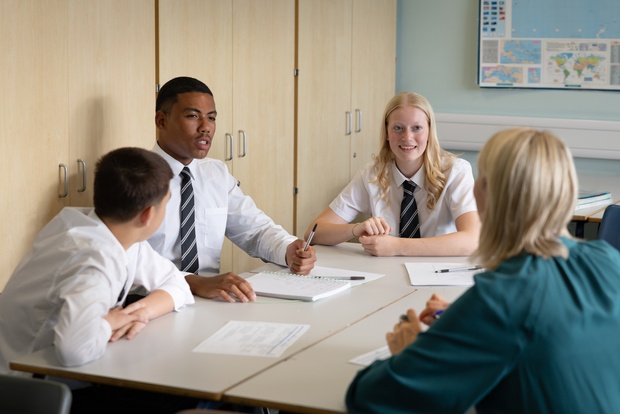

Conducted by the Rule of Law Education Centre, the survey highlights the impact of declining social cohesion in the community on teachers’ capacity to facilitate and model respectful debate in the classroom.
Almost half of respondents to the survey said that limited space in the curriculum is the most significant factor that discouraged them from facilitating debate-based discussions on contemporary or controversial issues, while 81 per cent said concerns about reactions from parents or students is the first or second most significant factor that stopped them.
Interestingly, 88 per cent said they felt comfortable facilitating discussions, however only just over half do so two or more times per week, and around 15 per cent do so less than once a fortnight.
“Effective civics and citizenship education relies on an open classroom climate. This cannot rest on teachers alone,” Rule of Law Education Centre CEO, Sally Layson, says.
“Teachers remain strongly committed to their role in developing students’ democratic skills and understanding, but face significant barriers in delivering high quality, relevant civics education.
“These include concerns about challenging reactions from parents or students and a crowded curriculum.”
At a time of growing concern about declining social cohesion and increased polarisation, schools play a crucial role in strengthening democratic understanding and trust in our community, Layson says.
“Research consistently shows that civics and citizenship education is most effective when it is meaningful, relevant and connected to students’ everyday lives.”
Students develop stronger civic knowledge, greater interpersonal and institutional trust, and a deeper sense of their role in a democracy when learning takes place in open classroom environments, according to Layson.
“In such classrooms, diverse views are welcomed, respectful discussion of contemporary issues is encouraged, and young people can see the relevance and integrity of democratic institutions and processes, and trust that they will be treated equally and fairly by them.
“The findings in our poll point to an urgent need to strengthen civics education policy settings.”
One teacher from Western Australia claimed schools should be a safe place to hear alternative views without fear of 'indoctrinating' from a parental or societal perspective.
“Leaders and government need to understand schools are societal microcosms,” they said.
Another said “being a commerce/humanities teacher can mean walking a fine line as you need to use current contexts for educational purposes.
“Perhaps having the right PD would enable me to better take on challenging situations in the classroom. Although, our students are pretty respectful of each other's opinions.”
One teacher said it’s “so important for schools to foster these shared norms and acceptance (and embracing) of others and different opinions.
“Many teachers feel that the Controversial Opinions policy means everything needs to be avoided.”
The survey overview shared that where education systems do not explicitly teach democratic principles around freedom, pluralism, and the rule of law, or fail to provide the skills and conditions needed to practise them, social cohesion is weakened, and space is created for ideologically motivated extremism to flourish.
In 2021 the British Government tasked Dame Sara Khan with producing an independent review with recommendations to build resilience against extremism, understand its impact, and better support its victims.
Published in March 2024, it concluded that there are significant challenges that impact social cohesion and the wellbeing of democracy.
“Social cohesion is concerned with how we live together in a diverse democracy and how we peacefully navigate disagreements for the common good, despite the difference among us…” the Khan Review stated.
“Cohesion does not mean consensus or conformity. Instead, cohesion embraces and recognizes the importance of pluralism, dissent and debate in a liberal democracy and the need to protect it.”
The Rule of Law Institute is supported by almost 3000 members across Australia, and of these members, 75 per cent are teachers.
It wants explicit curriculum outcomes and content that prioritises debate-based environments and policy support that recognises the central role of debate-based learning in our democracy.
“The Centre is calling on all governments to prioritise high quality professional development to strengthen teachers’ skills and confidence to address challenging topics in the classroom, and to provide professional guidelines and pedagogical strategies for teachers that help them facilitate discussions on controversial topics to limit personal bias,” Layson says.
“Classrooms must be an environment that is a safe space, where students are equipped with the knowledge and skills to disagree respectfully, explore and debate controversial ideas, and learn how democratic disagreement works in practice.”