


That’s according to new research which has revealed literacy, language and numeracy remain a major barrier to apprenticeship success, with strong maths skills increasingly critical for electrical and energy trades.
Powering Skills Organisation (PSO) research suggests the challenge is not driven by a lack of educational options, but more a misalignment between schooling outcomes and the functional demands of vocational training and employment.
PSO CEO Anthea Middleton tells EducationHQ that the research found that many students are leaving school without fully understanding the level of applied numeracy required in modern electrical and energy trades.
“While literacy and language skills remain important, the most significant barrier we identified was numeracy.
“The challenge isn’t that students can’t do maths; it’s that many have never had to apply mathematics in the way the trades require.”
Electrical apprentices are expected to work confidently with algebra, formulas, measurements, ratios, trigonometry and problem-solving in real-world contexts. Schools often teach these concepts at the Maths Method level, but the subject is often not the recommendation from schools for students who want to do a trade.
“Energy trades cannot be put in the same classification as all other trades where maths is concerned,” Middleton shares.
“Another issue is expectations. Young people, parents and career advisers frequently underestimate the technical demands of modern trade careers.

“For parents and career counsellors, the key message is that an apprenticeship should be viewed as the beginning of a professional career, not just a job,” Anthea Middleton says.
“Our research suggests numeracy expectations need to be communicated much earlier and much more clearly so students can make informed subject choices and prepare appropriately before starting an apprenticeship.”
Middleton says encouragingly, the research doesn’t suggest Australia has a shortage of pathways into trades, on the contrary, schools, VET providers, apprenticeships and industry are all investing heavily in workforce development.
“The challenge is that these parts of the system aren’t always aligned,” she says.
“We found a gap between the capabilities students develop at school and the functional demands they encounter when they enter energy sector training and employment.”
The solution, the expert suggests, doesn’t lie in schools becoming trade training providers, but rather, that they can play a critical role in helping students develop the foundational capabilities that underpin success in any pathway, including energy trades.
“Our research points particularly to applied numeracy, problem-solving, learning capability and helping students understand how classroom concepts translate into real workplace contexts,” she explains.
Students, parents and career advisers need to be much better informed about what modern trades actually involve, Middleton shares.
“The electrical and energy trades of today are highly technical occupations,” she says.
“They require people who can interpret information, solve problems, apply mathematical concepts and continue learning throughout their careers. Many young people still think of trades as purely practical occupations, when in reality they’re increasingly knowledge-intensive careers.”

The Industry School principal Peter Foster says Years 11 and 12 students at his school don't get any holidays at all during the year, other than four weeks which they apply for like everybody else in full-time working roles, and they can take those four weeks during the usual term breaks.
PSO’s research suggests 85 per cent of electrical apprenticeship cancellations occur at the stage at which numeracy demands escalate sharply and assessment reattempts peak.
Where these gaps are not identified and addressed, they contribute to assessment difficulty, delayed progression and attrition, particularly in the first two years of training.
Middleton says the cancellation point is no coincidence.
“I also don’t think numeracy is the sole cause of apprenticeship cancellations,” she says.
“What our research found was a very strong correlation … that suggests numeracy capability is an important factor and, for some apprentices, may be the tipping point that determines whether they persist or leave.”
Apprenticeships are complex Middleton says, and people leave for a range of reasons.
“The evidence shows that apprenticeship success is influenced by a combination of factors including workplace support, supervision quality, financial pressures, personal circumstances, motivation, training experiences and access to support networks.
“Our research specifically highlighted that family, schools, employers and Registered Training Organisations all play a significant role in supporting apprentice success, and that uneven access to these supports can create additional challenges. What numeracy appears to do is amplify those pressures.”
An apprentice who is already dealing with work, study and life challenges may find the increasing mathematical demands of the qualification become another barrier to overcome.
“When those demands are higher than expected, or when learners haven’t been adequately prepared beforehand, the risk of disengagement and non-completion increases.
“The key message from our research is that we shouldn’t view apprentice attrition as either an educational problem or a workplace problem. It’s a pathway problem. If we can better prepare learners before they enter apprenticeships, communicate expectations more clearly, and provide the right support at critical transition points, we have a much better chance of improving completion rates.”
In South East Queensland, The Industry School is an example of a different approach, where it takes practical steps to build students’ confidence and capability before they enter the workforce.
Spanning only Years 10-12, the school's principal Peter Foster says his Year 10s do their education within the normal Australian curriculum, whilst Year 11 and 12 students have a modified curriculum where they do their English, Mathematics and VET.
“So their VET in Year 11 will be a Cert 2 in foundational skills and in Year 12 it will be a Cert 3 in Business and Entrepreneurship,” he says.
A key difference is the school has two arms – an education arm and an industry arm.
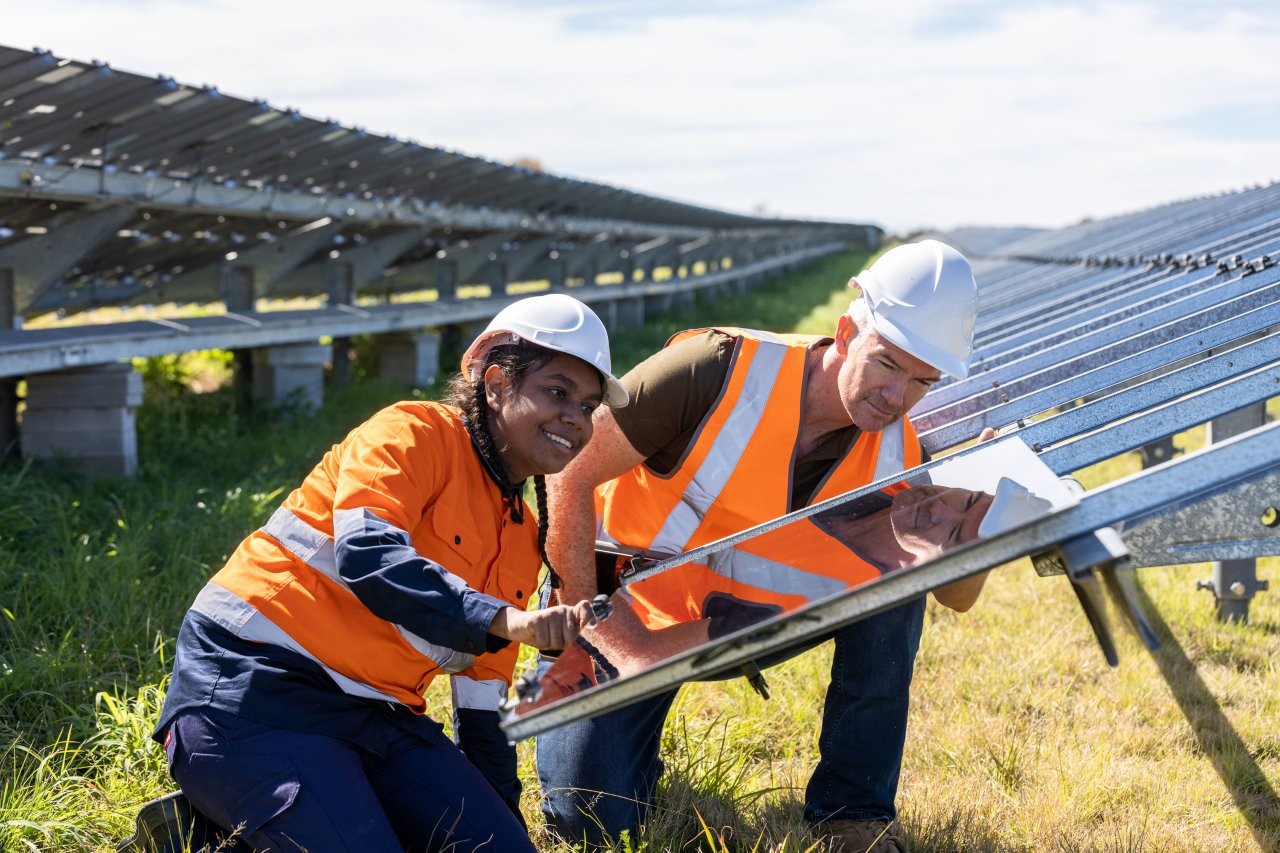
Australia risks a critical skills shortfall in the clean energy transition, with demand for workers in energy, gas and renewables set to outstrip supply by tens of thousands within a decade.
“So we have teachers and a deputy principal and the usual school structure, but we also have our industry education manager and industry consultants, which every one of our young people has a designated industry consultant, who guides and mentors them through their process of what they want to do and achieve.”
The school has seven campuses, mostly across south east Queensland in Brisbane, Toowoomba, the Gold Coast and Sunshine Coast, with one in Melbourne.
“I’ve been really interested in futuristic education. I’ve been a principal of some big mainstream schools, some very large independent schools, and they are academically focused.
“What I wanted to be able to do is add some real life education, because education in the mainstream is only suited to around about 40 per cent of students in their outcomes.
“I’m on a few committees across the globe within what’s called the ‘Next Learner Space’, and part of being on those committees opens your eyes significantly to different ways of doing education for a more sustainable output.”
Where the PSO research identified an issue with the subjects students choose, or are encouraged towards, not always aligning with the level of mathematical complexity required in later stages, Foster says that can’t happen at his school.
He says The Industry School commits a great deal of time and energy into careers advice and counselling and determining exactly what subjects are required for students that have expressed an interest in a particular career.
“For example, if you want to go to electrical trade, which is obviously higher in mathematics, we do what’s called Q-SMART Mathematics.
“It’s the maths that prepares you for the later stages of your maths in your electrical apprenticeship, which is challenging.
“I’ve got a son who’s an electrician and his third and fourth year apprenticeship Mathematics is equal to first and second year university.”
Foster says unfortunately students in mainstream schools are getting to Years 9 and 10 not really clear about what’s required for them to be able to move into their pathways of choice beyond those years.
“I think it’s all just getting through the subjects and then going from one year to the next, and just not really having that vision to where you want to go.”