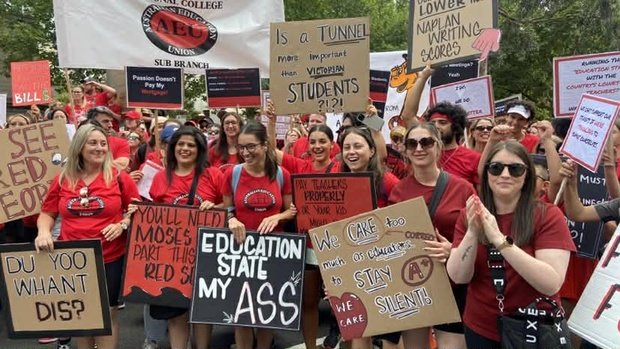
The newly endorsed actions by members of the AEU Victorian Branch come after teachers, school leaders and education support staff voted down an in-principle deal on pay and conditions last term, with some reporting a brewing sense of resentment towards the union leadership fuelled their decision.
The union, which has been locked in negotiations with the Allan Government for almost a year, has been demanding a 35 per cent rise over three years.
It argues the state’s public education workforce is paid far less than those in other jurisdictions and has said it is laughable the Government claim Victoria to be ‘the education state’.
One secondary teacher from Melbourne told EducationHQ that there was a ‘huge groundswell’ of support amongst her colleagues for another ‘visible and unified’ protest.
“There was a really positive culture forged amongst teachers at the previous full-day strike. I think it really drove home our message to Parliament, but also to the media.
“It was a kind of collective unity which hadn’t been seen for years, and I think there was this desperation amongst teachers to see real conditions be addressed – and teacher pay and government funding for schools.”
The teacher said voting down the Government’s latest offer, which included pay rises of up to 32.4 per cent over four years, was “reflective of the fact that we weren’t just going to roll over and let the Government placate us with a bit of a ‘carrot and stick’ incentive”.
“This new strike action is trying to continue the momentum of trying to get this deal closed quickly.
“Because I think the union also knows that Jacinta Allan and Ben Carroll can’t afford to have such visible strike numbers so close to an election.
“It’s about building momentum again.”
Under current industrial action this term, the state’s teachers are banned from implementing new government programs and even responding to Department of Education emails, with limitations on meetings also in the mix. There is also a ban on state Labor MPs visiting public schools.
The new ban on working unpaid overtime, however, did not sit well with the teacher we spoke with.
“I think it’s what should be happening anyway, like every other job,” they argued.
“I think we shouldn't be working overtime and hours when we’re not paid. So, in my opinion it's kind of a bit of a ridiculous measure, because that should be the condition of any workplace.”
A business owner from the retail industry told EducationHQ he supported the upcoming teacher strike and said he simply couldn’t get away with not paying his staff for any overtime they put in.
AEU-Vic Branch President Justin Mullaly said the industrial action was necessary as the state’s public schools remain the lowest funded in the country and associated workloads were driving people out of the profession.
He accused the Government of purposefully denying at least $2.4 billion in funding for public schools.
“In this underfunded system, teachers, principals, and education support staff are working an average of 12 hours unpaid overtime every week. The government must stop relying on the goodwill of school employees as a core part of their funding model for schools.
“School staff are stretched thin, putting in extra unpaid hours in the evenings and on weekends to ensure Victorian public school students have high quality educational and wellbeing programs.
“Just 3 in 10 employees expect to remain working public schools until retirement and report that excessive workloads are one of the reasons why they will leave,” Mullaly lamented.
But working unpaid hours at home was largely invisible labour, the teacher we spoke with said, and therefore banning it would do little to impact the Government directly.
“I think it actually just impacts the teacher individually and makes their life harder… it hurts students.
“Because all that administration that we’re required to do, we have to do in unpaid hours. And if we can’t do that, it’ll put a lot of stress on the teacher to do that in paid hours – which is impossible.”
It would be better to ban specific admin tasks directly, they contended.
“For example, no reports, no comments on reports, no progress reporting of a student, no contact home, no writing things on Compass, no writing behavioural plans and IEPs.
“I think that would send a stronger message to government which is that ‘we’re not going to implement any of your policy initiatives or meet your requirements….”
The teacher said she was concerned union members would be forced to vote again on another ‘sub-par’ agreement, but conceded the union was demanding some ‘idealistic goals’.
“I think when you go into a bargaining agreement, you do have to aim high, because if you set the bar too low, what you’ll get you’ll probably be very disappointed with.
“So, they’ve put in some idealistic goals in there and we're hoping the Government takes the bait, if you like, but I do think there are some real reasons as to why they have asked for those things and I don't think they're actually out of the question.
“As we know, history isn’t changed by people who just roll over – so this is kind of a big stance on saying, ‘enough is enough, and no, we’re not going to accept sub-par agreements again, and we’re not going to sell ourselves short’.”