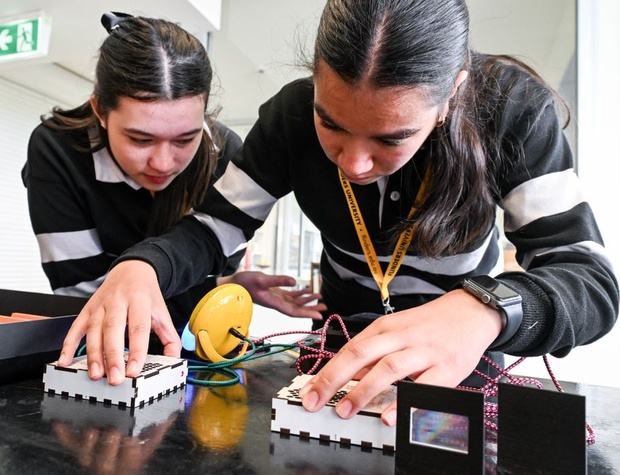

A pioneering STEM Enrichment Academy at Flinders University in South Australia, however, is fighting back, helping to steer more Year 9 schoolgirls to study subjects such as Specialist Math and Physics in Year 11 and Year 12.
The aim is to boost enrolments in tertiary degree courses such as engineering, space, astrophysics and nuclear physics, biomedicine, architecture and laboratory sciences. And it’s working.
More than 1900 female students have so far taken part in various enrichment programs since the project launched in late 2018, including 371 girls from the Northern Territory and regional South Australia during the second phase of the project, which started in May 2023.
“Unlike some overseas countries, the gender divide in some STEM subjects is expanding in Australia,” founding director, Professor of Physics Maria Parappilly, says.
“In fact, Year 11 and Year 12 physics, enrolments have declined for both girls and boys in most states.”
Parappilly says current literature suggests that compared to boys, girls seem less interested in science, attach less importance to science and feel less confident of their science capabilities.
“But we can tackle these perceptions if we can give middle school students more confidence through role-model interventions, a sense of belonging, enjoyment for the subject, opportunities in STEM, and the vision for a future in STEM from a younger age,” she says.

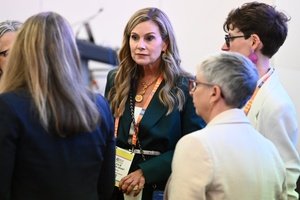
Early indications are that the Physics Skills Enhancement microcredential course offered by Flinders University, is boosting teachers’ confidence in delivering physics, Parappilly, pictured above left, says.
The program offers three STEM enrichment models – a one-day ‘Real Science’ Day, Design and Technology workshops and a concentrated three-day STEM Enrichment Conference – which Parappilly says are fulfilling the goal of inspiring more students to pursue STEM subjects at school and at university.
A new article published in the Physics Education journal tracked 46 participants in the 2019 STEM enrichment program and found 91 per cent of them had chosen traditional STEM subjects in their senior secondary years.
The study found an overall increase in career interest in STEM subjects following the one-day Real Science Days and significant overall increase in career interest in STEM following the 2021 conference.
“As well, the enrichment program appeared especially beneficial amongst girls from regional South Australia, who previously expressed less motivation to pursue STEM careers than metropolitan students,” Parappilly explains.
The STEM Enrichment Academy has also supported 263 teachers from 79 different schools.
The Physics Skills Enhancement microcredential course is offered by Flinders University to teachers around Australia.
“Early indications show that the program is effectively boosting teachers’ confidence in delivering physics through hands-on methods,” Parappilly says.
“Teachers reported that it equipped them to utilise unused science equipment in their schools and affirmed that the course was meeting their needs for future teaching.”
Enrolments more than doubled for the second intake, with teacher participation from around South Australia, Victoria, Queensland, NSW, and as far as East Pilbara, Margaret River and Broome in Western Australia
More broadly, Parappilly says more training and education opportunities will improve gender balance in STEM which, in turn, will ultimately enhance the economy via increased growth, productivity and innovation.
The program is funded by grants from the Department of Industry Science and Resources ‘Women in STEM and Entrepreneurship’ and Department of Education.
Click here to read the article, ‘Effectiveness of enrichment program in increasing middle grade girls’ interest to pursue physics studies and STEM careers’ (2025) by Maria Parappilly, Stephanie Mayes and Richard Woodman.