Loble joined education star Eddie Woo for a webinar this week, titled Curiosities Live - when AI does the homework, are students still learning? which explored how AI is changing K-12 education here and around the world.
Loble is chair of the Australian Network for Quality Digital Education and Industry Professor at the UTS Centre for Social Justice & Inclusion. She is also former chair of the Australian Education Ministerial Council’s Schooling Policy Group and former Deputy Secretary in the NSW Department of Education.
Woo is leader of teacher growth for the NSW Department of Education and a professor of practice at the School of Education and Social Work at the University of Sydney.
Loble released research in March, co-authored by Professor Jason Lodge from the University of Queensland, arguing that AI can deepen learning – but only if governments move quickly to adopt draft national standards for safe, educationally sound tools and equip teachers to guide their use.
The report outlines the need for a strong pedagogical response that supports students to offload lower-order tasks to AI while building self-regulated learning capability and critical thinking skills that will help them understand and evaluate complex content.
“The cognitive offloading from human to AI is especially risky for school students, who are building the foundational knowledge and skills that enable both schooling and lifelong capacity for learning and understanding,” Loble said in a UTS article in March this year.
The positives versus the negatives
In the webinar, Woo and Loble were intent on exploring “one of the biggest questions facing not only schools but all of society today – how is artificial intelligence changing the way that students learn?”
They unpacked what the research tells us, explored the risks and opportunities that are emerging, and looked at how schools can respond in ways that place learning at the centre.
AI can support learning, spark ideas, and improve efficiency, Woo shared, but it also raises important questions about critical thinking, effort, independence, and also how young people develop lasting knowledge that is secure and will make a difference in their lives.

Professor Loble says quality teaching and the way we learn isn't changing because of AI, however the context means we have to really focus on it, and we have to make it the centrepiece of what we're doing and give teachers the support and the agency to do that.
It’s here – 80 per cent of students are using it in some capacity, along with two thirds of teachers, the third highest usage in the OECD is amongst Australian teachers – and so Loble suggested: “what we have to think about instead is, what are the core aims that we have, the goals for education in Australia, the excellence and equity that we seek from education, and then where does AI play a role in getting us closer to that? That’s the fundamental frame in which we need to see it”.
The positive benefits are clear, she offered – workload reduction, helping with admin, AI and its adaptive and data presentations can assist with differentiation in increasingly complex classrooms, and it can help students with disability and special learning needs.
“In fact, some of the strongest evidence is around the use of adaptive tutoring tools, and how they can lift and underscore learning gains in areas, particularly maths, for example, where students have fallen behind,” Loble shared.
But that said, there are some pretty big cautions around AI and we have to take them seriously, she added.
These are governance, including safety, security, privacy, absence of bias (which is where the bulk of policy time and effort is being applied within AI in education); equity – and AI can either compound or counteract the underpinning conditions that are driving what is a terrible learning gap in Australia – a scene that includes teaching shortages, the uneven distribution of beginning teachers into areas of disadvantage, the concentrations of disadvantage, and lastly learning risks, which according to Loble, are “going up the charts with a bullet”.
“Those learning risks with AI are concerning, and we have to take very specific and concerted action to counteract them,” she impressed.
“There’s this paradoxical, dualistic nature to this immense power that we hold in our hands, but as most powers are, can be used for good and for ill, and is going to erode and enrich learning in equal ways,” Woo added.
He said the ability to give a diverse range of students a different set of experiences that is attuned to their needs, is extremely exciting to him as a time poor educator.
“At the school that I personally teach at, more than two thirds of the students have English as an alternative language or dialect, and to be able to produce resources and materials for them on a lesson by lesson basis – the AI has helped me to be in their mother tongue as well as in English. That’s a game changer.
“It’s extremely exciting, but some of the risks that you mentioned are also very, very disconcerting.”
What knowledge and skills are kids going to need?
Woo asked Loble how AI changes the knowledge and skills that our students are going need to be able to flourish in future, and while acknowledging this is impossible, given the speed and rate of change tech is moving at, Loble said a few surities remain.
“We all will need to know how to use AI, to amplify our talents, our interests, our creativity, our knowledge, experience etc,” she said.
“We need the tool to help us get even further, and not diminish our own humanity and our capability – and that’s more than tapping buttons on an app.”
Equity, and ensuring all students are getting the skills to use those tools really well, and not those who already have educational advantage, is vital.
You simply cannot access learning if you don’t have very high levels of literacy and numeracy, Loble said, and we need knowledge and content mastery, built on a quality curriculum.
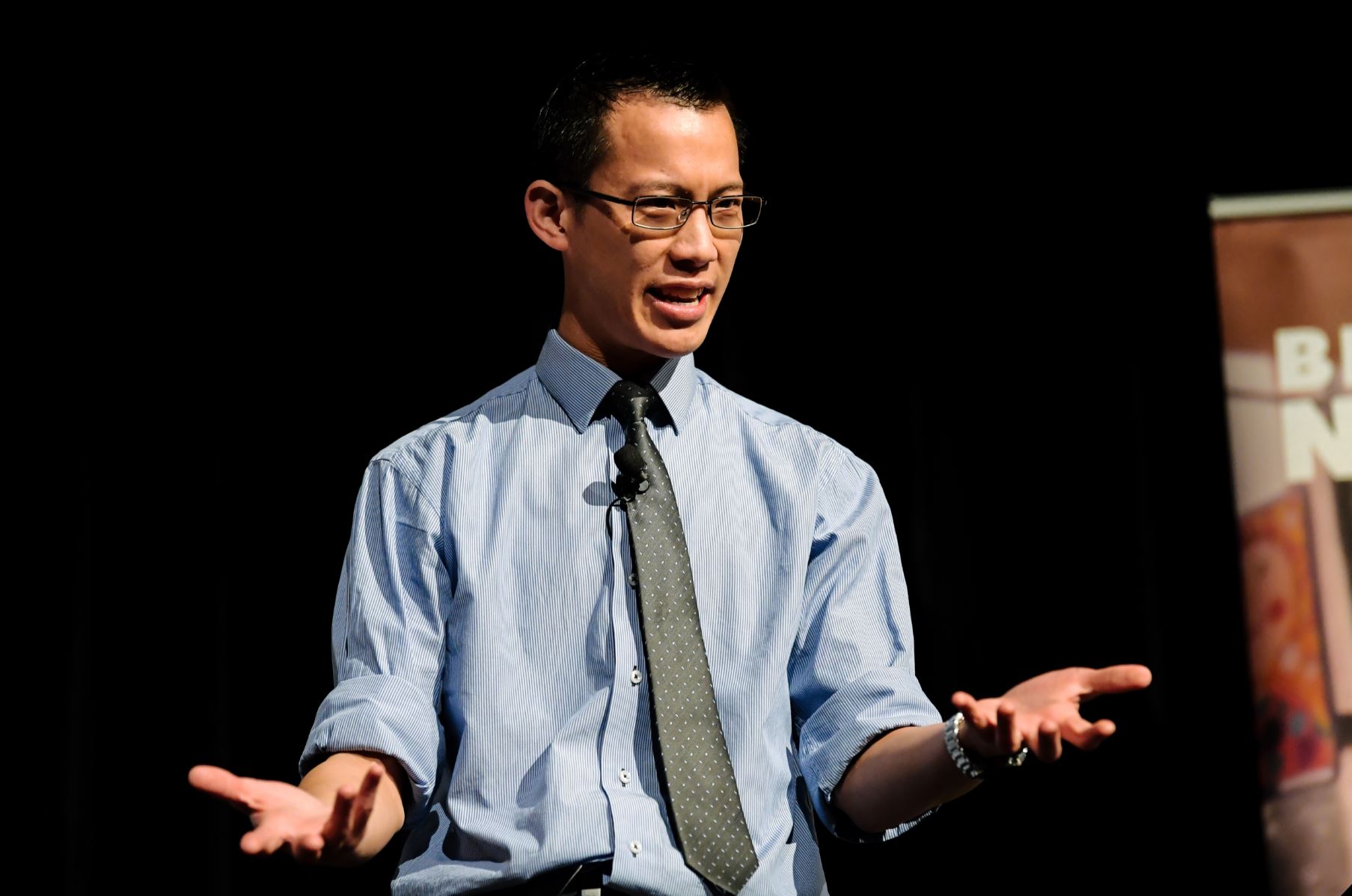
Educator Eddie Woo has more than 1.9 million YouTube subscribers worldwide and says the ability to give a diverse range of students a different set of experiences that is attuned to their needs, is extremely exciting to him as a time poor educator.
We particularly need critical thinking skills that allow us to build upon our basic skills and our knowledge to grapple with new concepts, Loble suggested.
“Learn them, apply them, evaluate them, discernment and judgement, all those things that are so important, and will become even more important in an AI world,” she said.
“So the good news is, in the midst of this new technological vector that is affecting education, just as everything else, the fundamentals remain exactly the same, and in fact, it’s a moment where we have to double down on just how important great teaching is.”
But we have to give teachers the tools and support to be able to do that.
The concerns of cognitive off-loading
It’s important that sound educational thinking is in the driver’s seat, and not technology.
Cognitive offloading is when we shift some of our memory stores to an external device to free up cognitive space and this can be can be positive and beneficial, or it can be negative and detrimental, Loble contended.
Our working memory is very limited, with studies finding it can hold as many as four things at once.
Our long-term memory is boundless and contains all of our experiences and the things we’ve learned, and it’s on these stores of memory that we build knowledge.
When cognitive offloading can be detrimental is when it essentially short circuits the memory formation process and stops us from building those mental structures upon which we not only continue to learn, but we think.
“AI, unfortunately, part of its beauty, is that it is designed with all the incentives in the world to push us more towards the detrimental. Essentially, it takes care of a lot of things for us, and we defer to it more and more.”
“The risk is not just that somebody cheats by using AI to write an essay – the real risk of AI and cognitive offloading is that we erode those mental structures, and for younger learners, we potentially don’t even build them robustly enough at all.”
‘Performance paradox’ and a ‘metacognitive laziness’
Evidence is mounting to suggest there is a real problem here, the expert suggests.
“We know from studies that there’s what’s called a ‘performance paradox’,” Loble shared.
“AI gives you a short-term boost, but then when students are tested later, they haven’t retained it. And so we get this boost, but we don’t have the learning.
“There’s an illusion of competence that comes with using AI, which leads to a false sense of mastery. We feel like we know it, and we think we’ve know it, but we don’t really.”
And in turn, Loble explains, that dynamic pushes what some have called a ‘metacognitive laziness’.
“In other words, we lose touch with our metacognition, which is essentially understanding what we know and what we don’t know...
“And when we have a tool that just makes it feel like all that information is at our fingertips, it creates an incentive to avoid the productive struggle that is the foundation of learning.”
This is what is going on with AI, but it’s not inevitable, and that’s really important, Loble shared.
“First and foremost, there are ways that we can structure the technology itself to be a positive incentive towards learning and not on a negative one – and most importantly, we can support teachers in how to effectively and intentionally teach around AI.”
In part two of our coverage of ‘When AI does the homework are kids still learning?’ with Professor Leslie Loble and Eddie Woo, the pair discuss how teachers should be harnessing AI in their classrooms and how students should approach using AI in the context of learning.