The VCEA, representing more than 30 Catholic school employers in enterprise bargaining negotiations, presented an offer last Friday that they said represents a fair deal for staff in Victorian Catholic schools.
However, the IEU called the offer “a backward step on several important conditions IEU members have won over decades”.
The union has concerns with the offer regarding workload, the dismantling of ES overtime, a refusal to improve TIL and camp allowance, teacher attendance on-site subject to the ‘operational requirements’ of the school, vagueness around pay, as well as concerns over professional practice days and an absence of better protocols on dealing with student behaviour or students with high needs.
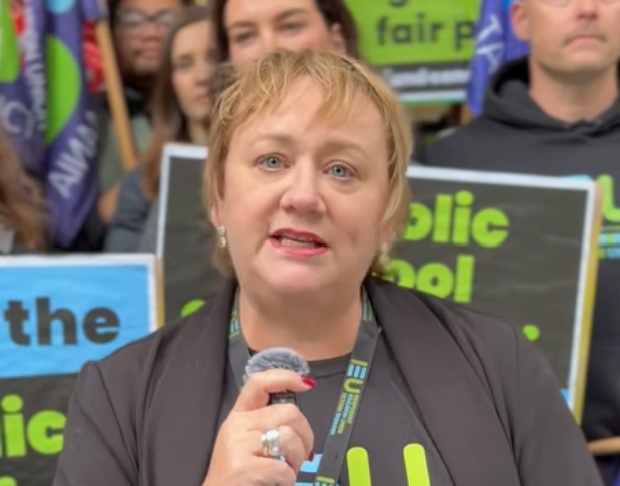
IEU members and supporters gathered outside the Commission yesterday morning, calling for a single, fair agreement covering staff across the system.
This campaign is one of the first major tests of Australia’s new multi-employer bargaining laws.
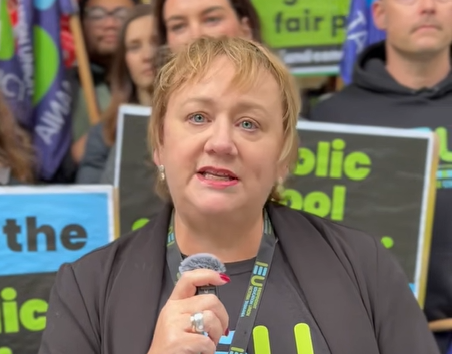
Kylie Busk, deputy general secretary of the IEU Victoria Tasmania Branch, told the group that their fight is an absolute necessity.
“We all know that staff across Catholic education in Victoria badly need a pay rise and improvement to conditions, and we know that they need them now,” she said.
“But unlike Catholic employers in every other Australian state and in government schools across the country, Victorian Catholic employers won’t allow access to fair bargaining rights for their staff – the rights we need to get a fair deal that is so badly needed in schools.
“So, we’ve had to fight them, and we took that fight to schools.”
In Term 4 last year, 20,000 IEU members and their supporters – comprising well in excess of 50 per cent of the Catholic education workforce – signed statements of support to win access to bargaining rights under a single interest agreement.
“All of those people know that fair bargaining is essential for fair outcomes,” Busk said.
“There is an urgent need for competitive wages, for measures to continue to address workload, and staff safety in managing burnout, and violent and challenging student behaviour.”
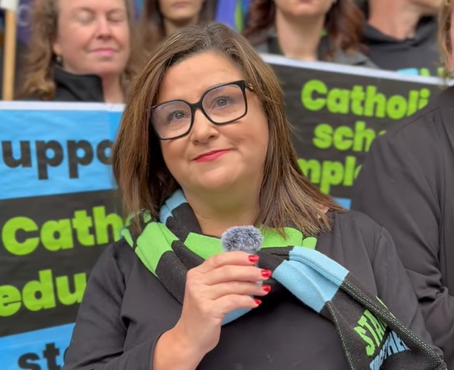
Deputy president of the IEU’s Committee of Management, Alex Abela, says securing an SIA is about restoring balance, protecting staff rights and ensuring Catholic educators have a real voice at the table.
Busk said IEU reps and members are rightly frustrated that they’ve needed to direct energy to the campaign – energy they would prefer to direct to their important work with students – but they also know that without these rights and positive outcomes, they will continue to lose good educators from Catholic education, “as employers continue their history of bargaining delays and failures to deliver on key claims”.
“We are not going to settle for the shabby second rate deal the employers dropped on staff on Friday morning.
“During the time of teacher shortage, these employers risk driving staff out the door with conditions worse than those offered in government schools. We will never settle for that.”
Also addressing the crowd yesterday, Alex Abela, a Victorian Catholic secondary teacher and deputy president of the IEU’s Committee of Management, sought to remind Catholic educators why fair bargaining rights are so important.
“Most of my time as a teacher has been in independent schools, and unlike my colleagues in Catholic schools, this has meant that I’ve had the right to access bargaining rights in pursuit of bargaining outcomes,” Abela shared.
“This includes having the right to access protected action, including strike action. These rights are essential for getting good outcomes in bargaining in schools.
Abela explained that her experience has been that these rights help progress bargaining and deliver good outcomes – even though she has never needed to use this access.
“Knowing that we had capacity to apply work bans when we were bargaining at the table, seek bargaining orders or take strike action and that was enough to help find genuine agreement in bargaining and that I contrast this with the experience of members in Catholic education,” Abela shared.
As a long-term member of the IEU Committee of Management, Abela said she has witnessed the long history and the delay and frustration in Catholic bargaining, and of IEU members in Catholic schools being denied rights that every other Catholic and government school employee has.
“And that’s so disappointing, that Catholic employers have continued to deny consent to Single Interest Authorisation, despite an overwhelming majority of employees in Catholic schools calling for it through statements of support.
“This is why access to new opportunities to secure single interest authorisation is essential to achieving fair, timely outcomes in bargaining.
“It’s about restoring balance, it’s about protecting staff rights and ensuring Catholic educators have a real voice at the table.”
The Fair Work Commission hearing taking place from June 16-26 and includes the 24 employers at which an independent ballot agent had already established clear majority support for an SIA.
Following the hearing, the Commission will determine whether to grant a SIA covering the employers in the amended application. A decision may take a number of weeks.
If an SIA is granted, the union’s immediate focus will be on commencing bargaining with the full rights available, pursuing the inclusion of remaining Victorian Catholic employers; and continuing the campaign for a single Agreement covering the sector.