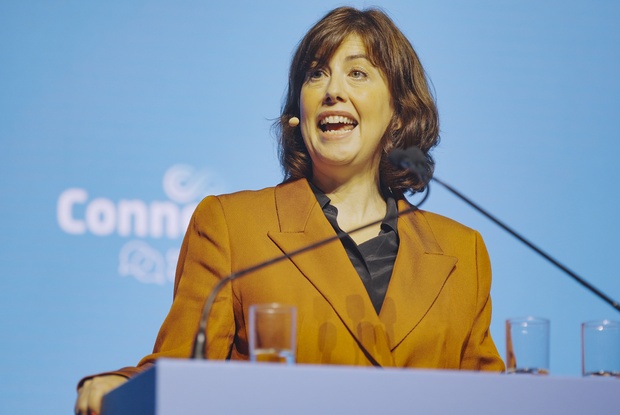
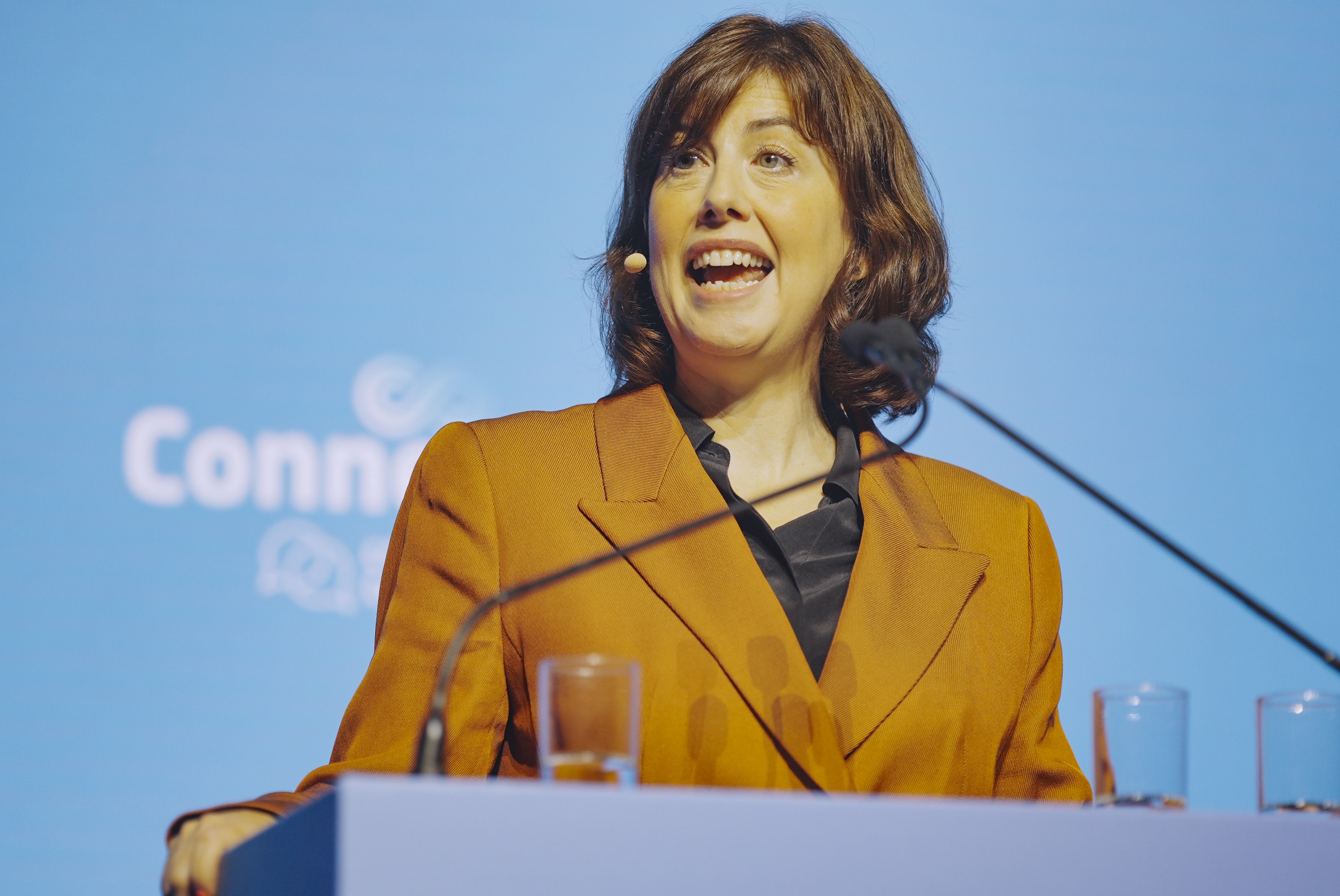
Speaking at a Confederation of School Trusts conference earlier this month, Education Secretary Lucy Powell unveiled her party’s plans to ‘hardwire’ oracy into England’s national curriculum, declaring “with AI on the rise, we need to go harder on the skills that makes us human, like oracy”.
“That ability to articulate yourself confidently is central to success in work and in life, but for too long it’s been a marker of privilege.
“Now it will become the right of every child – nobody left out because they can’t speak up.
“That’s why we’re hardwiring oracy into the revised National Curriculum,” she told delegates.
Under the change, oracy will be granted equal status to reading and writing as a new strand of the English curriculum, with Powell saying the skill will “light up every classroom”.
“Both in content and in assessment, speaking, listening and communicating will be a core part of every child’s education, from primary to GCSE and beyond.
“And that is the oldest form of connection we can think of, building relationships by communicating,” she added.
But education author Daisy Christodoulou, Director of Education at No More Marking and a former Head of Assessment for a group of UK academy schools, has raised a red flag on the Government’s plan, arguing that in the past speaking and listening assessments haven’t worked well in practice.
Christodoulou said that based on the Government’s current rhetoric and the evidence to date, the proposed oracy focus for schools would likely soon be seen as something of a farce.
“Are they going to introduce an oracy programme that teaches students to construct compelling arguments and respond thoughtfully to questions?
“Or are they going to introduce some vocational and speaking and listening qualifications that involve some box-ticking activities that have a 100 per cent pass rate and quickly get regarded by everyone as a bit of a joke?” she posed.
The education expert drew on her own teaching experience to illustrate her concern here.
“Back in 2007 I taught the old English Language GCSE, which had a speaking and listening coursework component.
“It took a lot of teacher and class time to administer, was very hard to grade reliably, and ended up being a contributor to grade inflation,” she noted.
Indeed, a former senior education official at the time has recently reported that while just 4 per cent of foundation students reached a pass grade in their written exam, 71 per cent reached the same passing grade in their spoken coursework, Christodoulou added.
Yet with the development of AI, there is potential to innovate oracy assessment, she flagged.
In 2024, No More Marking trialled an oracy assessment in order to make the process more reliable and efficient.
“You could add in AI and improve things even further. It would not be easy, and there are certain things that would still be too difficult to accomplish, but a government that really cared about improving oracy teaching and measurement could create a new assessment that helped both.”
However, the expert suggests the reform – coupled with other impending changes including a new set of school-based vocational qualifications – stands to weaken academic standards across the board.
The Burnham Government doesn’t appear to prioritise standards very highly – a fact that is “being obfuscated by all the misleading rhetoric”, Christodoulou argues.
“Standards are a very high priority for me. I think the purpose of a state school system is essentially about preserving and developing civilisation...
“It is about hard-won knowledge that is not innate, that is not inevitable, and that will die and wither if we don’t create institutions that value it and convince the next generation to value it.”
The Government seem to care more about a long list of other things, Christodoulou contends, such as “engagement, fun, creating ‘mind-blowing experiences’ (and) ‘reimagining childhood’”.
There is always a trade off between learning and fun, the expert argued, which makes it very difficult to prioritise the latter.
“I am being honest here and admitting that I do not prioritise fun. I wish the Government would do the same and more openly acknowledge the trade-offs inherent in their policies.”

In a recent interview with The Guardian UK, British Education Secretary Lucy Powell maintained, “I absolutely don’t want schools to dumb down".
While Scotland and Wales have gone down the path of pursuing skills-based curriculums, England has taken a different approach.
Conservative reforms over the past few decades have re-championed the acquisition of knowledge as a core aim, and there’s a system-wide focus on interactive explicit teaching, whole-class instruction and traditional assessments.
“This experiment has now run for over a decade and the results are in. While Scotland and Wales have seen their PISA scores slowly decline, England has held relatively stable,” Dr Greg Ashman, deputy principal at Ballarat Clarendon College in Victoria, recently argued in this piece for EducationHQ.
Some, including Ashman and Christodoulou, suggest Powell’s leadership may undermine the success of the country’s educational reform efforts.
The Education Secretary herself has declared that “we need to go beyond a one-size-fits-all system that sets too many up to fail”, arguing that “practical skills are disappearing from practical subjects, just when the world demands the opposite”.
“We need to widen the narrow view of what good is.
“And we need to give our young people something to believe in again. Hope for the future. That is my mission, I’ve dubbed it as me leading the department of hope. That is our mission…” she implored.
Ashman has shared his take on whether oracy is indeed a ‘marker of privilege’ as Powell claims.
“It is important to be able to express yourself clearly and there is nothing wrong with a domain specific focus on improving spoken language. Debating, drama and public speaking all have a role, as does regular classroom talk when discussing concepts with a partner or sharing thoughts with the class.
“If these opportunities are being squeezed out of the curriculum then that is a mistake,” he notes in a Substack post.
Yet one glaring problem with the term ‘oracy’ is that “nobody knows what it means”, Ashman flags.
“It must involve speaking, but that’s about it…” he writes.
The actual effectiveness of oral language interventions also remain unclear, Ashman adds.
According to the Education Endowment Foundation, oral language approaches have a high impact on student outcomes, citing six-plus months of additional progress.
“Unfortunately, when we examine the studies behind this figure, the majority do not show a statistically significant effect for oral language interventions,” Ashman asserts.
“This demonstrates just one of the problems with the Toolkit. Studies of often quite different interventions are mushed together to produce a spurious overall effect size that is then converted into ‘additional months of progress’.”
Posting recently on LinkedIn, Distinguished Professor of Cognitive Psychology Pamela Snow from La Trobe University said the term ‘oracy’ might not be everyone’s cup of tea, but there is no doubt that students' oral language competence must be developed for two key reasons:
“[Firstly] in its own right, to support the ability to form and maintain relationships and transact the business of everyday life and [secondly[ to support reading and writing skills across year levels and across the curriculum,” Snow writes.
“It is unfortunately well-established that families sit on a socio-economic gradient that influences the home language and literacy environment. We also know that language disorders impact 7-10 per cent of students…”
Effectively, the expert concluded, this means that teachers need to be able to explicitly teach language across all its dimensions: vocabulary, morphosyntax, grammar, discourse genres, figurative language, and pragmatic skills (for example turn-taking, topic maintenance, formality conventions).
She says this is to “give all students access to the academic learning and wellbeing on-ramp”.
“Many teachers already do an outstanding job of this,” she noted.