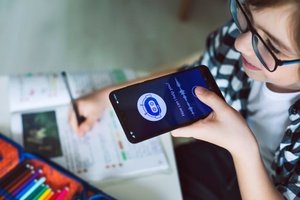
This is according to a new study by Steven Kolber and Dr Keith Heggart, who analysed 15 teachers’ reflections on their use of social media and how they engage via Facebook, LinkedIn, X and Flip, a video sharing platform.
Heggart says while teachers tend to naturally congregate online, he and Kolber sensed that educators’ online presence seemed quite distinct from their personality in the flesh.
Their interest on this front was piqued.
“If you ever go to a party, an event, teachers always find each other and they always end up talking, even if they try not to. They always end up talking about teaching.
“And I’m an academic now, but I used to be a teacher for a long time, so I feel comfortable saying that – and I think the internet is a little bit like that,” the senior lecturer at University of Technology Sydney tells EducationHQ.
“We felt that teachers kind of put on a mask when they were on the internet. Not all of them, but a lot of them.
“We felt that they were different on the internet than they were face-to-face, so to speak.”
Their study found teachers intentionally split their online identities across strict political, professional and personal lines.
Heggart says the vigilant strategy that teachers applied when using social media was striking.
“We all know about people who’ve done silly things on social media and ‘the internet is forever’ and all of that.
“But what was notable about this research, was that teachers were very intentional that ‘Twitter or [another] account is going to be my teaching account’ and ‘this account or platform is going to be for catching up with family, and never the two are going to meet’.
“And that’s why we called [the study] ‘splintered selves’; they splintered themselves into different people on the internet,” Heggart says.
As one teacher, ‘Clarissa’ explained:
“Professional Clarissa will share a lot more, and personal Clarissa lurks a lot more. And personal Courtney lurks for the sake of learning about issues that I don’t have a stake in the game.
“So, it’s usually political stuff, and that’s who I’m following. I’m following journalists or I’m following people with opinions that, sadly, as a departmental employee, I am not really allowed to click ’like’ on, if I was doing that from my professional account.”
‘Compartmentalisation’ is a good way to describe teachers’ approach to crafting their identities online, Heggart says.
“Some of the teachers also wanted to be active in local politics, for example, or even federal or international politics.
“So, they had another account that they would use to follow that and interact, and that way their teacher identity didn’t get mucked around with their political identity, and people couldn’t draw inferences and make claims and confuse the issues.”

Teachers are in need of new online spaces where they can congregate, Dr Keith Heggart says.
Self-censorship was a key theme to emerge from teachers’ accounts.
Interviewees were concerned about maintaining their professional standing, about being sucked into spending too much time on social media, and feared losing control over their privacy.
“I try to make my social media presence more about just putting stuff out there rather than engaging so much in it to such a deep extent.
“I guess I want to keep, maybe, just a foot of distance, because I know how deeply I could just … fall into it,” Tom, another teacher, shares in the study.
The educators also aired concerns over being misunderstood online – a consideration that tempered their engagement, the study found.
“And maybe there’s a bit of hesitancy that I understand the limitations of social media in developing relationships that I don’t maybe want to give too much of myself away, and just allow people to actually read my work to know who I am and speak to me to know who I am.
“Rather than form an image of me through any social media activity that can be simplistically interpreted,” Tom added.
When asked how they took to the idea of building a personal social media ‘brand’ for themselves, the teachers ‘almost unanimously rejected’ this notion.
“That was really interesting,” Heggart says of the finding.
“Because we were conscious that, especially on other platforms like Instagram, there had been the rise of what we were calling the ‘edupreneur’, the educational entrepreneur.
“And you see a lot of them who use their photos of classrooms to fund things – and I’m not making a value judgment about it at all or anything like that – but we asked our participants about whether they saw themselves as part of this kind of edupreneur group of people.
“They rejected the idea that they had a brand online … they weren’t looking to turn it into a commercial kind of [side hustle], which I think is probably common to most teachers. Most teachers don’t do it to sell things, do they?”
Since conducting the study, X has changed dramatically as a social media platform, the researcher flags.
“I dip in there every now and then, but I’m not active on it much at all. It’s a real cesspool of conspiracy theories and some really horrible stuff.”
Teachers are in need of new online spaces where they can congregate, Heggart concludes.
“Because sometimes it’s about having a critical mass; you need lots of teachers in one space if there’s going to be … benefits for all of them.
“I just don’t think we’ve quite seen that. There’s some ideas around Blue Sky. I know some people are doing some stuff on LinkedIn, but I just don’t think we’ve reached that central place for teachers, yet.”
In 2022, EducationHQ reported that strict social media policies for teachers were preventing the profession from fully engaging in civic society, infringe on their right to a personal life, and may in fact be unlawful, according to two experts in the field.
Dr Sandra Noakes and Dr Sarah Hook from Western Sydney University warned that employers’ right to control their employees’ behaviour and commentary on social media was largely a grey area in terms of the law and a contested issue in this country, with employers increasingly seeking to dictate what employees do and say online – even when they are not at work and their activity bears no relation to their job.
“We’ve both had friends that were teachers, who, when we talk to them about our research, (they say), ‘When I’m on Facebook I make sure I’m never photographed with a glass of wine in my hand, because I’m worried that that will (look bad)’.
”And we both looked at that and thought, ‘That’s interesting’,” Noakes, a senior lecturer in law, shared.