


Speaking on Weekend Sunrise with host Monique Wright yesterday, Jason Clare said ITE courses currently dedicate too little time to teaching students about the issue of bullying in schools – and that this needs to change.
The comments come following the launch of the Albanese Government’s new $10 million ‘Let’s Stop Bullying’ national awareness campaign, which aims to empower parents and educators to better spot and stop school bullying.
The initiative includes $5 million for a national ‘advertising blitz’ on TV and radio, with ads featuring various school-aged children who ask, “Can you tell which one of us is being bullied? Is it me?” in a range of settings.
The campaign responds to an Anti-Bullying Rapid Review conducted last year, which found that more than one in four students in Years 4-9 say they have experienced bullying regularly.
The review also investigated the changing nature of bullying, highlighting that reports of cyberbullying have risen by an alarming 455 per cent in five years, and over half of young Australians report having experienced cyberbullying.
Clare said the campaign was “just the start” in the wider bid to stamp out bullying.
“...kids have told us, in the work that we’ve done to develop the ad, that it can be anyone, it’s not the child that you normally expect, and parents have told us … we’ve spoken to P&Cs, we’ve spoken to Matt and Kelly O'Brien, whose daughter Charlotte took her life only almost two years ago, but they want resources, they want some information to help them to talk to their own children to be able to spot it when a child might be being bullied at school and not talking to their mum and dad about it,” he told Wright.
Wright asked how much time was allocated to bullying education in initial teacher education courses.
“Not enough,” Clare replied.
“One of the things that education ministers have said when we looked at the ad and when we met with Matt and Kelly O’Brien, is we need to make this part of the university degree.
“We’ve made some changes to the degree already, but I think there’s a very good argument that we need to build this into the university degree in a bigger way.”
When confronted by Wright as to whether or not the advertising campaign would have a big enough impact on the widespread problem, suggesting specialist training in ‘direct intervention’ for teachers might in fact be more effective, Clare dodged this line of inquiry and instead emphasised the importance of the bystander approach in schools as a means of stamping out bullying.
“One of the things that Charlotte said in her farewell message to her mum and dad was that she hoped that more children wouldn’t be bystanders, but they would be upstanders.
“I had my little boy, Jack, nine‑year‑old Jack, come home to me the other day and ask me, “Do you know what an upstander is, dad?” That told me that something’s happening in our schools.
“It’s about providing teachers resources, parents with information, but also our children in our schools and elsewhere about the importance of their role in not standing by and letting bullying happen, but to be upstanders as well, the sort of people that Charlotte asked for and hoped for,” Clare concluded.
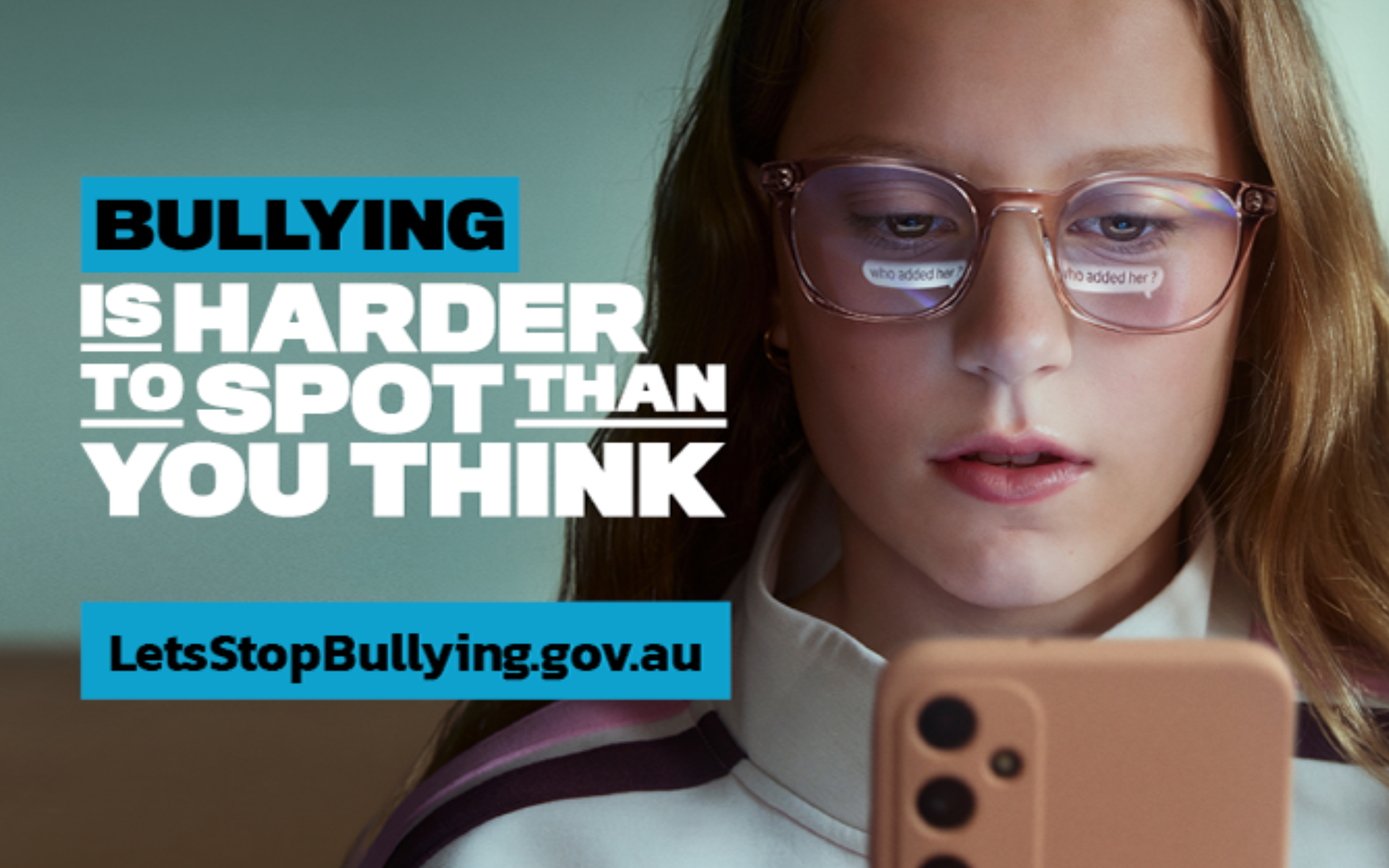
Some have said the new advertising blitz to stamp out school bullying does not go far enough to tackle the problem. PHOTO: Australian Government Department of Education
But last year a bullying expert warned the popular bystander strategy was among a number of approaches and programs marketed to schools as ‘evidence-based’ but that come with questionable research behind them.
Dr Karyn Healy, a researcher and psychologist from the University of Queensland, said many Australian schools were being led astray when it comes to bullying prevention and management.
“All schools and governments want to address bullying. They also want to be seen to be addressing bullying. And [often] the two aren’t the same,” Healy told EducationHQ.
“So, sometimes schools do things to show they are addressing bullying, which are actually counterproductive.
“For instance, giving victims a voice by getting them to speak in front of the class, speak in front of the [school], videoing them and putting them on the (school) website.”
Sweeping meta-analyses have only recently teased apart the various elements of school bullying programs to assess their impact, Healy noted, finding some do in fact worsen the problem.
One is the bystander intervention approach noted by Clare, which Healy said was picked up on the basis of just one observational study with glaring limitations.
“…[The study] showed that if someone intervenes then bullying will stop shortly afterwards, but it didn’t really compare to what happens if no one intervenes – and there was no measure also whether the bullying then occurred at the next break or the next day.
“We had no information whatsoever from the study about the ongoing impacts.”
The conclusion that bystander action is helpful has been grossly extrapolated to the view that ‘we need to train as many kids as possible to get involved’ in instances of bullying, Healy suggested.
“And that definitely has not been demonstrated by the research (to be effective).
“There’s some reasons to think that may not be helpful for kids who are on the receiving end of bullying, because it can potentially really draw broader attention to the issue and be quite embarrassing for the victim.”
Healy said the approach has ‘run away with itself’ in schools, despite the patchy evidence supporting it.
“It doesn’t necessarily follow that training of the kids who know nothing about the situation, to come in and get involved, is going to be a helpful thing.
“I think schools assume that’s going to be an effective thing when it may not be.”
According to Dr Charlotte Keating, a clinical psychologist and co-chair of the 2025 Anti-Bullying Rapid Review, the campaign serves a serious need in light of the changing nature of bullying.
“Bullying today is no longer limited to physical shoving and name-calling in the playground. It can be quieter and less visible, but the harm it causes is very real.
“It can detrimentally impact a young person’s sense of self-worth and confidence, their mental health and schooling outcomes, with those impacts often lasting well into adulthood,” Keating warned.
Alongside review co-chair Professor Jo Robinson AM, head of Suicide Prevention Research at Orygen, Keating said they had spoken to thousands of students and families across the country who have experienced bullying and “seen the devastating impact it has (or, can have) on children”.
“The Let’s Stop Bullying campaign will play a significant role in providing the knowledge and tools to help navigate the changing nature of bullying,” she concluded.
Robinson has also backed the initiative, warning those who are bullied are more likely to experience mental health issues including depression, self-harm, and suicidal ideation.
“This campaign provides communities with essential tools to recognise the possible signs of bullying and understand the actions they can take to help prevent and address harmful behaviours early,” she added.
Clare noted that from next year it will be mandatory for all Australian schools to take steps within the first two days when a complaint about bullying happens, because “all of the evidence tells us that if you act quickly here you can nip it in the bud”.
Confidential help and free counselling is available at Lifeline on 13 11 14 and Kids Helpline on 1800 55 1800.