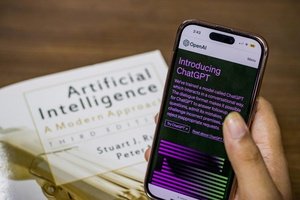


Last year’s TALLIS survey showed that Australian teachers are amongst the world’s most frequent adopters of AI, with around two thirds of teachers in lower secondary grades using AI in the past year, most often for tasks such as brainstorming, learning and summarising content.
Likewise, the Digital Landscapes in Australian Schools 2025 report indicated nearly 80 per cent of senior staff in a range of education settings were active users of AI tools.
AI in schools is here, and here to stay. So, what does this mean for print resources? Is there still a time and place for having access to print as an alternative to digitally-based content and AI tools?
We know that a universal design for learning framework is an effective way of making sure the suite of tools and methodologies we employ in the classroom meets the needs and characteristics of all learners. While AI is a great option for many students, it is not something that is available or effective for everyone.
Some students do better when they are able to feel, touch, hold and experience a sense of ownership of their learning materials. Being able to take a resource with them and access it when and where they like offers an important sense of ownership and autonomy that isn’t always available with digital options.
In some settings, students have very limited access to digital technology, and rely instead on information shared verbally, in print or as part of shared classroom learning experiences.
Students who are part of the corrections system typically don’t have access to the internet or AI tools in the same way that students in a high school might do. The same can be true of students in remote locations, where access to the internet can be less reliable than regional centres and cities.
For students who have arrived in the Australian schooling system with limited experience of having their own learning materials, the thrill of having individual learner booklets where they can record answers, make notes and create an ongoing record of their learning is a priceless experience.
Many teachers and school leaders across a range of settings are preferring to utilise a hybrid model where print resources are available alongside digital options. They know there is learning which happens with print that just isn’t the same in a digital or AI space.
This blended approach fits neatly with universal design, highlighting the need for a wide range of delivery options.
Some schools are training platform champions who become experts in a particular technology or approach, and can become a part of the ongoing professional development of the school.
Print resources are an important part of the mix in this scenario, with platform champions being needed to coach in the best way to design a print resource to meet the learning needs of all students.
Print resources which are well planned and designed can offer wonderful support to many students.
Some handy options to consider when you are planning a print resource include:
- Thinking about line spacing and margins, so there is enough white space around the text to make it easy to read
- Including meaningful visual cues, images with captions and alternative text and icons to support reading for understanding
- Use of clear, relevant chapter and section headings
- Choice of paper to align with student preferences (such as a low sheen paper or a high contrast colour)
- Font options including a dyslexia friendly font if this is preferred by some students
- An Easy English option available to support students who do best with reduced text length and a simpler sentence structure
- Space to write, draw and create in response to the text or learning activity
It is very likely that the AI genie has leapt from its proverbial bottle and there’s not much that will force it back. But as we plan for the digitally powered classrooms of the future, it is worth thinking about the vital role that print resources still play for many students.