


It’s a stat that is alarming for parents, but should also be for principals and wellbeing leads, many who have held on to the forlorn hope that legislation has gone a long way to solving many of the issues linked to social media’s dark underbelly.
With grave concerns for her own three kids’ future, and their reluctance to talk about digital-related issues, social worker Sharni Young decided to take matters into her own hands and create a set of conversation cards for kids, titled The Koji Collective.
Designed using trauma-informed principles to help children talk about things like online safety, feelings, friendships, and the moments that are hard to bring up out of nowhere, the little idea with big potential has seen Young land a bronze award in the Children’s Education & Activities category of the 2026 AusMumpreneur Awards.
With extensive experience spanning over 15 years involving children and families, it was while on maternity leave recently that Young actually had the time to focus on helping children, families and schools really be able to navigate some tricky conversations that ultimately need to happen with kids.
Young acknowledges that the social media ban was put in place for valid reasons, however age verification processes have failed dismally.
Test data from the eSafety Commissioner and academic studies indicate that more than 80 per cent of underage teens continue to use the platforms.
“Children are finding ways around the ban – lots still have full access anyway,” Young says.
“Kids just aren’t telling their parents as they don’t want to lose the access – or parents know and can’t do anything to stop it.”
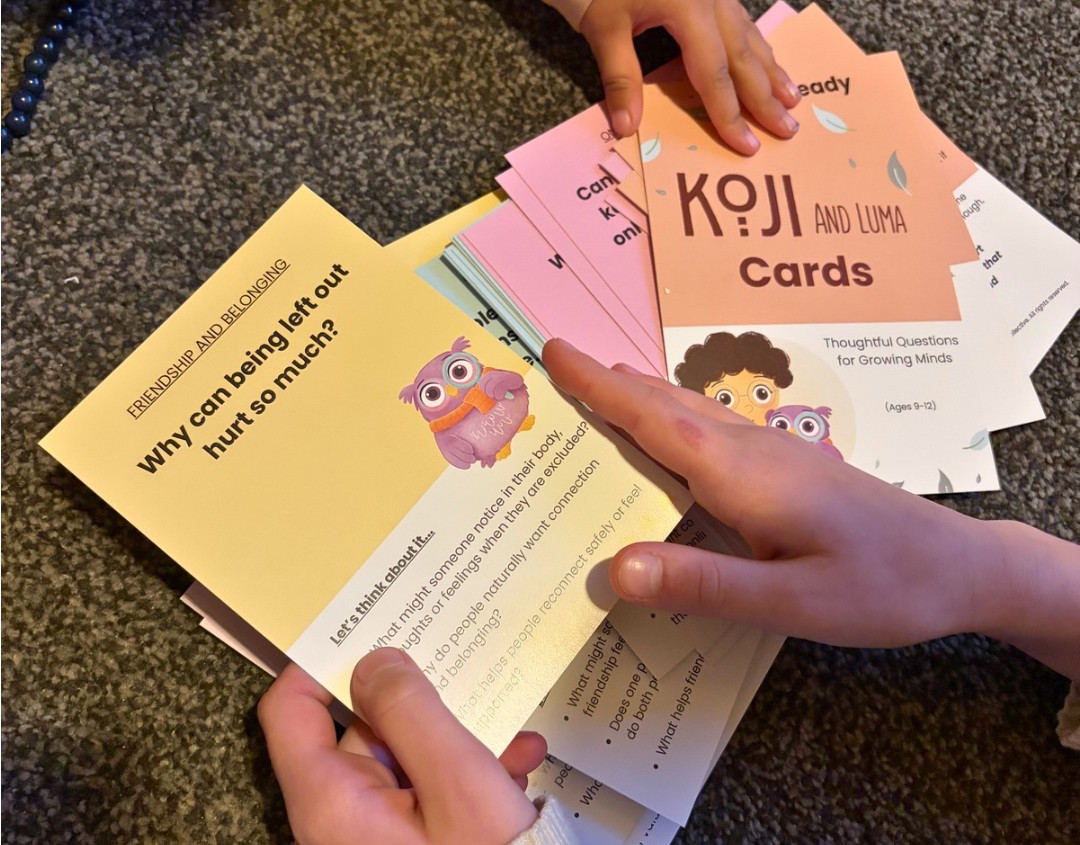
Less than 12 months after trialling the cards at a local school, with no team, no investment and no marketing budget, Sharni Young’s The Koji Collective has won bronze in the Children’s Education & Activities category of the 2026 AusMumpreneur Awards, out of more than 2000 nominations.
Whether it be VPN access, false dates of birth – there’s so many ways around the ban.
“The conversation cards are important because they help to open up conversations,” Young says.
“Parents can use them as a tool because they remove the shame, they remove the stigma, they remove it being something that the kids have done that’s wrong, and helps them to navigate that.”
Children are growing up in a digital world whether we like it or not, however Young says their brains aren’t often ready to process, comprehend, understand, and navigate all of the complexities around the platforms.
“They don’t yet have the ability be able to regulate, to understand what they’re witnessing and seeing, and make sense of it in a way that isn’t harmful to them,” she shares.
“That’s why it’s so important to be able to have conversations and support children’s emotional literacy, because they’re not ready to be taking on and understanding and comprehending everything that they’re seeing.”
Young says social media influences everything in their life – the way they form their peer connections, what they believe they like and what they don’t like.
“That’s the point of algorithms, to influence children and keep them hooked and keep them wanting to watch and wanting to engage,” she says.
The cards address a fear on the part of teachers and parents around how to have those conversations. It has to be in the right way and using the right words.
“Each card is designed using trauma-informed principles and really focused around the model around ‘pause, reflect and act’,” Young shares.
“So helping children to pause before they respond, reflect on the question and how the question prompts feelings and then act in response.
“It’s aimed at helping to open up conversations that ultimately don’t happen at all - and often don’t happen with children.”
There are two sets in The Koje Collective card series, broken into different themes based on age appropriateness.
So for example, one of the cards asks ‘how can AI or editing make something look real when it isn’t?’
”The card then prompts you to think about what clues might there be that this is something to feel cautious about,” Young explains.
“So what are some of the themes when you’re seeing something that might make you pause to start to think about ‘this doesn’t feel like it’s real’. Then it’s ‘what might people create fake images, videos or stories?’ And then what helps people to check before believing that something’s real?”
Young initially trialled the cards in two therapy centres in Bendigo, but was anxious to try them in a school setting, and so approached local school, White Hills Primary.
The school gladly agreed to get involved, and following a month of trialling, a survey provided valuable feedback from across the school community, which then contributed directly to how the final cards have taken shape – from the wording of individual questions to the age groupings and packaging.
Set 1, titled ‘Curious Questions for Brave Kids’, is designed for ages 6 to 11, while set 2, ‘Thoughtful Questions for Growing Minds’ is designed for ages 9 to 12.
Ultimately, Young says we know under 16s are going to access social media, irrespective of the ban being in place – that’s the reality, they’re going to do it.
“So we need to jump on board and we need to support them with it because otherwise they’re going to do it without us.”
“We need to be honest with them because otherwise they just don’t tell us and then there’s a secrecy around it and then they’re still doing it, they’re navigating it anyway.”