A year ago, researchers warned that Australia’s billion-dollar private tutoring industry was operating with almost no regulation, that at least one in seven students were being tutored, and that nobody could say with confidence whether it worked. Google Trends data suggests demand has not paused to wait for an answer.

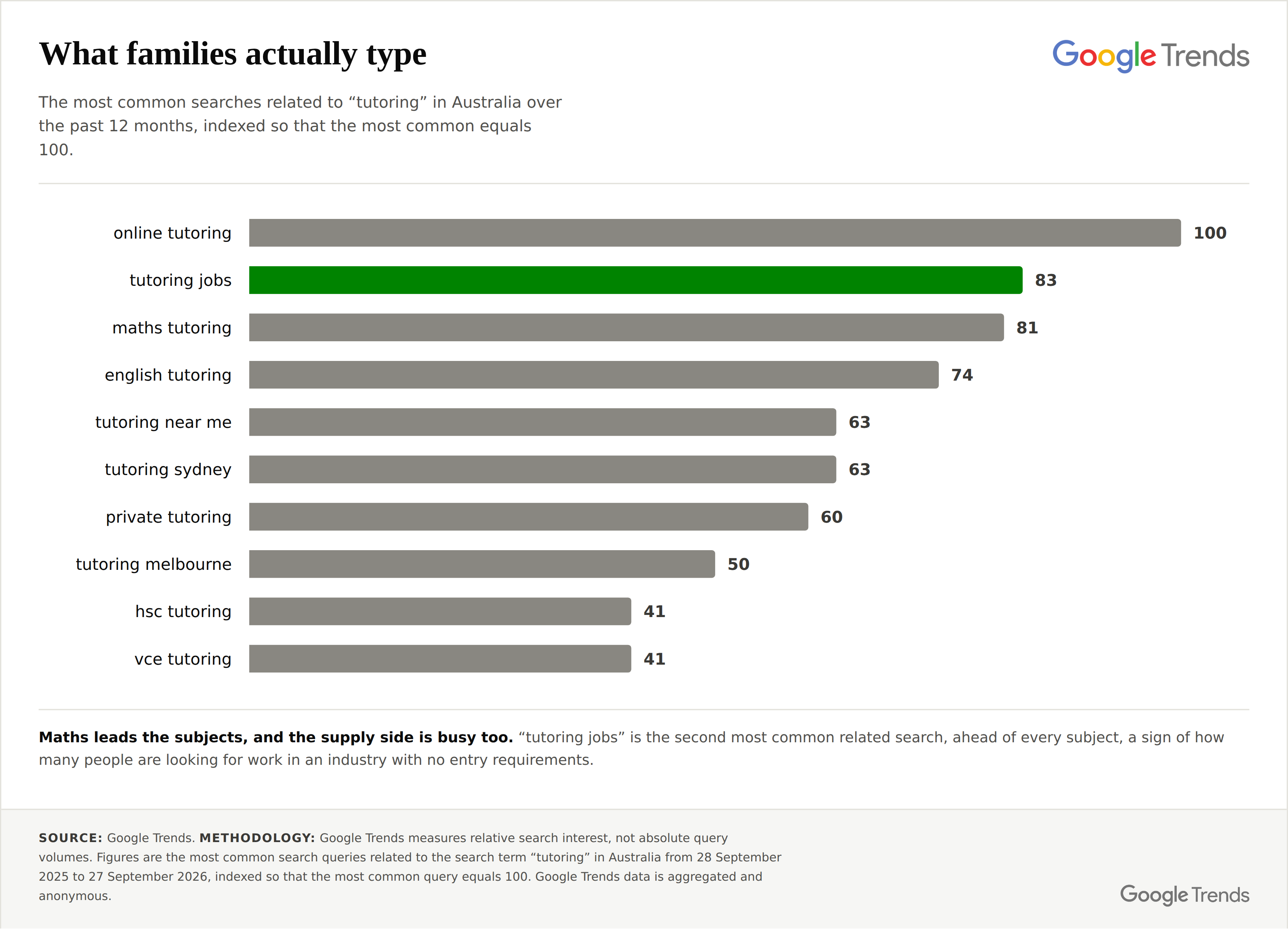
Five straight years of growth

Australian searches for “tutoring” were flat from 2016 to 2021. Since then they have risen every year. Interest in 2026 is roughly double its 2016 level and about 20 per cent above 2025, and February 2026 was the busiest month recorded in the past decade.

Average Australian search interest in tutoring by year, 2016 to 2026. Source: Google Trends.

The turning point is worth noting: the increase begins in 2022, as schools returned to normal operation after two disrupted years, and it has continued through a period of cost-of-living pressure in which families have cut back on much else.

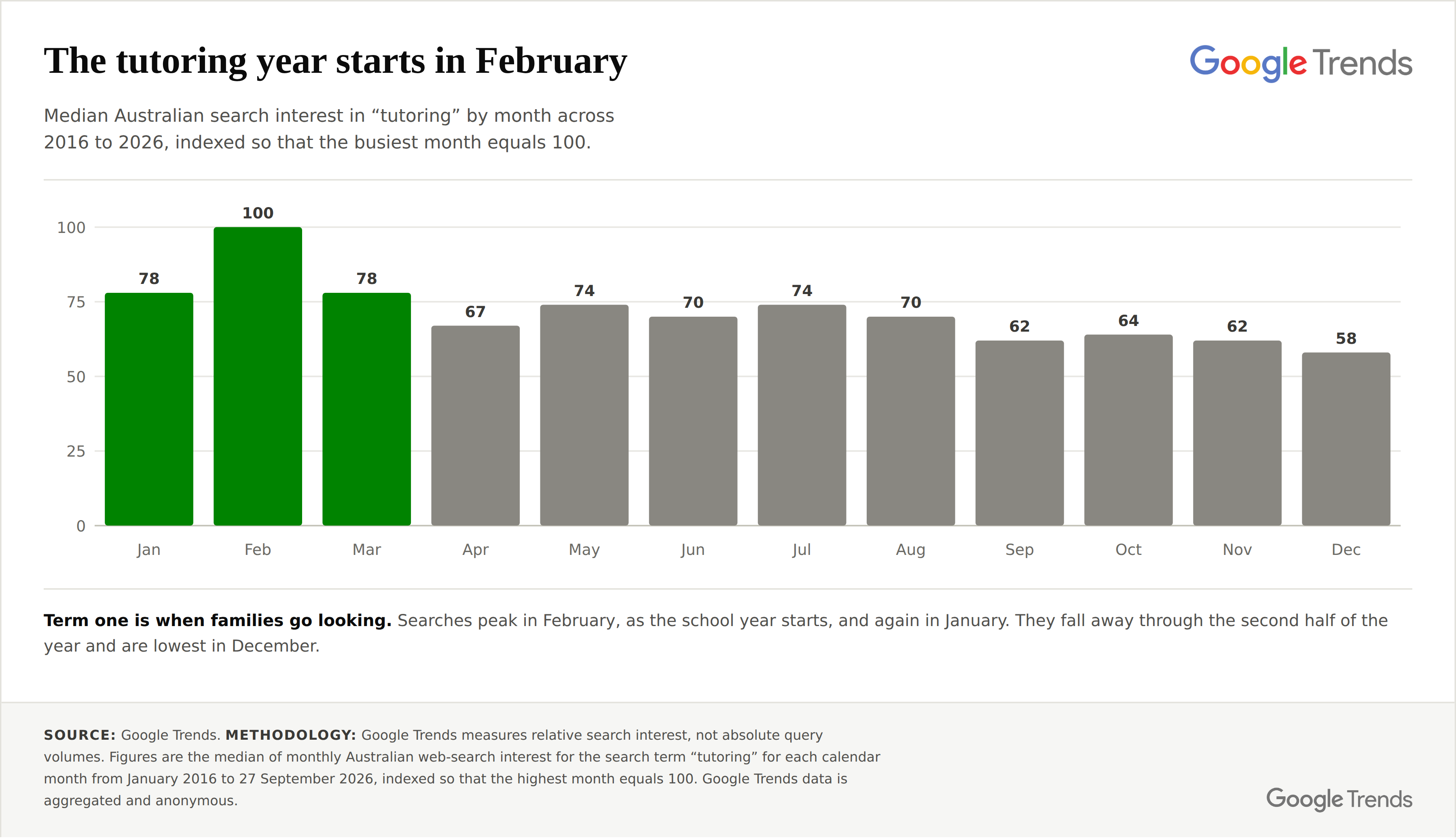
The tutoring year starts in February

Demand very much reflects the school calendar. Searches peak in February, at the start of the school year, with January close behind. They fall away through the second half of the year and bottom out in December.

Median Australian search interest in tutoring by month, 2016 to 2026. Source: Google Trends.

For schools, that is a useful piece of timing. The point at which families decide their child needs outside help is the first few weeks of Term 1, often before the first report card and before most parent-teacher meetings.

A NSW story, above all

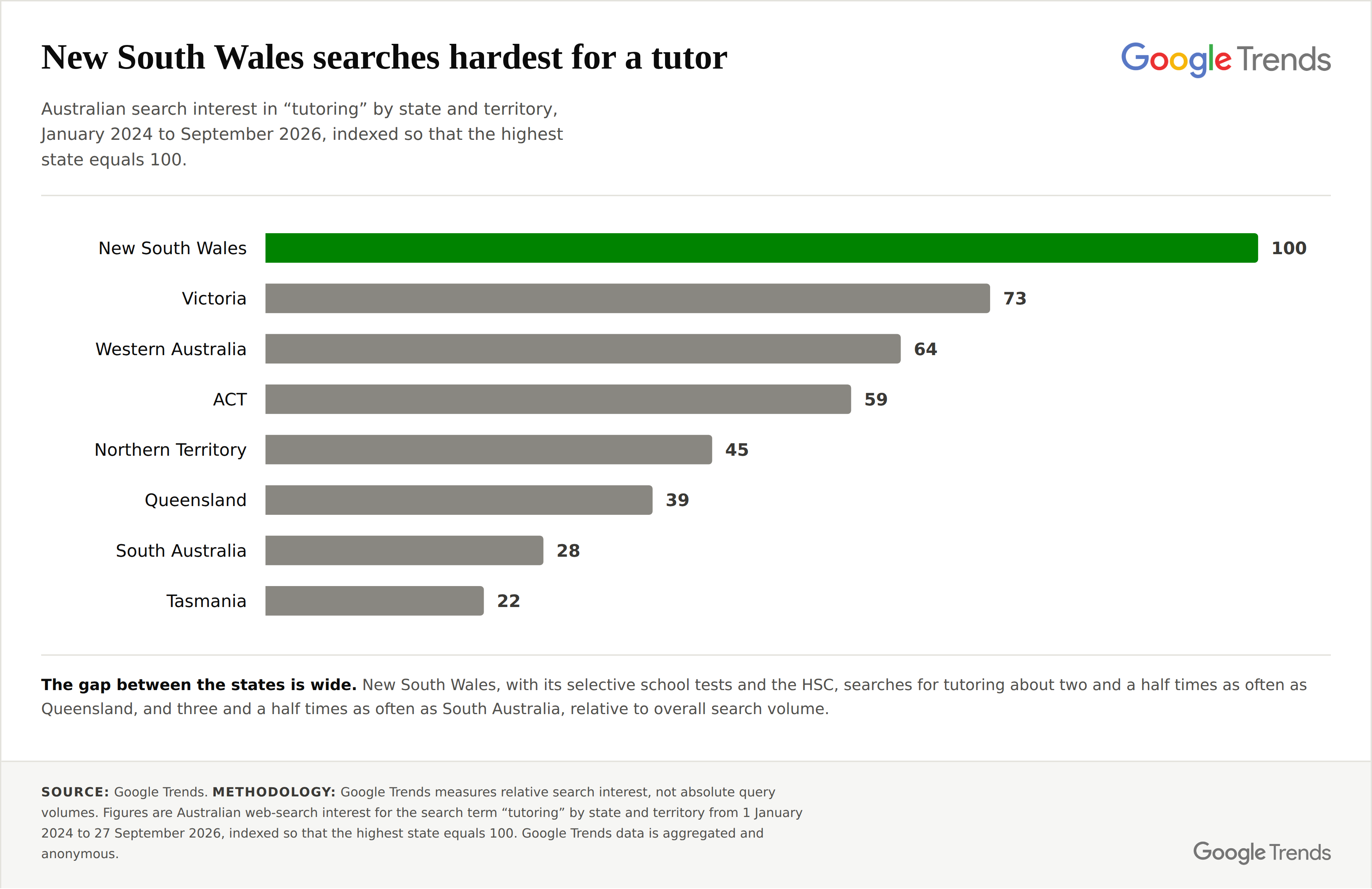
The state differences are large. Measured against total search volume in each state, NSW searches for tutoring about two-and-a-half times as often as Queensland, and three and a half times as often as South Australia. Victoria and Western Australia sit in between.

Australian search interest in tutoring by state and territory, January 2024 to September 2026. Source: Google Trends.
That pattern fits what is known about the market. NSW has the largest selective school system in the country and a high-stakes HSC, and “HSC tutoring” is among the most common tutoring-related searches nationally. Searches for “VCE tutoring” rank alongside it.

What families type, and who else is searching

The most common related search is “online tutoring”. Maths leads the subjects, ahead of English. But the second most common tutoring-related search in Australia is not from a parent at all: it is “tutoring jobs”.

The most common searches related to tutoring in Australia, past 12 months. Source: Google Trends.
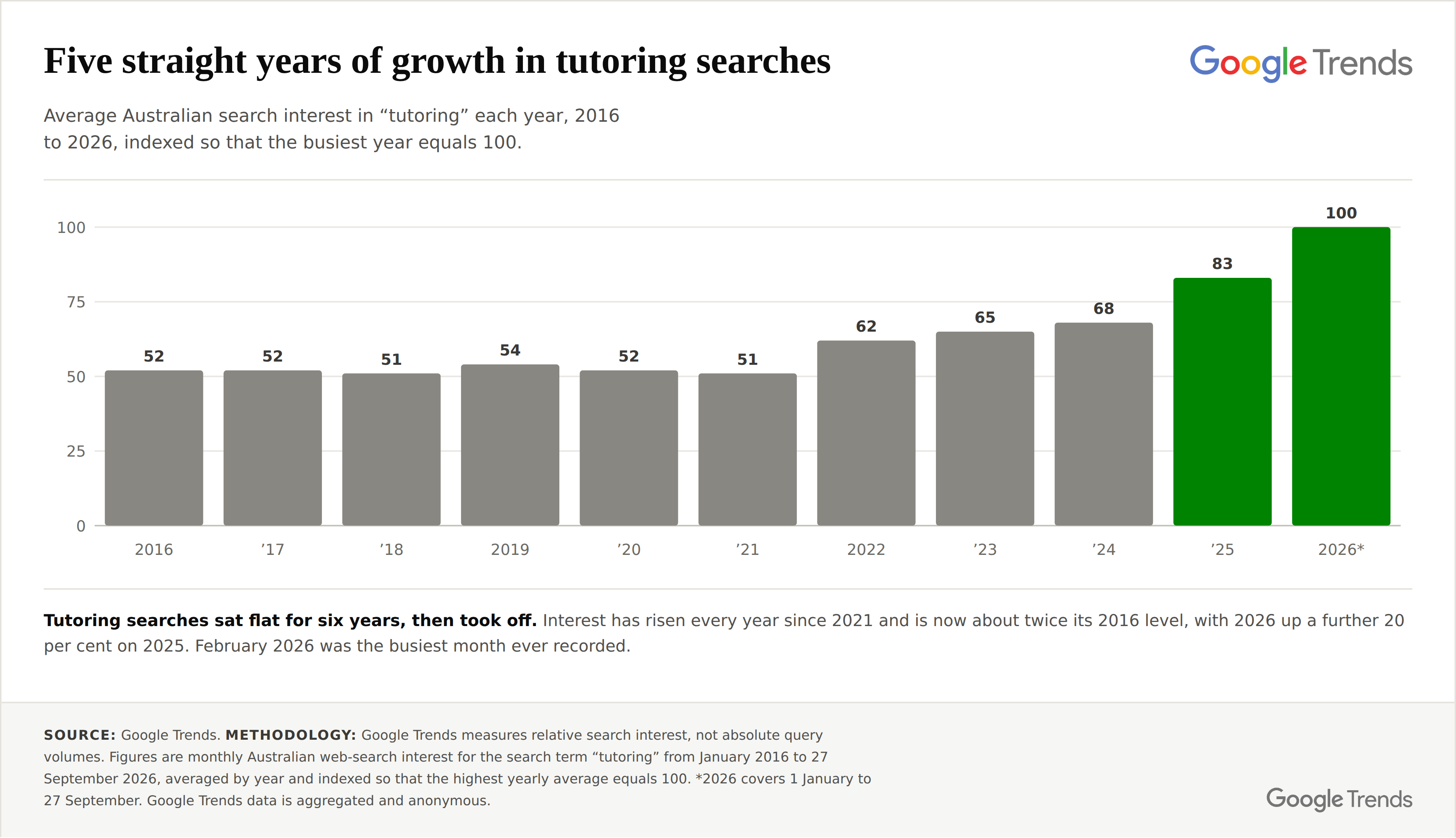
That is a reminder of the supply side of a sector with no mandated qualifications. University of Sydney researcher Dr Ben Zunica, whose team’s work on the industry was reported by EducationHQ last year, put it plainly: “You don’t need any training at all to be a tutor.” His team found fees of $80 to $100 an hour, inconsistent background checks and no national data on who is tutoring whom.

Rising searches for tutoring work also speak to the wider labour market. Searches for jobs of all kinds rose through 2026 as unemployment climbed to 4.6 per cent in August, its highest level since the pandemic.

What the data can and cannot show

Search interest is not enrolment. It measures how often people look, not how many engage a tutor, and it cannot see word-of-mouth arrangements, community language schools or the informal tutoring that happens within families. What it does show is direction and timing: demand is growing, it is seasonal, and it is unevenly spread across the country.

For teachers, the practical consequence is the one the researchers raised: a growing share of students arriving in class having already been taught the content, by someone whose qualifications nobody has checked.

About the data

Figures are from Google Trends for Australia and were collected on 28 September 2026. Google Trends measures relative search interest on a 0–100 scale rather than absolute search volumes, so figures can only be compared within the same chart, and state figures are measured relative to total searches in each state. Yearly and monthly figures use the search term “tutoring” from January 2016 to 27 September 2026. State figures and related searches cover more recent periods, as noted in each chart. Industry figures are from research by Dr Ben Zunica, Dr Bronwyn Reid O’Connor and Dr Katherin Cartwright, reported by EducationHQ in September 2025. Unemployment figures are from the Australian Bureau of Statistics for August 2026. Google Trends data is aggregated and anonymous.