With the Bard’s presence in the curriculum dwindling by the year, University of Southern Queensland (UniSQ) researcher Dr Charlie Thomson believes students aren’t rejecting Shakespeare – they just need a new way to connect with him, and hip-hop might just provide that welcome access.
He believes creative teaching approaches can improve student engagement while helping teachers build stronger classroom connections and support their own wellbeing.
Thomson is no stranger to hip-hop – before becoming a lecturer and researcher, the former high school teacher and rapper founded highly regarded hip-hop group The Winnie Coopers, whose highlights included playing the Big Day Out and one particularly memorable Good Vibrations on the Gold Coast, which featured hip-hop legends the Beastie Boys and Snoop Dogg.
“I’ve always wanted to incorporate my passion for hip-hop and music with my enthusiasm for education and Shakespeare,” Thomson shares with EducationHQ.
“I spent over 20 years in education and I just saw so many links between hip-hop pedagogy, hip-hop lyrics and music and the culture with different parts of the curriculum, but particularly with Shakespeare.”
Thomson says students can readily identify some of the poetic devices within hip-hop, and it’s a great way to engage not only students but teachers as well in a poetry unit.
“You can also take parts of Shakespeare and put it under a consistent beat, and it’s a great way to highlight rhythm and rhyme to students as well and show those links.”
Shakespeare has long been a staple fixture in most curriculums, but the Bard’s presence these days just isn’t what it used to be.
“In some systems, a Shakespearean play is not a mandatory part of a prescribed list anymore, whereas it used to be a more prominent and a compulsory part of the curriculum. But that seems to be changing where it is optional,” Thomson shares.
He says one of the other major impediments, is that Australian educators are very time-poor.

“Hip-hop is a powerful way of connecting with young people. It provides different opportunities for creative expression and encourages collaboration,” Dr Thomson says. PHOTO: SeventyFour
“One of the challenges with exploring Shakespeare is the reduced time that they have available within the senior English curriculum to be able to go into depth about a place.
“So what we’re finding is, if given the choice, some educators are choosing smaller texts that are easier to go through and analyse in a school term.
“So time constraints are impacting some of those decisions.”
There can be no argument that Shakespeare remains timeless and universal. His works are continually being reinvented and reworked – with animated versions like Nomeo and Juliet, movie re-imaginings like Baz Luhrmann’s memorable version of Romeo and Juliet (just celebrating 30 years since its release), and even the recent hit film Hamnet, which explores Shakespeare’s life.
“Shakespeare is always going to be prominent because he dealt with what it means to be human, that holds a mirror up to us,” Thomson argues.
“And I think that’s one of the interesting things about Shakespeare - because he’s dealing with what it is to be a human being, it’s always going to retain that significance and relevance.”
The Shakespeare hip-hop link evolved from an idea Thomson had while he was a secondary English teacher.
“We were studying Romeo and Juliet at the time and I had a song idea around querying who’s to blame for the deaths of the lovers, and looking at all the different characters and concepts that we can blame for their deaths.
“The song became a resource and a workshop series called The Shakespeare Sessions, and from that, I was able to see not just use hip-hop as a form to respond to a question or to summarise a play in a poem or a rap form, but looked at other elements of hip-hop, such as graffiti, which links to a visual art component, or if we look at Shakespeare, in regards to staging, set design and costuming.
Thomson says he and his students could also see a link to break dancing or the physical movement and performance aspects of the Shakespearean play and DJing being the musical component.
“And obviously Shakespeare incorporated music and lyrics and song in his works, and obviously emceeing or poetry.
“We can see that all throughout Shakespeare’s work, and one of the unofficial elements of hip-hop culture is this idea of knowledge, and I think Shakespeare deals with that concept of knowledge in regards to knowledge of self and knowledge of what’s happening in society.”
Thomson says both hip-hop and Shakespeare encourage the listener or the viewer to question different power dynamics in society, question who’s loyal to them and who they are as individuals.
“So those bigger philosophical questions are evident not only in hip hop music but also in Shakespeare as well,” he says.
The academic has now produced a 12-track hip-hop concept album inspired by Hamlet a way of illustrating his ideas.
“One thing I do talk a lot about is how much of Shakespeare’s work contains iambic pentameter, so it has a rhythm and a structure to lines that have been constructed.
“I like to highlight to students that if we can identify the number of syllables and rests in a line, we can start formulating a greater appreciation for Shakespeare and his masterful control of language.
“And so, we get students to try: ‘can you write in that rhythm, can you imagine writing a whole song with that timing or structure, can you imagine writing 37 plays that way?’”
By looking at the iambic pentameter structure and then linking that to contemporary hip-hop or musical time signatures, Thomson says students can start to get a greater appreciation of how Shakespeare was able to not only fit to a certain rhythm or timing structure, “but the language had this depth and beauty to it”.

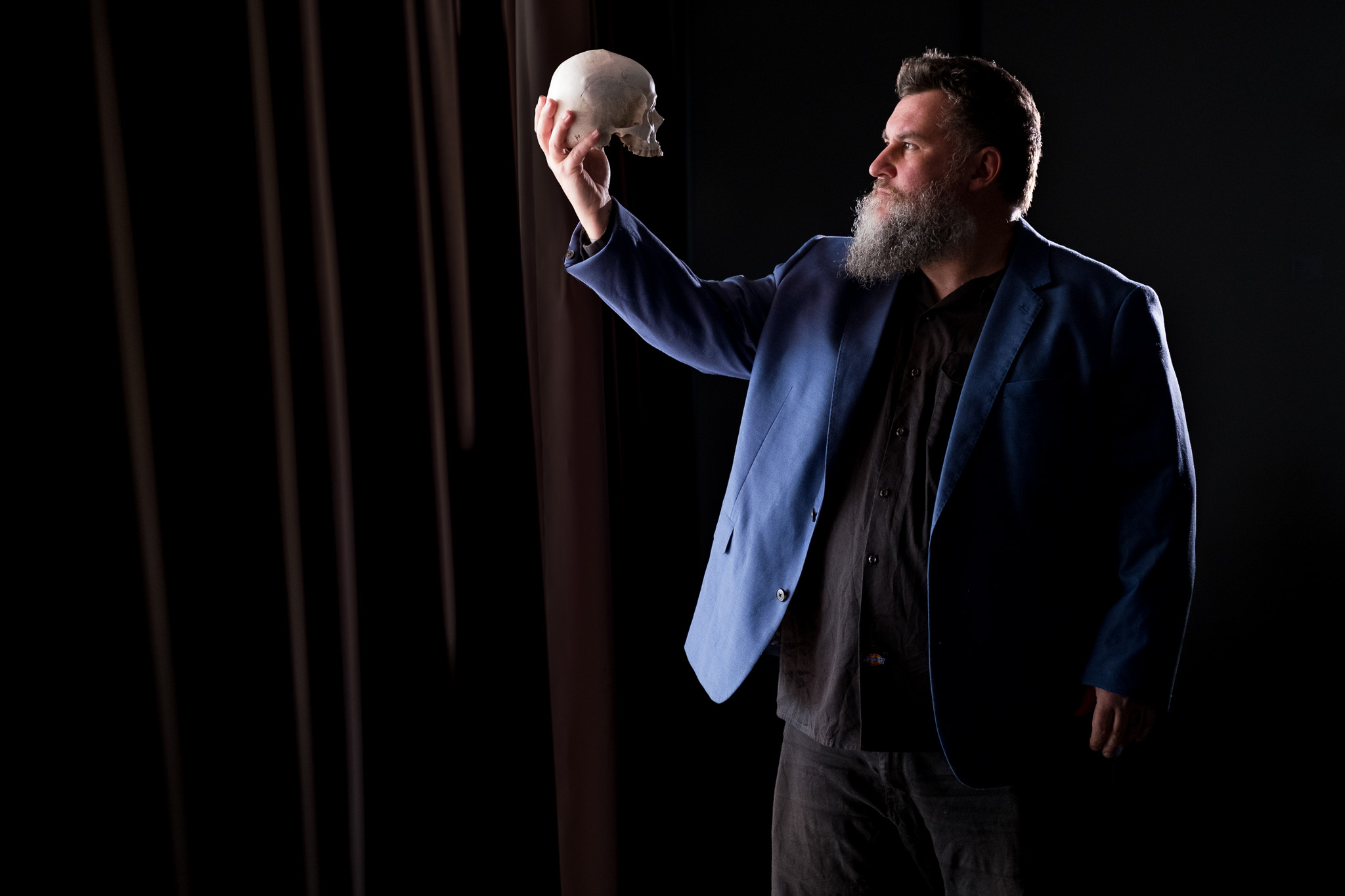
Although hip-hop and Shakespeare may initially seem worlds apart, they have more in common than people might think. Thomson says both are built on storytelling, rhythm, poetry and asking difficult questions. PHOTO: Leon Hellegers
A big part of Thomson’s approach involves developing an appreciation for Shakespeare first, and one of the strengths of his work is that it also allows us to reinterpret the work through different contexts.
“I would encourage both teachers and students to ask questions about what they think is a particular meaning - because that’s a great thing about Shakespeare, it can be interpreted in different ways and in a hip-hop sense remixed or reinterpreted in different ways as well.
“But, if you want to change the meaning or the context or the structure of something, you first need to understand the original text first.
“I think that’s, you one of the strengths of Shakespeare’s work.”
Thomson is putting his approach into practice with Year 10 students at Bellbird Park State Secondary College through a Uni-SQ in-school enabling program designed to build pathways to higher education.
“I’m working with a class of students all from non-English speaking backgrounds and one of the great things about working with this cohort of students is how hip hop music has been able to assist me in breaking through different language barriers or communication issues with a wide range of students.
“It’s been a great way for students to develop their literacy and communication skills through writing and presenting raps throughout the course and this idea of - hip hop discusses this idea of being able to show and prove what you do so there’s a real encouragement within the class for students to collaborate with others but also share their work with others.
“This is a great way of building positive relationships within a classroom and also highlights the, I guess, the universal power of music and specifically hip hop in engaging students from a diverse range of backgrounds.”
Dr Charlie Thomson’s latest research, published in the Australian Journal of English Education, explores how hip-hop pedagogy can help students engage more deeply with Shakespeare while building literacy, critical thinking, questioning skills and classroom participation.