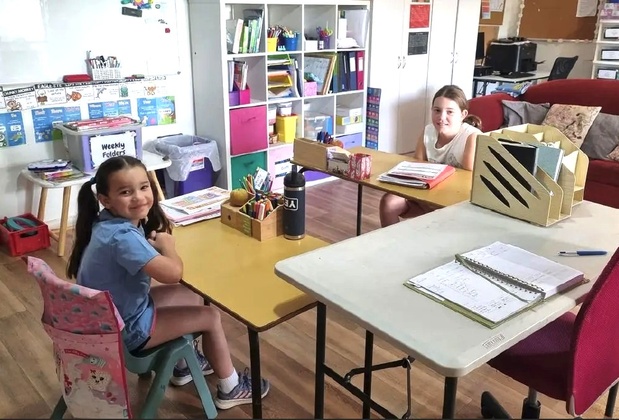
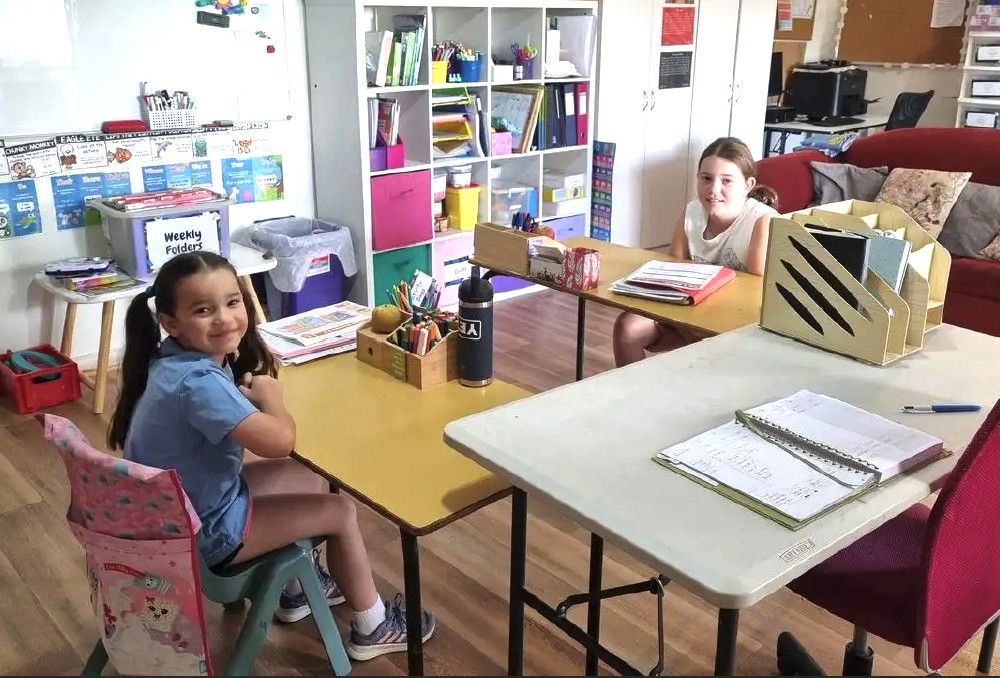
“There’s definitely no average day,” the eight-year-old’s mum, farmer Rebecca Pearce, says during a break from herding cattle.
Pearce, who lives on a station 300 kilometres northeast of Broken Hill, in far western NSW, splits her days between managing livestock and supervising Matilda’s learning.
A trained teacher, Pearce has spent more than a decade getting her four daughters through distance education via School of the Air, with the local school a three-hour drive from the farm gate.
Despite support roles being salaried positions in schools, she has never been paid for supervising her children’s education.
Her critical work in the station’s dedicated school room takes her away from full-time labour on the farm, affects productivity, household income and has created a significant career gap.
“I’ve got no recognition for all these years of work that I’ve put into a supervisor role,” she said.
Pearce is among many remote parents – mostly women – across Australia who have had to give up paid employment and limit their contribution to farming to oversee their children’s education.
The Isolated Children’s Parents’ Association has been pushing for a home tutor payment for 50 years to better support households and boost women’s participation in the workforce.
Over those same decades, Australian women have experienced sweeping workplace reforms, including the right to equal pay, outlawing of gender discrimination and maternity leave entitlements.
But those benefits have not flowed to women in rural and remote areas, association president and Queensland farmer Louise Martin says.
“Women have sacrificed employment, superannuation and any other career possibilities in order to educate their children,” she says.
“They do it in a very passionate way because they’re invested in their children’s education but it has come at a cost.”
The association spent a week in Canberra in November lobbying for a tutor payment, continued funding for mobile early education services and living-away-from-home allowances.
Representatives from ICPA Australia’s Federal Council met with MPs and departmental officials, including the Assistant Minister for Social Services Ged Kearney, Senator Pauline Hanson and former Nationals leader David Littleproud, to press for urgent reform of support measures that have failed to keep pace with the realities of regional life.
The reps also lobbied for an increase to boarding subsidies for remote students who do not have daily access to a physical school.
The allowance was introduced in 1973 but has not kept pace with rising school fees and inflation.
Quality education should not be a postcode lottery, Martin says.
“We are contributing to the bottom line of this country,” she says.
“We shouldn’t be penalised.”
Pearce’s eldest daughter is studying at university, while her 16 and 13-year-olds are at boarding school in Tamworth, northern NSW, about 1000km from home.
The vast distances covered and sacrifices made to see her daughters flourish have not been a matter of choice, she says.
“We don’t have five schools, choose which school we like and then put a kid on a bus,” Pearce says.
“Every Australian has the right to live anywhere they want.
“We provide food and fibre for the country, we live here because we love it.”
(AAP)