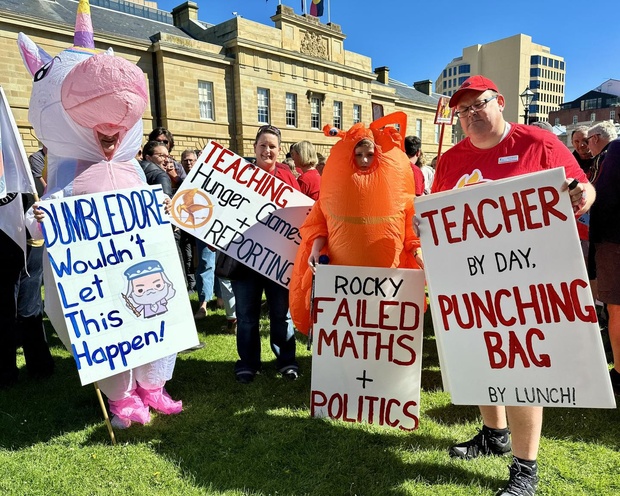

Thousands of teachers, health workers, firefighters and other state servants rallied outside the state’s parliament house in Hobart on Thursday.
The stop-work action followed protests in Burnie, Devonport and Launceston on Tuesday and Wednesday, which forced schools to open several hours late.
The Rockliff Government has offered a one-year, three per cent pay rise across the public sector while longer-term deals are negotiated.
Unions say the offer is not up to scratch and does not address specific issues, such as overtime and leave, in each sector.
Wage agreements for 16 state sector enterprise bargaining deals are up for renewal this year, with educators joining health and community service workers in rejecting the blanket Government offer.
The Australian Education Union (AEU) said the government schools offer equates to a refusal to fix workload, classroom violence, and educator shortages until at least 2027.
AEU Tasmania Branch president David Genford said huge turnouts at each of the rallies this week has shown the depth of concern public service workers in the state have about the Government’s poor handling of agreement negotiations.
“It was really encouraging seeing the different public sector unions coming together, standing as one,” Genford told EducationHQ.
“It was great to be able to hear from members, I think that it really resonated with the crowd.
“They heard people from different industries and they really feel as though they’re being treated the same way by the government; they want to be treated with respect and they were standing up for it.”

The AEU says it wants Premier Jeremy Rockliff and Education Minister Jo Palmer to sit down with them to look at what can be legitimately done to try and ease the workload on teachers and support staff, to in turn encourage people to stay in the profession. PHOTO: AEU Tasmania Branch
Speaking at the Hobart rally yesterday, Jake, a teacher, said workloads are unsustainable, classrooms were unsafe and his colleagues were forced to “put up with it” because they cared about their students.
“This job is not sustainable. The workload that we are given is not sustainable,” Jake said.
“Over the ten years that I have taught, every single year the government adds more and more things to our plate – more expectation, more admin – the only thing they don’t add is time and they know it.”
Several speakers criticised the government’s planned $1.13 billion spend on a new stadium and a recent $75 million bailout of Bass Strait ferry operator TT-Line.
“They’re quite happy to throw money at things like TT-Line and the stadium … but there is not enough money for you,” Jake, who did not want his last name to be used, said.
“What the Government needs to understand is that we are not going to stop. This is just the beginning.”
Genford said unfortunately planned meetings with the Government this week had been cancelled.
“We’re hoping that we’ll be able to reinstate those meetings for next week and actually be able to have some legitimate conversations,” he said.
“The only way forward is to show that we can make meaningful changes in schools themselves and not simply kick the can down the road like we’ve seen in the agreement that the offer that’s been put forward to us.
“We haven’t seen any movement, but we are prepared to give the Government a chance to be back at the table and to show that there’s meaningful discussion – otherwise, we will need to see an increase in industrial action before the end of the year.”
Despite schools opening late on different days this week, Genford said teachers had been buoyed by the support of parents and others in the broader school community.
“Usually I don’t advocate for people to read comments on social media, but you always have a little bit of a squizz,” he said.
“And when the comments on social media are 90 per cent positive, you know you’ve got great community support.”
People understand what’s going on, Genford said.
“They want to see what’s best for their children in schools, they want to see their health services up to scratch, and people being treated with respect as well.
“When you hear from teacher assistants speaking at the rallies, as well as teachers, the stories of what’s going on and not being paid 52 weeks a year, dealing with our most vulnerable kids, really loving their career and desperate to remain in the sector, but it’s just not financially viable to have that as your only job – I think that really hits home with people.”
Teachers’ aide Natalie Barkoczy said she worked with vulnerable students but was under-resourced and treated like a glorified babysitter
“Not one of us here wanted to have our school closed,” she said.
“But it seems this is the only measure we can take for our concerns to be listened to and hopefully taken seriously.”
Premier Jeremy Rockliff has described the three per cent offer, which includes changes to conditions such as parental leave, as fair and affordable.
The offer was almost double Tasmania’s annual inflation rate of 1.7 per cent and demonstrated genuine support, he said.
Tasmania’s debt is set to grow to $13 billion by 2027/28, with Treasury warning “corrective action” is needed to address the deterioration.
(with AAP)