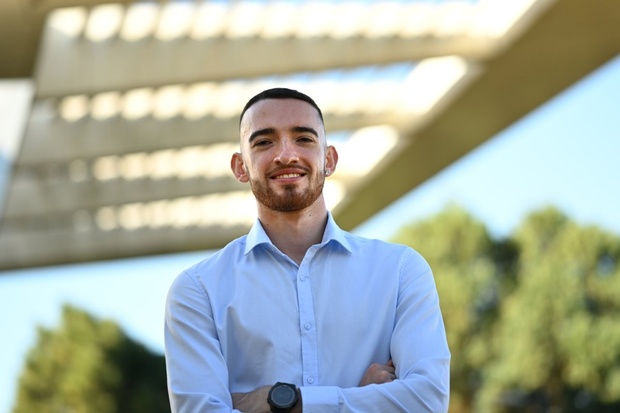
He remembers wearing the same pair of shoes throughout primary school and not having his first laptop until high school.
His vocabulary was also behind his classmates, he says, because there were words and opportunities he had not encountered.
“It feels like it’s almost like living under a rock,” Bow says about growing up disadvantaged in Campbelltown.
But he always had an ambition to do well.
“I always knew that I wanted to achieve really high results,” the 23-year-old says.
“I was always putting 110 per cent in.”
These days, Bow is working full-time while studying for a degree in mechanical engineering at the University of Wollongong.
His journey from disadvantage to university has been helped by The Smith Family’s Learning for Life scholarship, but he also took an unconventional education pathway.
Bow wanted to study mechanical engineering but, like many disadvantaged schools, his school did not offer the advanced mathematics subject required for the university course.
Instead, he completed a Diploma of Engineering at college before transitioning to university.
The diploma provided a fast-track route into his chosen degree.
Now Bow is working as a mechanical engineer specialising in heating, ventilation and air conditioning while completing his studies.

The Smith Family is calling for young Australians experiencing disadvantage to have greater exposure to careers education and vocational education and training pathways while still at school.
He has worked throughout university, including three years combining full-time work and study.
“There hasn’t been a day that I haven’t been working,” Bow, who runs ultramarathons in the little spare time he has, says.
His story comes as The Smith Family calls for young Australians experiencing disadvantage to have greater exposure to careers education and vocational education and training pathways while still at school.
New data from Jobs and Skills Australia shows the number of VET course completions aligned to occupations in national shortage rose 26 per cent from 369,719 in 2020 to 467,245 in 2024.
The latest National Skills Agreement Balanced Scorecard also found 88 per cent of VET graduates were participating in the workforce after completing their qualification, up from 84 per cent the previous measured year.
The report says clear career pathways, evidence-based career decisions, work-integrated learning and wraparound support are among the conditions needed to ensure VET translates into workforce outcomes.
The Smith Family chief executive Doug Taylor says young people needed to understand the range of pathways available to them beyond school.
“As entry-level jobs become harder to secure, it’s more important than ever that young people understand the different pathways that can help them build rewarding careers, including vocational education and training opportunities that are closely linked to workforce demand,” Taylor says.
For Bow, his scholarship’s impact went well beyond financial assistance.
The first time he received money from someone he did not know, he realised someone outside his immediate family believed in him.
“The first time I got money from someone who I had no idea who they were and they had belief in me and had faith in me, that’s when I ultimately was like, OK, I can’t let this person down,” he says.
He began staying at school until 4pm or 5pm with teachers, putting in extra hours to improve his results.
“I almost had no life – just every day making sure I was at school getting good grades and results,” he says.
He eventually achieved the results he was striving for.
The Smith Family says its Learning for Life program provides financial assistance for essentials including uniforms, textbooks and digital tools, along with family support and access to literacy, numeracy, digital, mentoring and career programs.
More than 71,000 families are currently supported through the program.

The Smith Family’s Learning for Life program provides financial assistance for uniforms, textbooks and digital tools, along with family support and access to literacy, numeracy, digital, mentoring and career programs.
Taylor says access to careers knowledge was not equal for all young Australians, with some parents and carers lacking the professional networks needed to help children understand the opportunities available to them.
“For many young people, access to careers knowledge isn’t equal,” he says.
“Parents and carers may have limited exposure to today’s workforce and early career pathways, and may not have access to the professional networks that help young people understand the wide range of opportunities available to them.”
Asked how his life might have turned out without the scholarship, Bow admits he does not know.
“I’ve been trying to reflect on this as well and I actually have no idea,” he says.
But he has seen what happened to some people around him.
“A lot of my friends, they diverted to drugs ... this gave me a lot of direction,” he says.
Bow says overcoming difficult challenges has changed his perception of what is possible.
“Once you do something really hard and you kind of break that barrier, it just breaks that fear,” he says.
His ambitions have also grown as his world has expanded.
Asked what he would say to another child growing up in poverty, Bow says he would not begin by asking what career they wanted.
“I would ask this person what his dream is,” he says.
“A lot of people don’t get asked the question – why are you doing what you’re doing?
“If you can spark or see something within them, that’s when ... the world becomes your oyster.”
AAP