
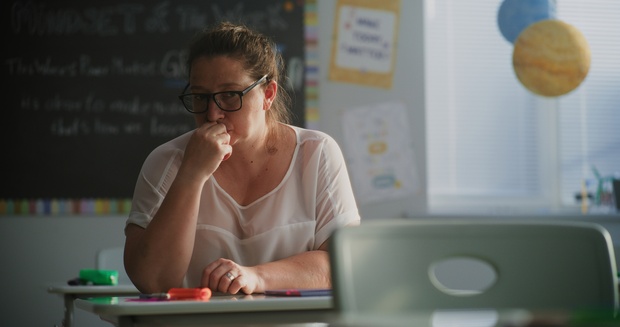

A growing body of recent research has flagged the widespread escalation in sexist and misogynistic behaviour directed towards teachers by students, colleagues and, in some cases, parents – a phenomenon that has been reported across all states and school sectors and which most often echoes the language, attitudes and worldview of online ‘manfluencers’, the likes of Andrew Tate.
Now a new Monash University study involving more than 2600 AEU members has confirmed the extent to which sexism and misogyny dictate the everyday realities of those in school workplaces.
It has also highlighted the severe policy shortcomings that researchers suggest are putting teachers at risk of harm.
Tellingly, some 78 per cent of teachers reported observing or experiencing sexism or misogyny in their school, while one in three observed or experienced it frequently.
Half of all teachers surveyed said there had been an increase in sexist or misogynistic behaviour among students, and one in three said they encountered it frequently.
On average, teachers said that misogyny from parents had increased in the past year, but amongst staff it had decreased.
“There has been a definite increase. So many male students think nothing of speaking about women in a derogatory way. The language and intent and profanity, misogyny has risen to a horrific level among male students at my workplace,” one teacher in the study shared.
One third of teachers said gendered violence causes them to occasionally consider quitting teaching, and 16 per cent said they very often consider leaving because of it.
“I should be able to come to work and have a safe working environment. The increase in sexism and misogyny in schools has made many schools increasingly unhealthy and toxic workplaces. I would not be expected to put up with this behaviour in any other profession however because we work with children, we are expected to put up with it and just ‘teach them it’s not appropriate’.
“If I worked in another job, there would be consequences for these actions and I would feel safe,” one teacher argued.
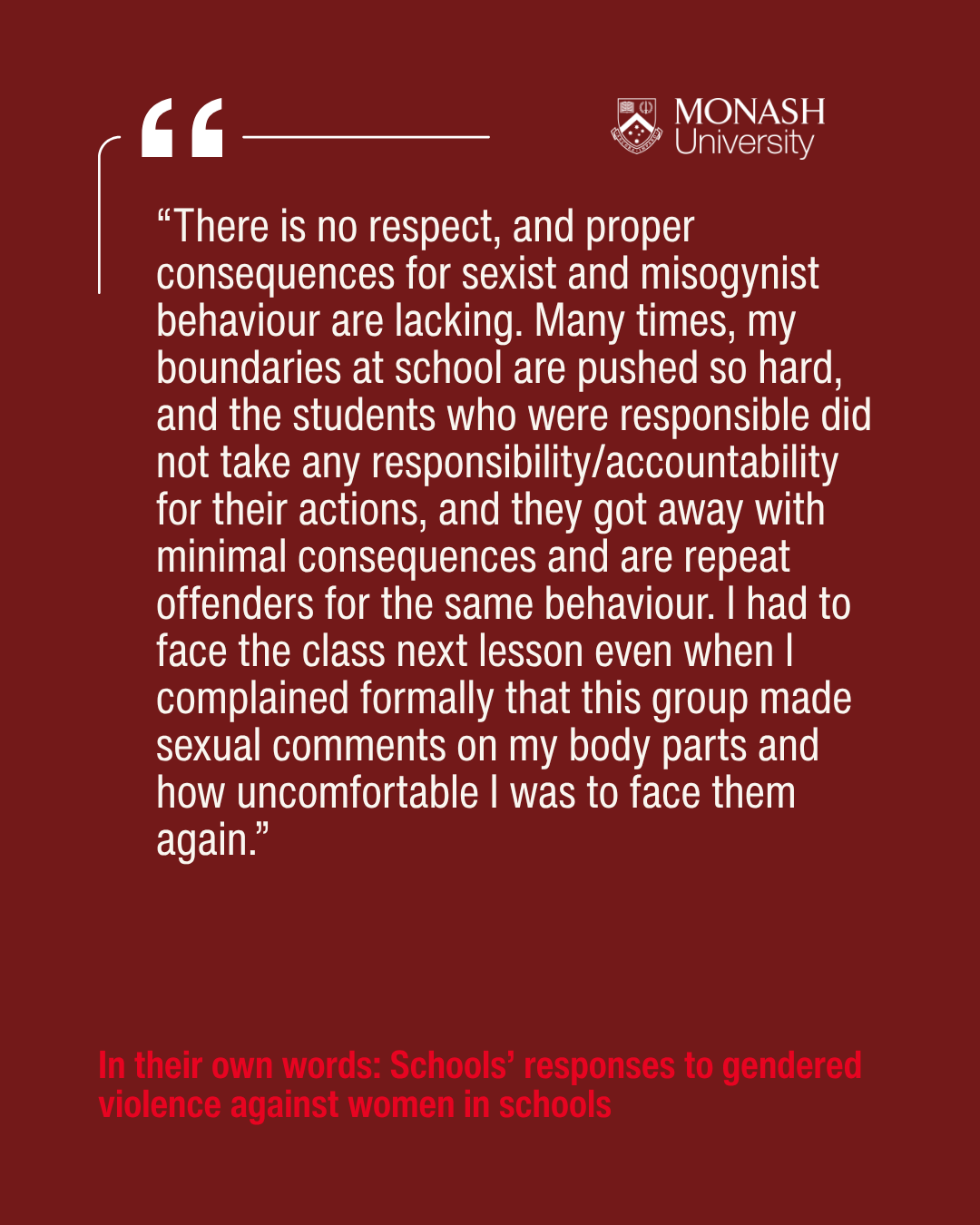
Sexism was observed by teachers in two main modes: explicit, overt behaviours (such as physical intimidation of female teachers, arguing with female teachers’ authority, and gendered slurs) and implicit, subtle behaviours (such as ignoring direction from female teachers, dismissing their authority, and making sexist jokes).
Teachers saw parental reinforcement (that is, permissive parenting or the modelling of sexist attitudes at home) and inadequate institutional responses as key enablers of these behaviours.
Meanwhile, 95 per cent of teachers said they believe that at least some of their students access manosphere content, and 70 per cent have seen the influence of manosphere ideas on student attitudes and behaviour in the past 12 months.
The study suggests that system responses often fail to keep pace with the changing nature and severity of gendered violence, with many teachers describing uncertainty about policies, inconsistent responses to incidents, and the system’s lack of capacity to effectively prevent and respond to sexism and misogyny.
Indeed, some 40 per cent of teachers reported their schools don’t have clear policies on responding to sexism and gender bias.
One teacher said that female staff at their school had been sexually harassed by students and were now reluctant to come into work.
“Female students are also starting to avoid school based on how male students have been treating them,” they added.
One educator noted they had “personally experienced and bore witness to male students verbally and physically assaulting female staff and sexually harassing staff both in and outside the classroom”, only for this to be “considered as students simply ‘misbehaving’”.
“Now, in addition to these, sadly common, traumatising experiences, we are facing a daily struggle against pervasive misogynistic ideas in our classrooms and out in the yard, undermining our ability to effectively teach and eroding our self-worth,” the teacher added.
One teacher revealed they were leaving their public school at the end of this year to take up a position in a girls-only Catholic school, saying “it breaks my heart to leave the public education system I have championed for two decades”.
Lead author and former teacher, Dr Stephanie Wescott, said our public schools are workplaces first and foremost.
“Schools employ hundreds of thousands of Australians, the majority of them women, and they are governed by the same workplace health and safety and anti-discrimination laws that apply across other businesses and organisations,” Wescott said.
“Educators are skilled and essential workers who make valued contributions to Australian society, yet, for many teachers, schools have become unbearably hostile places to work, with levels of sexism, misogyny and sexual harassment that have made their jobs untenable.”
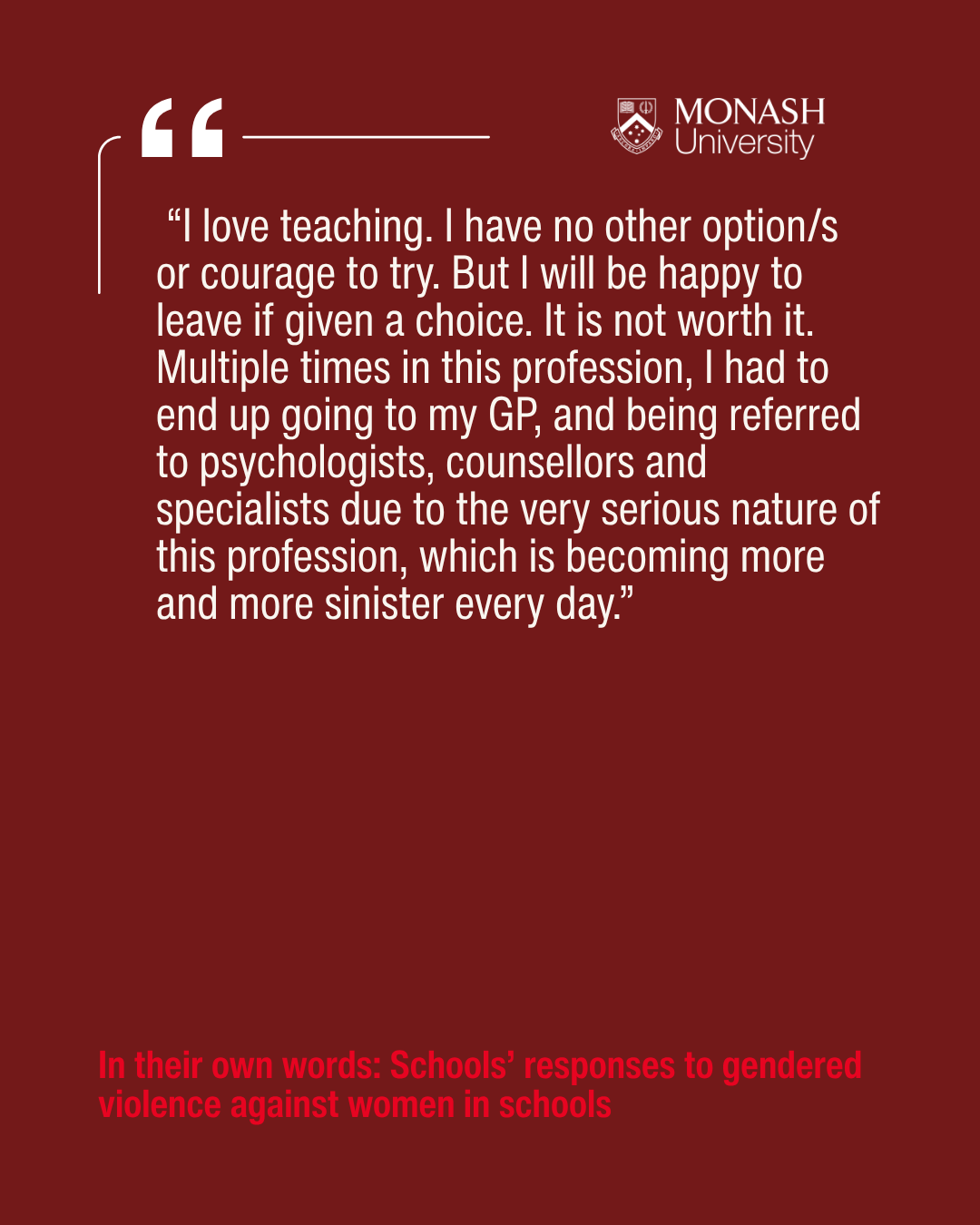
Co-author Professor Steven Roberts argued the findings make it clear that urgent political attention and action is needed.
“Our research in the last three years has documented a large number of stories of misogyny faced by teachers in schools, indicating a resurgent form of brazen ‘male supremacy’ among boys and young men.
“Now, in addition to understanding the shape and experience of the problem, the data in our research report today signals the scale and prevalence of the problem nationally…”
The researchers warned that incidents of gendered violence in schools continue to be treated as isolated and rare occurrences within separate schools.
“This positioning does not identify its systemic nature, its embeddedness in school cultures, nor the opaqueness of policies designed to support staff safety. Both the scale and consistency of teachers’ experiences, taken alongside the extensive body of scholarly literature, reveal a critical gap between the realities teachers face in their classrooms daily, and the systems that are designed to respond and protect,” they concluded.
It is unreasonable to expect schools to respond to these harms purely through the efforts of individual leaders and teachers or via isolated programs, they noted.
“The data in this survey compel a stronger and more transformative response: addressing gendered violence in schools must be treated as a core responsibility of education systems and a national priority for preventing violence before it occurs,” the report flagged.
AEU Federal President Correna Haythorpe said the study shows the risks misogynistic behaviour poses to the teaching profession as a whole if it is not addressed by Governments.
“This behaviour is disrupting girls’ education and driving teachers out of the profession at a time when Australia is already facing a teacher shortage,” she began.
“These issues cannot continue to be dismissed or ignored. Schools and school leaders should not be expected to deal with these issues alone. This is a systems issue that requires a systems solution.
“Schools need strong support from Governments and Education departments with clear policies, proper resourcing and strong leadership to challenge misogyny and support safe workplaces and learning environments.”
Researchers have called for governments to urgently address workplace health and safety requirements and establish effective policy and protocols to better support schools.
They say governments must also ensure adequate access to workers’ compensation for teachers who have experienced workplace sexual and gender-based harassment and other forms of gendered occupational violence, among a host of recommendations put forward.
“At a time of persistent teacher workforce shortages, creating school workplaces that are free from harm is a moral responsibility and a social, educational and economic imperative,” Wescott said.