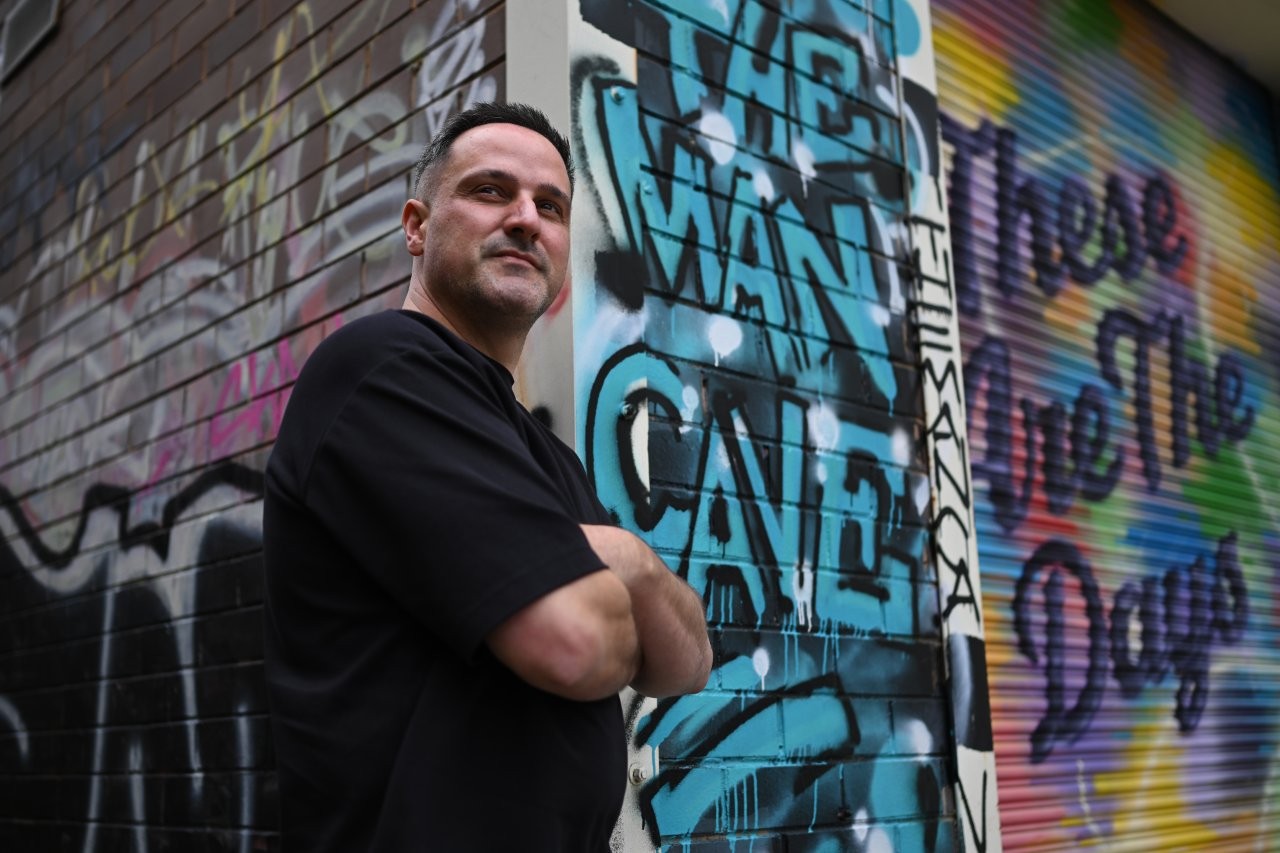
He has just clocked up 18 months as CEO of men and boy’s preventative mental health charity Man Cave, where he has increased outreach by 40,000 boys.
This is despite only nine per cent of government investment in their programs teaching boys and young men about emotional vulnerability, gender equality and healthy masculinity.
“We’ve gone from working with about 80,000 boys in our first 10 years, to now working with 120,000 boys. The need and demand is significant,” he says.
“We’re motivated by the fact 75 per cent of all suicides are still men but the vast majority of violence against women and children is perpetrated by men.”
One government-backed initiative is Man Cave’s healthy masculinities trial, educating boys about consent, control, boundaries and emotions.
At the start of the program about 31 per cent feel comfortable talking to mates about their feelings.
By the end, it’s 75 per cent.
“That’s the definition of courage, being willing to talk to your mates about what’s going on in your life,” Vasiliou says.
He points to a wall inside Man Cave headquarters, which is down a lane surrounded by cafes and boutique bakeries in Melbourne’s trendy Brunswick.
Photos of a dozen diverse young men who help run the workshops adorn the space.
They share their experiences to encourage the boys to open up, something Vasiliou says comes from traditional First Nations storytelling.
“It’s actually based on ancient rights of rites and the boys challenge each other.
“We look back on First Nations culture, storytelling and dream time ... How have I showed up in history and what does that look like for me?”
Vasiliou is also using storytelling in a new book.
Better Man: Promoting Masculinity for Good offers a guide to modern manhood for parents, educators and boys, drawing on two decades of work as well as his own experiences.
“If we can work with boys to understand what modern masculinity looks like, what modern manhood looks like, it’ll benefit them but it’ll also our strive for gender equality,” he says.
The term toxic masculinity is increasingly being attached to all masculinity, which Vasiliou says lacks nuance.
“What I talk about is a more expansive masculinity.
“The traditional parts – growing up, being taught you should live a life of service, have courage, have strength, be a provider, be a protector, love and care for your family – all beautiful things.
“But when they’re used in isolation they become dangerous, that’s where dominance, control, entitlement comes in.”
When Vasiliou was 11, his dad went to a work Christmas party and “basically just didn’t come back”.
“He became addicted to heroin, just like that,” he says.
“Left mum and us three kids and it was turbulent for the next few years because he was just in and out of our lives. He’d steal stuff from the house.”
His mother was then diagnosed with cervical cancer and died when Vasiliou was 16.
“I started to go off in the wrong direction; I was at a fork in the road and I chose the wrong bit – party, drugs, the wrong crowd,” he says.
A youth worker helped get him involved in raising money for charity, with the pair starting a foundation in Bali.
Vasiliou also became a young father and faced his own identity and mental health crisis.
He says a “mask of masculinity” prevented him coming out as gay until he was 28, and he experienced suicidal thoughts during this time.
“I was like, ‘I’m going to kill myself instead of telling people that I’m gay, would I rather have children with a dead dad or children with a gay dad’?
“And when you unpack all of that, you’re like, ‘It’s because I don’t feel manly enough or my mates are going to hate me or I didn’t feel safe coming out as a kid.’“
These realisations and working extensively with disadvantaged kids as Youth Projects chief executive brought home the importance of early intervention.
“I started to understand that if we don’t get in early, particularly with boys, boys will harm themselves and harm others,” he says.
Boys need to learn emotional literacy, compassion, respect, boundaries and the importance of gender equality from a young age.
Man Cave’s foundational programs are delivered in Victorian schools from grade five and teach about self, relationships and boundaries.
“Life shifts really quickly for teenage boys,” Vasiliou says.
AAP
Lifeline 13 11 14
beyondblue 1300 22 4636