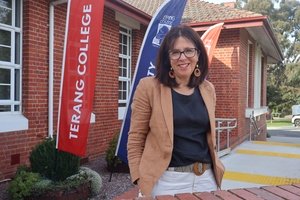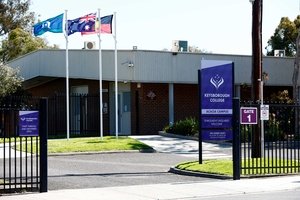
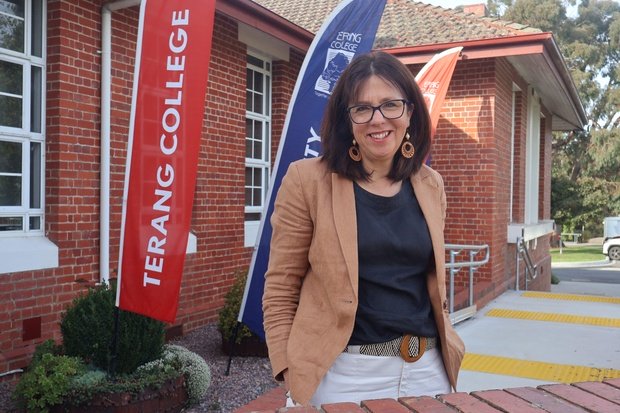
So says principal Kath Tanner, who has overseen a successful school-wide instructional shift at Terang College that has worked to ensure all teachers’ instruction aligns with the science about what works best.
When Tanner took up the role five years ago she says there was obvious inconsistency in teachers’ practice, with varying ideas about what effective literacy instruction entailed.
In the lower primary years, you could expect to see a familiar classroom scene play out as children were being taught to read, Tanner explains.
“There was still a lot of what we used to call the early years model, and so it would be whole class reading of a book or something like that, and then [the class] would break into small groups.
“[They] would be doing different things, working independently, and not having the attention and focus of a teacher (except for one group).”
While this appeared to give the impression students were highly engaged amid a flurry of learning activity, the reality was there was negligible reading progress being made, the principal says.
This approach was especially ineffective for those children at risk of falling behind in reading and who were in need of more intensive instruction, Tanner adds.
“They were doing busy work, but it wasn’t really effective teaching or learning for students ... the research says that novice learners need explicit teaching
“[The approach was not] targeted, or scaffolded to be building on schema – it was really just to facilitate the teacher being able to work without interruption with one group of students.
“It was hard to see the benefit of it.”
Reading instruction now looks markedly different at the college.
“We took out all the groupwork and we have whole-class instruction all the time, I'm a really strong advocate for doing this,” Tanner shares.
The school's F-2 reading approach has been refined with a strong focus on the teaching of systematic synthetic phonics and phonemic awareness every day, along with fluency routines, vocabulary and a rich text curriculum.
Meanwhile, students in Years 3-12 are taken through embedded practices including fluency routines, vocabulary lessons and a strong text curriculum that uses the Read, Discuss, Vocab, Write model to bolster comprehension skills and content knowledge.
This improvement agenda was underway well before the Victorian Government implemented the VTLM 2.0, the principal says, and so guidance from the Department was scant at the outset.
“What I really wanted was more teacher-directed instruction for students, and I wanted learning to be scaffolded – and what I mean by that is I wanted students to master a skill before they learnt the next skill in the order of learning,” Tanner says.
There are three key levers that were critical to the success of the instructional overhaul, Tanner says, the first being drawing on external expertise to set change in motion.
“I’d seen (these experts) at different conferences and so forth, and their philosophies really aligned with mine - people like Emina McClean and Bronwyn Ryrie Jones,” Tanner says.
“These really amazing experts hold a lot of credential amongst teachers, when they speak teachers really listen because they've both been teachers and they're very popular, because they go ‘you get it, you know what it's like’ – they've got that lived experience
and give teachers feedback and coaching as they go.”
Identifying a number of ‘early adopters’ – staff who are informed, open and or/willing to change their practice – is also critical, the school leader advises.
“If you can utilise them then you've got a really good chance of creating change.
“After a while other people see that [improved practice] in action, see the results, and then before you know it you can get everyone on board. We've been able to do that…”
The leadership team also took the time to look carefully at other schools who had successful literacy models in place and that were achieving incredible results.
Bentleigh West Primary School in Melbourne was one, Tanner says.
“We looked at their practice and then we had to try to contextualise that for our school ... they're (in) a more affluent suburb and are a primary school, whereas [we serve] quite a disadvantaged cohort in rural Victoria.
“So, it was taking what they did and then trying to make it specific to Terang College.”
Students now spend two hours a day on literacy, the principal reports, with the last chunk of this time focused on the school’s rich text curriculum.
“We take really rich, authentic texts and the teachers use them to build comprehension skills and to also build writing skills.
“So, everything is connected to that text – you might find that there's vocabulary connected to the text, so they learn rich words to use in their writing and to explain what they're thinking, and they might use punctuation and grammar that's connected to the story, as well as different writing genres,” Tanner says.
Visitors may be surprised to walk into a Year 1 class and find children with novels in their hands as they read along with their teachers, she says.
“We call it ‘read write discuss vocab’ which is some of the work that Emina has done with the Wimmera southwest area, but it could be called a dialogic approach where it's closed reading – you read a passage and then you stop and then you talk about what the author's trying to do [within it].”
Tanner is preparing to share her insights on whole-school literacy improvement at the upcoming Government Schools Principals Conference this month.
“You've got to play the long game, you know, go slow to go well. This is not something that can change things overnight.
“We were probably as a school in a bit of a low point, and our results were quite low across the board, and now our results are really shifting.
“We've got 80 per cent of our Year 1s achieving what is needed at the Year 1 phonics test.
“So for a small rural school, I think the state benchmark is about 58 per cent and we're at 80 per cent.
“Change is possible, but it does take time. You're probably not going to see the changes straight away, but persist.”