Such were the biting conundrums that plagued Natalie Wexler years ago as she grappled with identifying where the improvement agenda in the US was getting it horribly wrong.
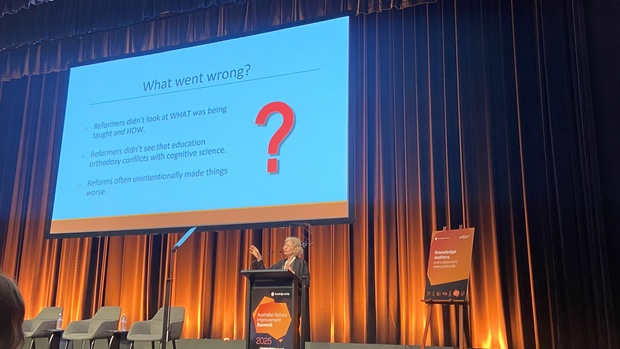
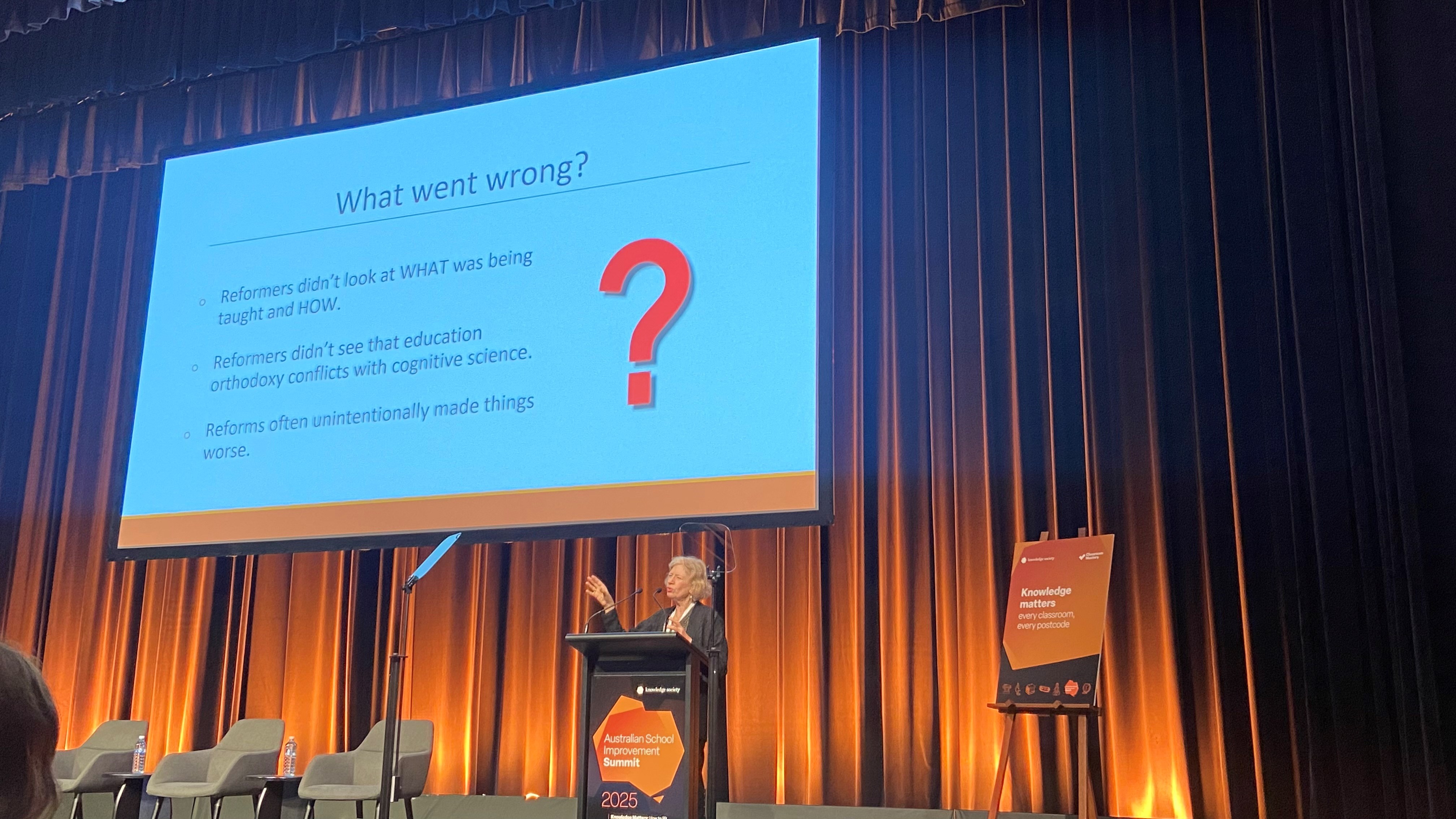
Headlining Knowledge Society’s Australian School Improvement Summit last week, the leading education author revealed what she has since learnt about the huge oversight of cognitive science, and how misguided literacy approaches that try to teach children skills in isolation have compounded learning gaps and inequity, with new historical lows in achievement the result.
“Once or twice (I was) taken into high school classrooms where kids had their heads down on their desks, or there were many empty seats because kids just hadn’t shown up for class,” the expert told delegates.
“And I asked one of my mentors – who was telling me ‘we know what works’ – ‘why does this all fall apart when kids get to high school? Why are these gains at the elementary level not carrying over to the higher grade levels?’
“And she basically just shrugged and said, ‘well, we don’t really know’. So, I decided I wanted to look into that because the goal, ultimately, was not to produce eight-year-olds who can ace a standardised reading test.”
Wexler has since drawn some clear conclusions on where things have gone awry.
“For one thing, reformers didn’t look inside the classroom.
“They looked at school governance, they looked at school choice, they looked at accountability, but they didn’t look at actually what teachers were being asked to teach, and how they were being asked to teach,” she explained.
“They kind of trusted it, that educators understood what to do in that realm.”
It’s not the fault of teachers that cognitive science and its implications for instruction has been seemingly ignored for so long either, Wexler clarifies.
“It’s a systemic problem that education orthodoxy, as it is developed in schools of education, really conflicts with what cognitive science has discovered about how people actually learn.
“And some of those reforms unintentionally made the situation worse by putting so much emphasis on reading and maths, and particularly reading, in isolation from the content areas.
“These efforts really distorted curriculum instruction so that massive amounts of time were then spent on reading and maths to the exclusion of things like social studies, science, and the arts.”
Also absent has been the acknowledgement of the importance of clear, explicit instruction as the most efficient way to transmit information to students, rather than learning via inquiry or discovery-based approaches, Wexler said.
And while the ‘hands-on’ activities might appear to be highly engaging, they can mask the fact that negligible learning might in fact be underway, she flagged.
Yet something even more crucial has been overlooked by policymakers, Wexler proposes.
“Even more fundamentally, what was missing was that knowledge really matters; that you need to transmit information and guide students to build substantive knowledge about things like history and science...”
What was instead prized both in the US and Australia was those so-called ‘21st century skills’ like critical thinking, communication and creativity, Wexler said.
“Apparently these weren’t important before the 21st century and they are now,” she noted with a touch of sarcasm.
“But the idea is that you can teach these, and things like ‘how to find the main idea’ of a text in the abstract, that kids just need to practice these skills, get better at them, and they can always Google stuff, right?
“So that you don’t need to ensure that they retain any actual information,” she posed.
“And the problem is that, yes, these skills are important certainly, but you cannot teach them in the abstract. They can only grow alongside knowledge.”

Students are getting even to prominent universities in the US without having read an entire book in high school, Wexler told delegates.
The role of background knowledge in reading instruction
That path to reading proficiency requires more than just mastery of foundational phonics, Wexler said.
For one, it requires sound reading comprehension skills, such as the ability to draw out the main idea of a text, to make inferences, and to be able to compare and contrast texts.
Cognitive scientists have known for a long time that the more academic knowledge and vocabulary we are exposed to, the stronger our reading comprehension skills will be, Wexler emphasised.
And yet schools have been trying to build students’ comprehension skills in a way that runs against what the evidence shows works best, she warned.
“Comprehension, as with those [21st century skills], it’s been approached as a set of discrete abstract skills that you can teach directly and then (there’s the view that) they can be applied generally.”
This might look like teachers running a ‘skill of the week’ regime, Wexler noted, where a specific skill is modelled before students practice on books or texts that have been set at their so-called individual reading levels.
“[These] could be well below their grade levels … on random topics,” Wexler said.
“This theory is that if a child diligently practices a skill like finding the main idea of a text, it doesn’t really matter what knowledge they might be acquiring, they will master that skill and they’ll be able to apply it to any text they try to read, whether it’s a textbook in high school or a newspaper article or whatever.”
This approach fails to account for the crucial role that a reader’s background and topic-specific knowledge plays in the meaning they can decode from a given text, Wexler warned.
“We have many studies [that show how] there’s really no dispute about the fact that having knowledge of the topic you’re reading about is very helpful to comprehension.”
Instead of having students practice ‘supposedly general’ reading comprehension skills year after year, what we really need to do to boost their reading comprehension is “give them access to as much academic knowledge and vocabulary as possible,” the expert argues.
Under this misguided approach, weaker students have also been limited to simpler texts, and thus exposed to less knowledge and less complex syntax than their higher performing peers – the very things that will allow them to access more sophisticated texts, Wexler said.
And thus the gap between struggling and excelling students widens as they progress through the year levels.
“This combination of levelled reading and a focus on these supposedly abstract skills, it really can have a negative impact on all students – even if you’re a good reader, it can get boring to read about random topics day after day practicing ‘finding the main idea’,” Wexler explained.
“But it has its most negative impact on certain subgroups of students: [those] who struggle with decoding, students who are lacking that academic knowledge and vocabulary that enables them to read more complex text.
“And of course many students, especially at the lower end of the socioeconomic spectrum, fall into both of these categories.”
Knoweldge is like mental velcro
Wexler is especially keen on the phrase ‘knowledge is like mental velcro’.
“It sticks best to other related knowledge,” she said.
“... prior relevant knowledge doesn’t just help you understand what you read. It also helps you retain new information from what you’re reading.”
Yet we’ve seen the wrong literacy approaches have been in place for decades, Wexler lamented, and the implications are bearing out in national assessments as well as concerning anecdotal accounts from universities and employers.
“What’s happened is, even at the high school level, many schools, many teachers, have started using excerpts and brief texts rather than whole books because, well, if you’re finding the main idea, it’s more efficient to just use an excerpt to teach the skill.
“But what that has led to at even elite universities, and there’s been a lot of coverage of this in the United States in the last year or two, students getting even to prominent universities without having read an entire book in high school and being unable to do the kind of work that’s expected at the university level.”
Despite years’ spent practising how to extract key concepts from texts, school graduates are falling short here, too, Wexler said.
I’ve talked to a number of college-level instructors who said they cannot find the main idea of a text, they are unable to do that.
“And then even with students who don’t go on to college, employers are finding that they are lacking basic reading and math skills, even though we supposedly have been trying to teach those, and employers are having to step in to try to provide that education that the K-12 system has failed to provide.”
Thankfully, it’s not all bad news, Wexler told the audience.
Australia now has government recognition of the need for explicit teaching and the science of learning, more so than the US, she said.
“Most (US) states have recognised the importance of cognitive science and explicit teaching in connection with phonics, but they’ve stopped there.
“But the movement of knowledge-building curriculum, [and by that] I mean detailed curriculum resources, including lesson plans, that movement has been spreading across the United States.”
Teachers’ practice is broadly changing to align with cognitive science, the expert said.
“And what amazes me is that despite the painfulness of that message, so many teachers in the United States are nevertheless embracing it, and they feel terribly guilty, but they realise that for the sake of their students, they need to acknowledge that what they were doing wasn’t working.”
Wexler’s final message is that when it comes to literacy and learning, “it’s all connected”.
“Once you get past foundational skills, everything that we can understand when we read, everything we can express when we write, draws on everything we have been able to learn.
“And at the same time, [reading and writing] are ways of learning, ways of acquiring and deepening knowledge.
“So every literacy teacher also needs to be a content teacher, and vice versa.”
EducationHQ is a media partner of the Australian School Improvement Summit. Read more of our event coverage here.