Speaking at the Australian School Improvement Summit in Sydney yesterday, Dr Ben Jensen argued that our shambolic national curriculum is fuelling the widening achievement gap between the nation’s advantaged and disadvantaged students.
Poverty and disadvantage are not the real problems here, the CEO of education research consultancy firm Learning First said.
Rather, too many students are progressing through school without the depth and breadth of background knowledge they need to succeed across all learning areas.
“[Our achievement gap problem] doesn’t exist because we have low SES students. This exists because of the structures and policies we put in place,” he told delegates.
Children’s reading comprehension skills are not just important in English, Jensen emphasised.
“If we want to succeed in science, mathematics, social sciences, the arts and so on, reading comprehension is a key aspect of learning and participating there.
“…what we pick up in the humanities, social sciences, civics, and so on, impacts how we go in other areas. Our background knowledge is not discipline-specific.
“There’s an increasing amount of research now that shows how we will go in reading comprehension in English and in other areas, actually is related to our understanding of science and so on that we have picked up in other areas.”
If school curriculum fails students on this front, Jensen said, schools are only “reinforcing the inequities in background knowledge that exist in our society”.
In 2023, Learning First benchmarked the content of the national science curriculum against that of seven comparable systems around the world, finding Australian students have been comparatively set a terribly low standard of achievement.
“I have been shocked by the size of the holes in the Australian science curriculum revealed in this report,” Jensen noted in the research.
Yesterday he highlighted the extent to which we are an outlier on the international stage.
Science results have ‘fallen through the floor’
“In terms of the knowledge in our science curriculum, K-8, we’re saying that it’s okay for Australian students to actually learn 57 per cent less than the average of other systems,” he said.
“We have lowered the bar that much.”
And since its introduction, “our science results in PISA have fallen through the floor”, he flagged.
While it’s commonly lamented that our curriculum is ‘a mile wide and an inch deep’, this take is well off the mark, Jensen said.
“It’s not (that). It’s an inch deep and an inch wide”, he told the audience.
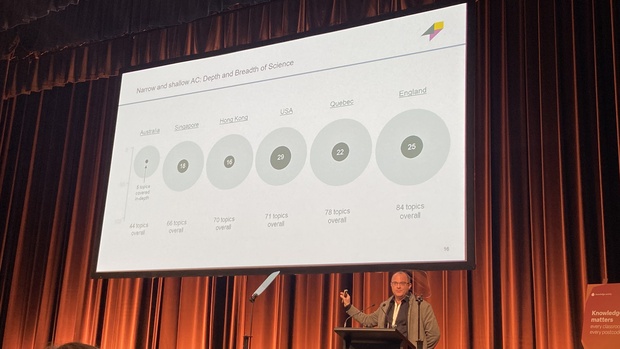
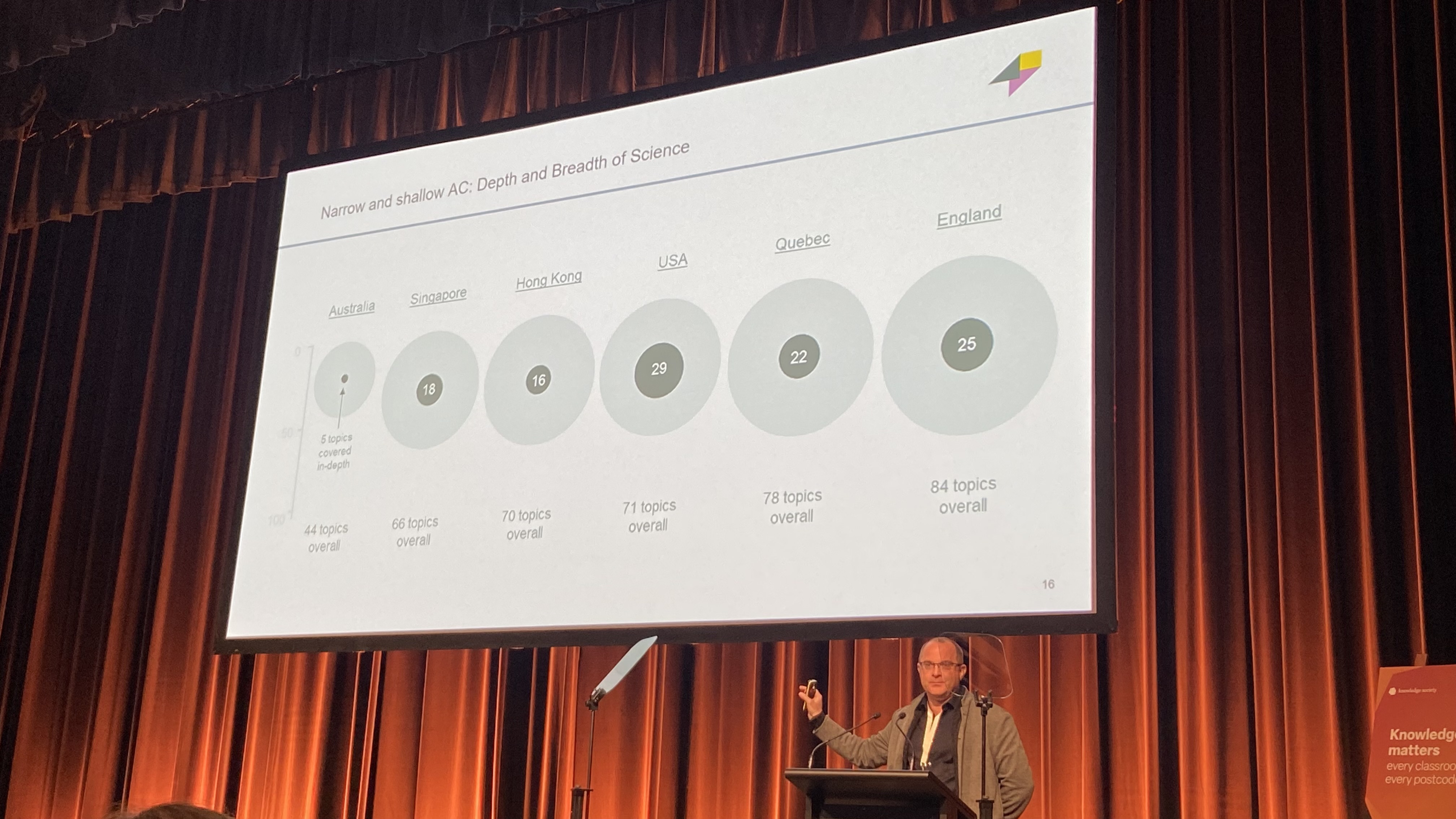
Drilling down into the curriculum ‘weeds’, the expert noted England’s science curriculum covers 84 topics in total and 25 in depth.
“But then you have the Australian system where we have just five topics in depth, and 44 topics just covered at all.”
It gets worse from here, the expert warned.
When you look at how knowledge of body systems, for example, is carefully sequenced in England from primary school through to the secondary years, Australia on the other hand randomly introduces the topic at Year 8 – encapsulated in an ’absolutely huge’ statement that would be impossible to teach without prior scaffolding, Jensen explains.
“This also explains why Australia, with a curriculum that has so much less knowledge, is also reported by teachers as having too much knowledge,” Jensen said.
“Because for these Year 8 and Year 9 teachers, it’s way too much. (They think) ‘how can I possibly do this?’
“And the answer is because we don’t have a curriculum that prepares students to enter [into more complicated content].”
This is precisely why we have so many educators saying the curriculum contains too much to teach effectively, he said.
“So we push it back, and push it back … until we get this crap (result).”
Other systems are waking up
While there is a broader push for high quality, knowledge-rich curriculum internationally, those school systems that have topped the league tables ‘for ever and a day’ have never strayed down the skills-based path, Jensen notes.
“And what’s really interesting, the benchmarking that we have done for science is of incredible interest to these systems now.
“When we present our benchmarking in Singapore, they are all over it. We have not had the same response in Australia…that might be a clue.”
Ultimately, the curriculum should contain clear and detailed content, Jensen said.
“What’s really important here is [that we don’t have] ambiguous, high-level criteria that we can’t test.
“We can test clarity really, really easily. Get 20 teachers in a room, (and ask) ‘what do you understand this statement to believe?’ It takes about an hour to test it,” he asserted.
A knowledge-rich curriculum is often criticised as a being a collection of independent facts, but the reality is far from this, the expert concluded.
“It is actually embracing how disciplinary concepts are built up in (say) history, how we are not including a historical fact about government in Ancient Rome because we like to know that as an individual standpoint fact, but it helps us understand how democracy and government form over time.”
Grassroots action needed
The critical role of high quality, knowledge-rich curriculum as a tool for school improvement was reiterated throughout the summit.
Reflecting on Jensen’s address, Dr Greg Ashman, deputy principal at Ballarat Clarendon College in Victoria, suggested solutions to our curriculum woes would need to come from the ground up.
“What is to be done? I am currently of the view, which I think Ben shares, that we cannot reform this mess in any meaningful way and will have to develop our own grass-roots solutions,” he wrote in a Substack post published this morning.
“Two thirds of the science curriculum is just waffle about ‘science as a human endeavour’ and so on.”
Speaking at the summit dinner last night, Elena Pasquini Douglas, founder and CEO of Knowledge Society, outlined how the wrong approach to curriculum means schools don't function as they should.
“...teachers in the same year don’t teach the same things, compounding gaps,” Douglas told the room.
“When we teach less knowledge, our students graduate with less creativity having fewer ideas and precedents to draw on. Less will thrive in higher education which requires solid foundational and disciplinary knowledge...”
EducationHQ is a media partner of the Australian School Improvement Summit. Stay tuned for more coverage on the insights and expertise shared on the day.