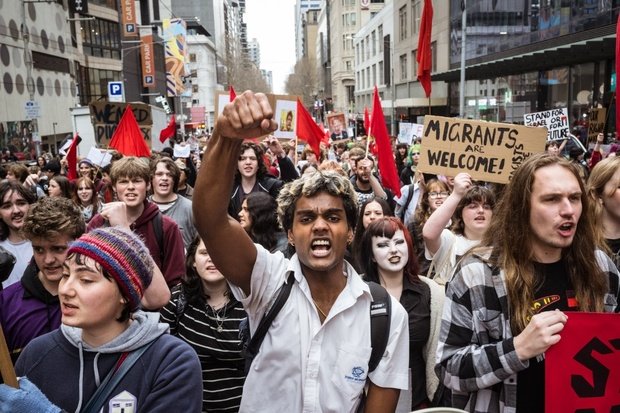
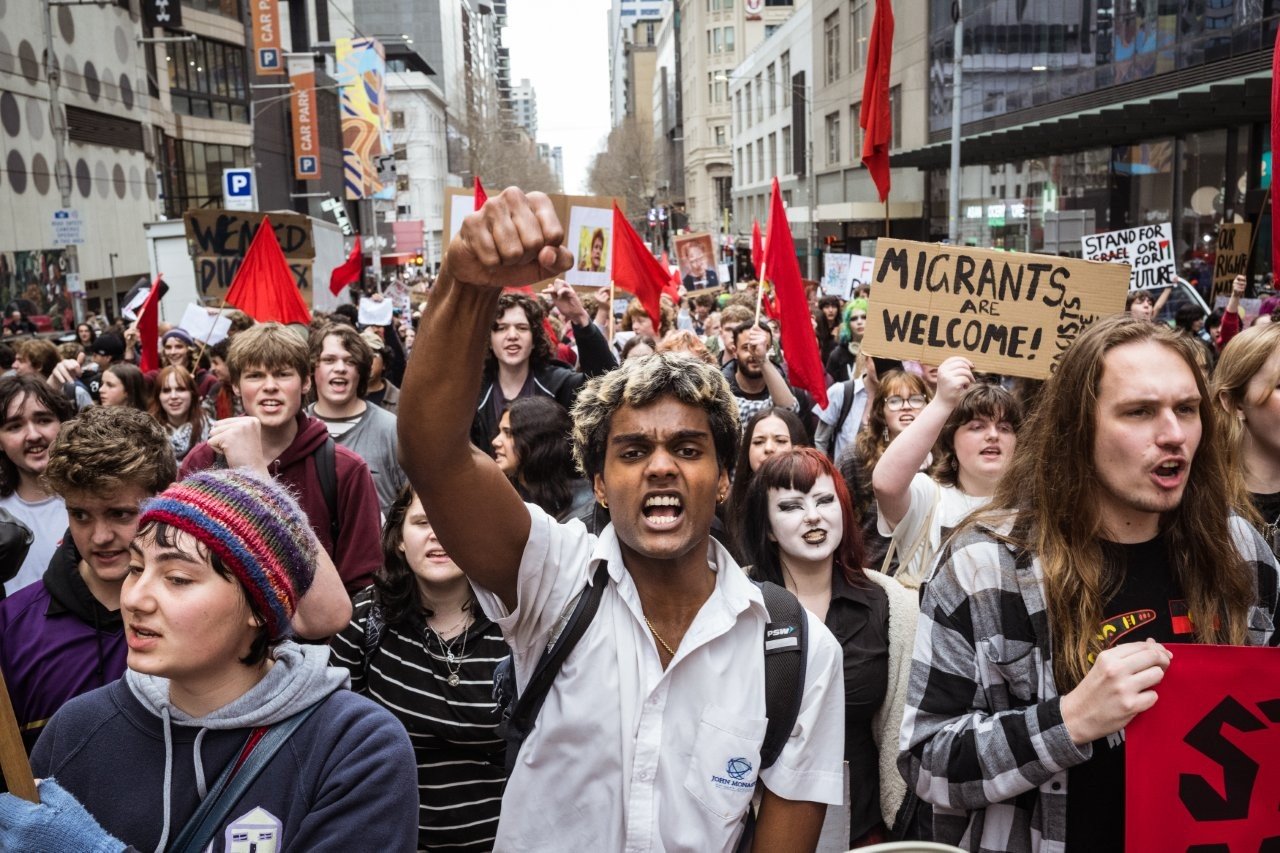
Organised by the National Union of Students, having thousands of students across the country downing their pens and devices is a powerful means of igniting interest and discussion in the area of civics, democracy and politics, Monash University’s Dr Benjamin Moffitt says.
“Students care most when they can see the relevance of what they’re learning to what’s going on out there, what’s unfolding out there,” the academic tells EducationHQ.
“Any teacher knows that that’s a hook, when something’s in the news, when something’s a pop cultural phenomenon or whatever, when you can hook it to that, it matters and it’s easier to get students excited and involved.”
So often our teaching about civics and democracy can be really dry, Moffitt suggests, and it becomes just about learning the levels of government and how this voting system works and so on.
“This is an opportunity, no matter how people feel about this specific topic in this particular protest, to really talk about what does it mean to live in a liberal democracy? What political action is there beyond elections?
“And even what people are protesting against here, is Australia at risk of going towards a racist future? Why is that a concern? What would people do about that? These are big, meaty issues and I think it’s a way in.”
Moffitt says attending protests from a young age has a socialisation effect. Students experience being part of a wider collective and gain confirmation that they are not alone in having a given idea, view or concern.
“That can be highly motivating,” he says.
“It can demonstrate to young people that modes of expressing their political voice and sovereignty in this regard, that the people in any democratic society do have the sovereignty, and it’s the people’s voice in the end that democracies are supposed to listen to.”

“This is an opportunity, no matter how people feel about this specific topic in this particular protest, to really talk about what does it mean to live in a liberal democracy? Dr Ben Moffitt says. “What political action is there beyond elections? Is Australia at risk of going towards a racist future? Why is that a concern?”
Protests, Moffitt says, are never really just one-off things.
“They’re not about just an electoral shift – this is about (a) changing attitude.
“There’ll be a lot of discussions around dinner tables [around if] the students did walk out of class or they didn’t.
“You know, why did your mate do that? Why didn’t you, et cetera. What are you concerned about? What do you think your mates are concerned about?”
With the rise of One Nation, there’s a fairly soft contingent of voters, what we think of as soft voters.
“They (One Nation) don’t have a core base built over many decades and years like the other major parties,” Moffitt says.
“So there’s probably going to be some hard discussions going on with parents or older siblings, family members who might be One Nation curious.
“And I think that something like this is an opening to discuss that in households across the country.”
In Sydney, Year 12 student Theodore told news.com.au that students had “always” been part of the fight against fascism.
“They call us indoctrinated and naive, they say all we want is a day off school, but would you say that to the students of the past?” he says.
“We have power beyond our education, we have power in these streets.”
Moffitt says One Nation’s rise in the polls doesn’t just affect those who can vote, it also affects young people.
“Many of them can’t cast a ballot yet, they’re the ones who’ll live longest with the climate this party is trying to create, and who see its messaging aimed squarely at the diverse, multicultural Australia they’ve grown up in,” he shares.
“Walking out of class is how they get a say that the ballot box doesn’t yet give them.”
Hanson and One Nation MP, Barnaby Joyce claim students are being unfairly influenced and told what to think by some teachers and education institutions.
“Whenever I hear this line, I think of the reality of teaching in contemporary Australian tertiary university sector.
“We can’t get students to come to class, we can’t get them to do their readings. If we can’t get them to do that, it’s pretty hard to then also be brainwashing them at the same time,” Moffitt says.
“It’s not like One Nation’s rise has been some arcane or hidden away issue that students wouldn’t be picking up on unless their teachers had mentioned it.”
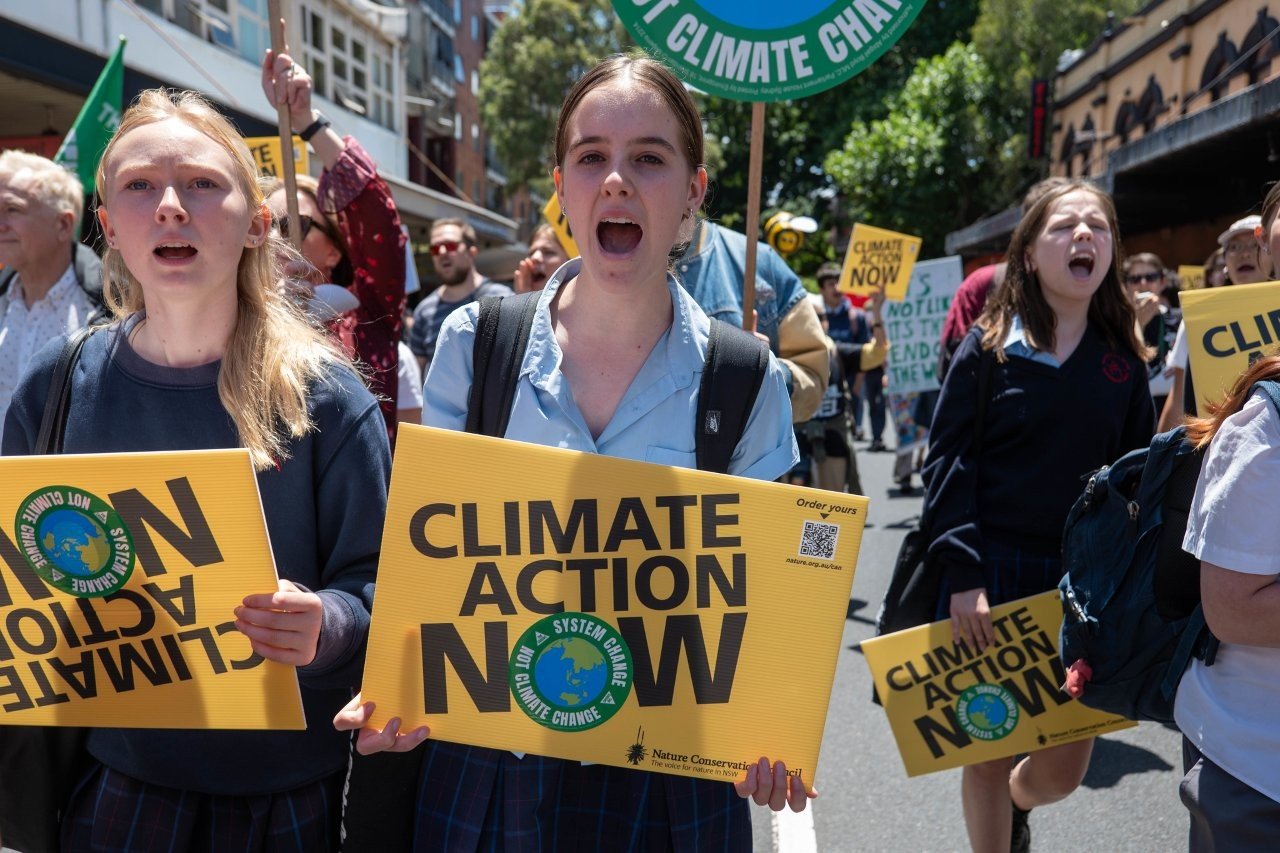
While the School Strike for Climate movement was unsuccessful at the federal level, the powerful, student-driven campaign led to the ACT becoming the first jurisdiction in this country to embed a duty of care to young people and future generations in the new ACT Climate Change Strategy.
One Nation’s Rise has essentially been the media story for the last nine months on every news bulletin, on every headline – you can’t ignore it, the academic asserts.
“So this is one of those things that I think to pretend that students have only come to this through their educators ignores the reality of the media and information environment for this particular societal issue and this political trend, as opposed to maybe some other issues that students would be protesting. I just don’t think it holds water in this case.”
Writing in an opinion piece for The Conversation, Professor of Political Sociology at Western Sydney University, Philippa Collin, says her research has found that high school students articulate a deep understanding of contemporary issues when provided with platforms to express their views.
“As part of this research, my colleagues and I analysed more than 22,500 entries to the Whitlam Institute “What Matters?” competition from 2019–2023. The competition asks students from Years 5-12 to write about what’s important to them,” Collin writes.
“We found young people have strong ideas about how a range of problems facing society should be addressed. Entrants expressed concerns about climate change, war, economic inequality, racism, violence against women and children, and social media development and regulation.”
High school student protests are nothing new and historically have often brought issues of importance into the spotlight.
In the early 70s, national protests called for an end to gender segregation and corporal punishment in schools alongside other demands, while more recently, student activism for climate justice has led to tangible change and government action.
The School Strike for Climate might have fallen just short of the national response it had hoped for, but in response to students mobilising, the ACT became the first jurisdiction to embed a duty of care to young people and future generations in the new ACT Climate Change Strategy.
“That’s only in recent memory, too, when kids look at student protests about Vietnam in, as my kids say, “the olden days”, they’ve seen that these kind of actions can work, that there is a script here, that there is a pattern, and that young people can mobilise.
“And I think they would be encouraged by that.”
Moffitt says what will be interesting to see is whether there are more protests coming.
“I suspect that this is not going to be a case of ‘one and done’.
“There’s two years until the federal election. I don’t think the polls are going to dramatically shift. So the one thing I’d be wanting to know from teachers is if this becomes a recurrent thing, how they balance that. I’d be curious to probe that.”