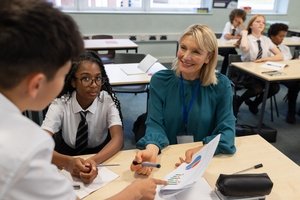


Mihajla Gavin from University of Technology Sydney has led a study analysing teachers’ views on their workload as reported in union surveys conducted across all Australian states over the last decade.
She says it was a chance to interrogate the extent to which the voice of the profession had been heard and accounted for in policy responses designed to alleviate their workload burden – but also to explore how wellbeing research has framed the issue.
“We’ve noticed the wellbeing literature taking a bit of a different angle on looking at how to address the workload problem,” Gavin tells EducationHQ.
“What that literature does is it often doesn’t necessarily look at workload itself. It often looks at the effects or the outcome of that workload. So, it looks more at the stress or the burnout that’s created because of workload.”
This is clearly problematic, Gavin says.
“It individualises the problem of workload. So, it basically says, ‘to deal with your stress or to deal with your workload, there are potentially other resources available to you, like engaging in downtime or exercising or other kinds of stress management techniques to deal with the effects of workload’, rather than looking a bit more systematically at what the source of that workload pressure is in the first place…”
A range of government initiatives have sought to tackle the escalating issue of teacher workload in recent years.
Yet despite the creation of central resource hubs, efforts to plug schools with extra administrative staff and limits on teachers’ contact hours outside of school time, burnout remains rife and an unsustainable workload is cited as the biggest factor fuelling teacher attrition at scale.
AITSL data from last year shows Australian teachers are clocking up 52-hour working weeks on average, with some working up to 60 hours or even more.
One Melbourne secondary teacher told EducationHQ that excess marking had become a huge issue.
“You’re so disrupted during the day that you have to take it home with you after staff meetings and do it in your own time. It’s impossible to focus on it otherwise.
“Teachers are literally taking days off so they can sit at home and catch up on urgent marking.”

When it comes to workload solutions, it's time to give teachers a seat at the decision-making table, lead researcher Mihajla Gavin urges.
Gavin says teachers’ views on how their workload could best be eased have not been fully listened to in policy circles.
“There actually needs to be that real recognition at the system level and the policymaking level as well, of the actual demands that are involved, the complexities involved in doing the work of teaching.
“It’s literally getting to that really fine-grained grassroots level of what is actually involved in this very complex job of teaching … there’s emotional labour, there’s paperwork requirements, there’s the expertise required to actually be a teacher within the classroom … there’s always new policy developments and changes that are happening within the profession at the same time.”
Increasingly disruptive student behaviour and a rise in complex student learning needs, combined with the added challenge of AI, have made the job of teaching far more challenging than perhaps the average policymaker is aware, Gavin suggests.
“It actually means [they need] to speak to teachers, to really get the voice of teachers within policymaking environments and debates and discussions, which I think is what the richness of this research really shows…
“That actually means that you can then act on those solutions, because you then ask teachers specifically, ‘what are the pressures, what are the challenges?’ that they’re facing.
“But also knowing exactly then how to take those solutions forward and how to bring them to life as well.”
Responses to the teacher workload crisis have been mixed and even contradictory in nature across school systems and jurisdictions, the researcher adds.
For example, differing views around class sizes and their impact on teachers and debate over the role and value of centralised lesson plans have endured.
Drawing on a sample of more than 50,000 public school teachers and school leaders, Gavin and her team trawled through union surveys spanning the last 10 years to identify what the profession has had to say about their workload.
A few strong points emerged from the vast sample.
“We found a couple of key priorities that really stood out for us – one of the key ones being teachers just really want an increase in time to focus on their core work of teaching and learning.
“So doing the main things that contribute to that, like lesson planning, like being able to collaborate with their colleagues.
“Teachers also really said that they wanted increased specialised support, particularly for students with special needs or to assist with differentiation around learning needs.
“We also found teachers really saying that they want more recognition or more acknowledgement of their own professional judgment.”
Another secondary teacher working in a Melbourne public school told this publisher that some teachers were now relying on AI just to keep their head above water.
“I think AI has allowed teachers to circumnavigate the problem that government fails to address, which is our horrendous workload – and so while they won’t admit it openly, they will use AI and sort of go back on their morals for the sake of saving everything else,” the teacher reports.
It’s time to give teachers a seat at the decision-making table, Gavin urges.
“We know that there’s been a big compliancy and accountability focus on teachers, but teachers just want to do away with having to do these administrative tasks that they feel are unnecessary or time consuming,” Gavin says.
“They just want their own expertise to be recognised by the system.
“Plus, teachers also want greater consideration around how future (system) changes might impact them.”