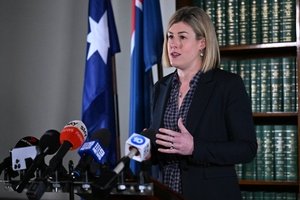


Led by Dr Sara Meger from The University of Melbourne, the research has painted an entirely disturbing picture of the online radicalisation of Australian children as young as 13.
It further confirms the manosphere as the driving influence over a widespread and brazen hostility towards women amongst school-aged students.
Meger says that of the 500 teachers involved in the study, many offered up alarming examples of extremist sentiments or behaviours they had witnessed from boys, with ‘extremely hostile’ gender attitudes drawn from manosphere ideology the most prevalent and pervasive.
“…and female teachers are really copping the brunt of it, as well as their female peers in the classroom,” she tells EducationHQ.
“The sentiment seemed to be that, uniform across the survey, that boys in Australian schools feel emboldened to say really egregious and outrageous things to their female teachers that I think a lot of us would have thought unthinkable not that long ago.”
Both primary and secondary teachers reported incidents of explicitly demeaning and sexualised language targeting female teachers and students, with researchers calling the severity in many responses ‘striking’.
One teacher noted ‘deep level misogynistic behaviour’ at their school, with female staff sexually harassed and ‘being called bitch and told ‘you’re a dumbass’.”
“Students will openly say... ‘Get back in the kitchen.’ I have been called a stupid fat c***,” another reported.
Several teachers flagged the escalation of this language in recent years, pointing to manosphere content and online influencers, the likes of Andrew Tate, who they suggest have worked to normalise degrading language about women.
“Students are funnelled into echo chambers, lured into extremist content through innocent avenues such as gaming and workout videos, then exposed to extreme misogyny, racism, homophobia and transphobia.
“They then come to school and discuss the content they all consume or parrot concerning sound bites in class discussions,” one teacher noted.

Dr Sara Meger says the manosphere pipeline is more dangerous than any single extremist ideology.
Boys are also refusing to follow instructions from female teachers in what appear to be deliberate attempts to undermine their authority, the study found.
“I have been asked if I am on my period when I attempt to discipline students through stern voice or language,” one explained.
Several described the experience of calling a male colleague to deliver the exact same instruction and having students immediately comply.
A significant number of teachers also reported clear evidence of racial and religious extremism amongst students.
Incidents of antisemitism, anti-Islamic rhetoric, anti-immigration sentiment, and in several cases explicit expressions of white supremacist ideology emerged from their responses.
Teachers noted Nazi symbolism and ideology being used, along with racist remarks and taunts.
“A group of boys in Year 10 had been making rape jokes and then stated that they wish Hitler was still alive and completed the job,” one stated.
“A Muslim student expressed an opinion that those of Jewish descent deserved acts of terrorism,” another reported.
One teacher said Islamic students had expressed hatred about Jews and non-Muslim people in general.
“Students will openly say that they hate Jews and free Palestine,” another flagged.
A small number of responses included explicit content that would meet the threshold of serious concern for school safety, the study found.
“What was quite surprising to me was the rate at which teachers were volunteering examples, some of these (reflecting) extremely racist, xenophobic, and white supremacist ideas,” Meger says.
“…in my read, what’s happening is that political discourse, especially online, has become so polarised, and things that we would have thought were too taboo to be said in most media sources are now increasingly popular rhetoric online – this is what young people are exposed to, that’s where they are spending the majority of their free time.”
The statistics are worrying, Meger suggests.
“For example, 47 per cent of teachers observed students expressing support for restrictive immigration policies on the basis of ethnicity – that’s almost half.
“Forty-one per cent saw students express attitudes about the legitimacy of violence to oppose the government – that’s quite worryingly high.
“And over a quarter had seen students express incel ideology and the legitimacy of violence against women who refuse to have sex with men.”
More than a quarter of teen boys also agreed with right-wing extremist statements, left-wing extremism and white supremacist ideologies rooted in violence.
One in four agreed that feminism should be resisted with violence.
Meger warns that these attitudes are evident well before the age at which most of our national prevention efforts intervene, including the recent social media ban for under 16s.
The strongest predictor of extremism wasn’t people’s political ideology, ethnicity, religion or time spent online, but hostility towards women, she says.
This is a critical finding.
“The reason this finding is significant is because currently our national security framework for addressing terrorism and violent extremism is framed through entirely through the lens of political motivation and political ideologies.
“But as we’ve seen through a number of years, and ASIO Director General Mike Burgess has come out and said, increasingly people are expressing these mixed and unclear ideologies that our national security framework just can’t make sense of.
“What my research is showing is that what’s driving people into these mixed, unclear ideologies, why they’re cherry picking elements from vastly different political belief systems, is because their primary motivation isn’t the political end goal; it’s that they're expressing a really deeply felt grievance that they’ve come to understand through an incredibly gendered lens.”
That is, people are facing hampered life outcomes, reduced economic opportunities and limited political voice, and so they go online looking for answers, Meger explains.
“And the answer they keep getting sold, regardless of what the political agenda is, is that feminism is the reason for these problems, and that women are no longer fulfilling their expected gender role in society.”
The researcher argues that addressing violence against women as a matter of gender equity alone, rather than also a matter of national security, means we are missing a key part of the puzzle for understanding who becomes radicalised and dangerous.
“Actual intervention programs (addressing violence against women) are massively underfunded, massively under-resourced, so it’s not like we don’t understand the problem, it’s just not enough of a political priority.
“And so what I’m calling for is to recognise that resourcing these programs properly wouldn’t just solve the pandemic of violence against women that’s facing Australia … but it would have this flow-on effect of actually acting as primary prevention against radicalisation.”