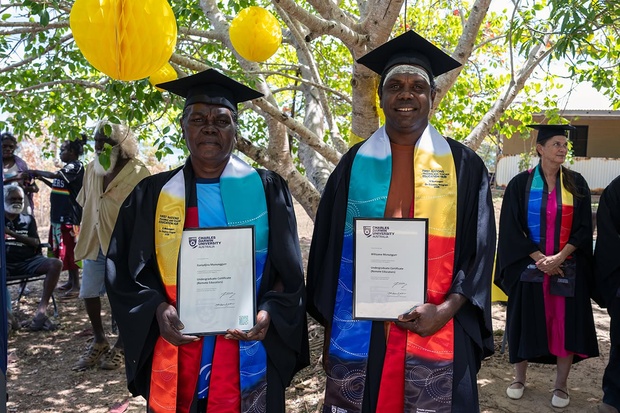
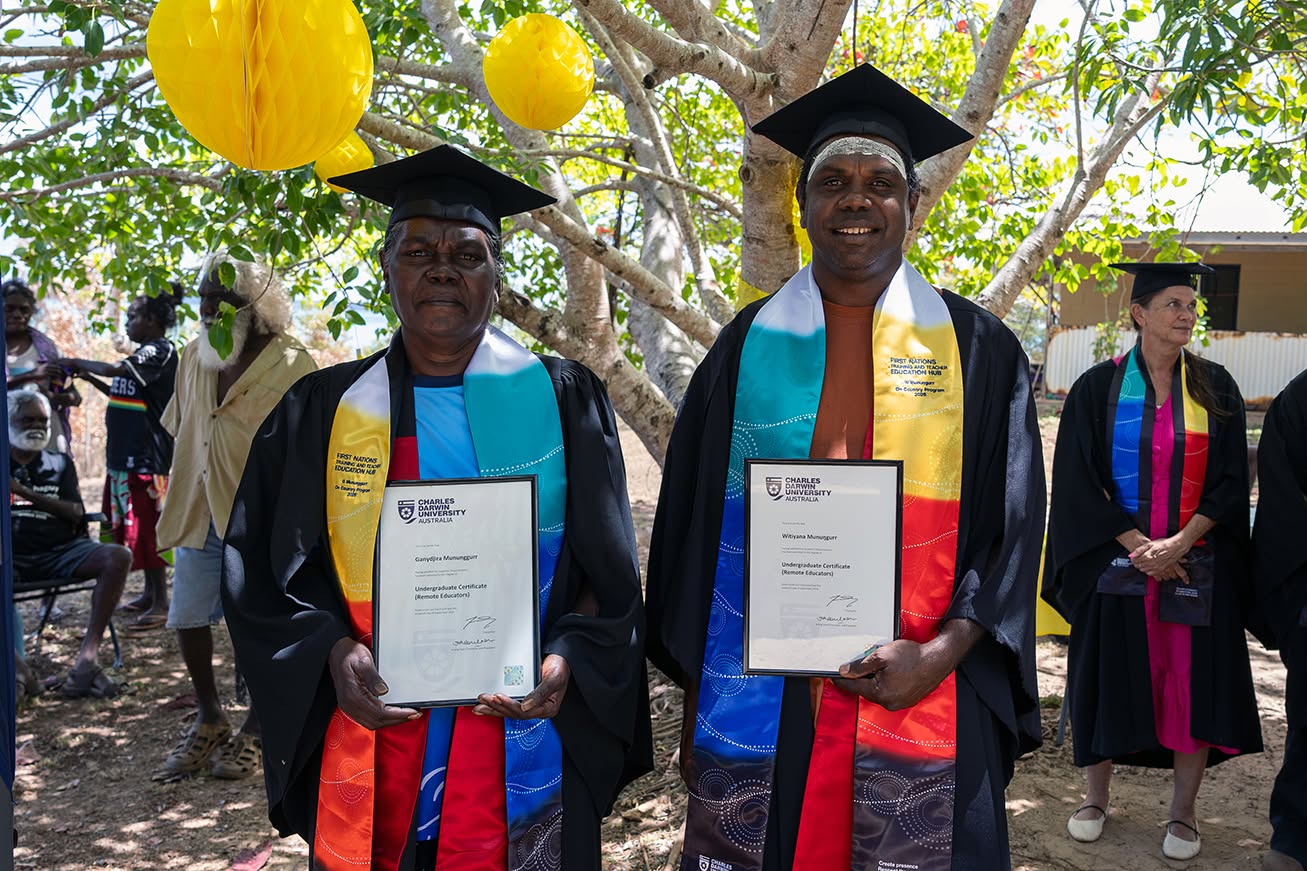
Co-designed with schools and communities across the Northern Territory, the Charles Darwin University (CDU) program recognises the valuable cultural knowledge, language expertise, and classroom experience that Aboriginal educators already bring to their work.
Through flexible, community-based learning, CDU lecturers travel to remote communities to support students in their own schools and workplaces, enabling them to build professional skills, gain academic credit, and progress towards becoming qualified teachers while continuing to teach and support local children in their communities.
CDU lecturer in Indigenous Knowledges (On Country Education) Melina Davidson says new graduates – Witiyana, Rilmi, Rerrkirr, Godut, Yindyjay and Milkinydjarrwuy – have strengthened their teaching knowledge, built confidence in their professional practice, and taken an important step towards becoming qualified teachers while continuing to support learning in their own communities.
All six have just completed the Undergraduate Certificate Remote Educators and are experienced First Nations educators working at Garrthalala School, Dhalinybuy School and Wandawuy School.
“For me, one of the most rewarding parts of being an on Country lecturer has been learning about the students’ teaching expertise and cultural knowledge through the assessment of evidence collected and shared,” Davidson says.
“Their assessments have highlighted the deep knowledge they already bring to teaching and the important role they play in supporting children to learn in culturally responsive ways.
“It has been a privilege to witness and recognise this expertise through a university program that values and celebrates the strengths Aboriginal educators bring to their schools and communities.”
The students’ graduation is a clear demonstration of what is possible when higher education is designed in partnership with communities, Davidson says, and it’s clear her students drew on cultural resources, local languages, stories, Country, and community knowledge to shape their journey and approach to teaching.
She says the group were the first of a 30-strong cohort across remote communities in 2026 to complete the Certificate through the pilot on-Country program.
“One of the most memorable moments was watching the faces of their own students as they saw their teachers graduate,” she said.
“It was incredibly powerful to see the pride and excitement in the children as they celebrated this achievement alongside their teachers.
“It showed them that higher education is possible while staying connected to community, culture and Country, and that learning is something that continues throughout life.”
Graduate and Laynhapuy Homelands School teacher Witiyana Munuŋgurr says learning on Country – both from fellow Yolngu teachers and visiting lecturers – is an empowering experience.
“CDU lecturers coming, sharing their knowledge and experience with the Yolngu teachers so we can learn both ways helps us shape our education and teach the kids, because kids are the reason we teach,” Munuŋgurr says.
“I’m really proud of my studies, because it’s helping me upgrade my skills and inspiring me to do more.
“Teaching is a really important role. I’m now enrolled in a Diploma of First Nations Language Work, where I’ll be challenged more but I get to keep going.”
All of the graduates plan to continue their studies through the diploma, which is a pathway to the Hub’s Associate Degree of First Nations Cultural and Language Education.