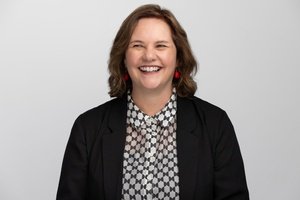

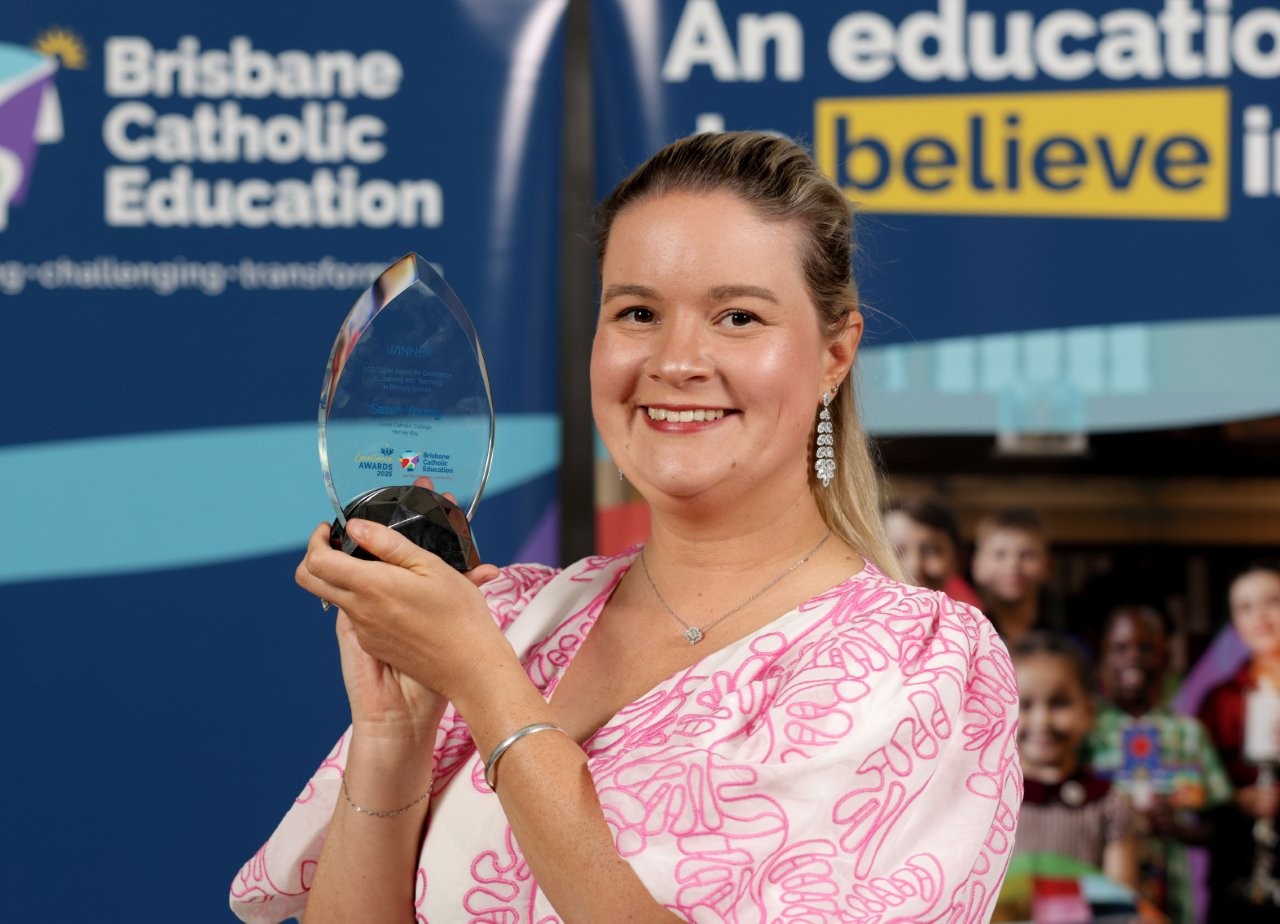
For saving her primary colleagues precious time by implementing integrated learning for STEM subjects from Prep to Year 6, Sarah Young has taken home the top prize at the awards.
Young’s program has not only improved attendance, but has lifted mathematics results, improved collaboration between students and ultimately resulted in an across-the-board lift in engagement.
The Year 6 teacher at Xavier Catholic College in Hervey Bay has been at the school for eight years, having graduated from Brisbane’s ACU and arrived at the Sunshine Coast not long after.
Her principal Simon Dash says with students more connected to their learning than ever, Young’s impact has been transformative.
“By combining STEM subjects into one learning experience, Sarah has revolutionised the way our teachers teach, and the way our students learn,” Dash says.
“From planting sunflower seeds and watching them grow, to designing their own virtual solar systems, Sarah’s teaching methods cultivate curiosity and creativity.”
Young says in a world where educators are overworked and short on time, she was keen to find a way to make a tangible difference.
“I won a scholarship two years ago based on my STEM work and I wanted to use it to teach teachers how to write STEM units with the idea that one unit can teach three or four subjects,” she tells EducationHQ.

“Gone are the days of students sitting in chairs watching the teacher write on the white board,” Year 6 teacher Sarah Young says.
”So teachers aren’t going home and marking 30 maths assignments, 30 science assignments, 30 tech assessments.”
Instead, Young explains, they are marking formatively throughout the STEM unit with check-ins and a final piece gives them a STEM mark based on the assessment.
“So we explicitly teach the lesson, kids do whatever’s required, teachers monitor what’s happening throughout that and they can see who gets it, who doesn’t understand it, who’s excelling in it – and then once that final assessment comes to play it’s an accumulation of all of their learning.”
When it comes to marking, teachers are only marking an English assessment, a health assessment, a religion assessment and a single STEM assessment.
Buy-in by staff has been an ongoing process, with Young gradually sharing the theory of integrated learning through demonstration and professional learning.
“Through the scholarship I was released to plan with teaching teams so I could show them how it all connects and how it all works and what the end product will be,” she says.
“They were able to build a lot more understanding of what was happening for the final assessment, and by having that time to sit and plan and show them the expected outcomes, that was a lot better than just ‘here’s a unit, go teach it, good luck’.”
Integrated learning allows kids to explore using their hands and senses as they explore their own curiosities.
“It’s the idea of encouraging kids to present their learning in a way that they’re comfortable with,” Young shares.
“So not every child is a ‘sit down and do a test’ type of students or a ‘stand up and present an oral’ or that sort of thing, it’s the idea that the learning occurs the same for each student but the understanding and the final presentation is different.
“So they might pull on their strengths and create a stop motion, or they might create a virtual reality, or they might create a poster with QR codes, or they might create a YouTube video or something like that.
“How they present their final learning is really the chance for them to show what they understand and their strengths – which I think gives kids who don’t typically succeed, the chance to succeed, because they know that they can present differently.”
As an example, Young says recently her students have been studying a science tech unit on circuits and so she devised a scavenger hunt around the school, based on the popular Disneyland passport in the US.

“From planting sunflower seeds and watching them grow, to designing their own virtual solar systems, Sarah’s teaching methods cultivate curiosity and creativity,” principal Simon Dash says.
“So they run around the school and they have to scan QR codes to see what the corresponding video says, answer questions about how circuits are used, show their understanding of a circuit, then move on to the next QR code to scan.
“Then at the end they had to design their own circuit based on what they’ve learnt.”
It’s a bit more hands-on than just, ‘here’s a circuit, copy it down’, she adds.
Young says in terms of pedagogy, she likes to build a foundation through explicit instruction.
“So they know exactly what the task is, but then it’s using their strengths and the different ways of learning for them to present the learning – so if they’re an artistic person they’ll do it that way, or if they’re a mathematician they’ll do it this way.
“... I also then like to use the universal design for learning (UDL), where it’s all connected and integrated and linked up...”
Young says her Award for Excellence in Learning and Teaching in Primary Schools was unexpected and quite a thrill.
“I didn’t think I was going to place at all, I was just happy to be nominated, but then when they said I was a finalist, I was like ‘oh this is amazing, let’s see’, and then when I won it! Wow!
“STEM is a passion of mine, and it’s nice to be recognised and for BCE to say, ‘STEM matters and the work you do is making a difference and is important to us’... that they can see the value in it and can appreciate it, is fantastic.
“And also the possibility of me doing more, that door’s now open.”