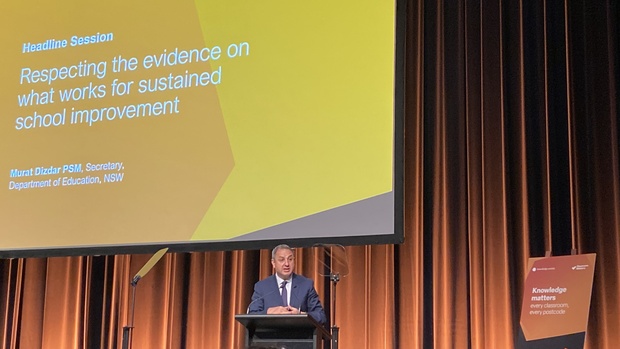
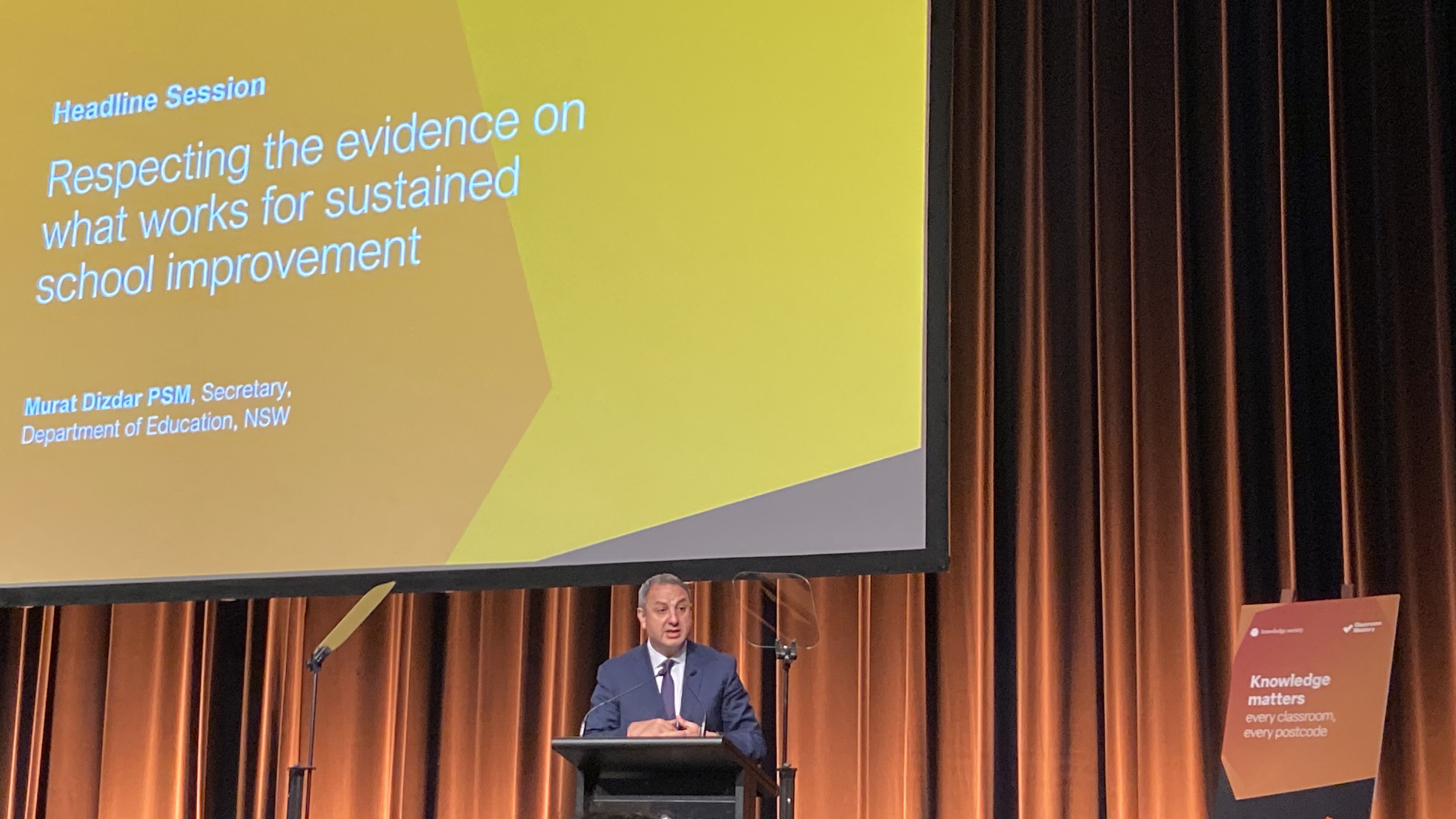
Speaking at The Australian School Improvement Summit last week, Dizdar, a former teacher and school leader himself, seized the opportunity to highlight the initiatives he has overseen in the role – changes he suggested have led to significant gains.
In his 18-minute speech, Dizdar made mention of his charge to ‘back in teachers’ no less than five times.
Revealing soon-to-be released results from the latest NSW People Matter Employee Survey, Dizdar said the dial had moved on a few key markers.
“We had the highest response rate ever in our time from teachers – 41 per cent of the system [of] 95,000 teachers.
“I’m proud to tell you before it reaches the press, teacher engagement is up 5 per cent.
“Job satisfaction is up 6 per cent. Don’t worry, this workforce is not afraid to tell me when it’s not going right…
“Wellbeing is up 7 per cent. Recognition is up 4 per cent.
“You don’t move the dial on those things unless the workforce feels that you’re backing them in – that’s not going to do school improvement across the board,” Dizdar told delegates.
The leader was keen to emphasise his connection to the classroom coalface in the Department’s bid to lead school improvement at scale.
“I am determined to lift the lot for 800,000 students, 2216 schools, but I’ve got a good sense and dose of that (classroom) reality, which I don’t want to lose,” he said.
“And when you’re in my position … if you want to turn that workforce off, if you want them to chase their new secretary, if you want them to have a lack of belief, then you can just go at it and make reform and change after change after change.
“So, the first thing I did when I walked in, close to three years ago, is I stopped the department’s strategic plan.
“It was ready to go. It was a glossy brochure, 16 pages, and I stopped it.”
Department staff were mortified, Dizdar said, but he knew too well the fate of these unwieldy documents in schools.
“I was one of those teachers and principals on the ground that only rolled out the department’s strategic plan when the secretary visited or the minister visited.
“And I placed it strategically in classrooms in the staff room, et cetera, because none of us believed it.”
Instead, Dizdar rolled out a decidedly more succinct one-page plan for systemic improvement that was, for the first time in 177 years, informed by teachers.
“I’ve made a career out of surrounding myself with much smarter people.
“I know that the answers also are in the system and on the ground. I can only cope with one to two pages anyway, so I made it a one-page plan,” he elaborated.
“And this is what we’re chasing:
- Equity and excellence.
- Trust and respect for the teaching profession and the support staff.
- Give children the best start in learning.
- Deliver outstanding leadership, teaching, and learning.
- Strengthen student wellbeing and development, and provide meaningful post-school pathways.”
Dizdar also doubled down on the importance of explicit teaching, declaring the evidence was in.
“I’m not going to run away from the evidence. I don’t know why we still have to stare down, as a profession, each other and ignore the evidence base.
“So, I put out a statement on explicit teaching.
“We haven’t done [something like this] for 177 years. I believe that students need to know what they’re going to learn, how it relates to formal learning, how successfully we judge (that).”
From NSW teachers, Dizdar said he wants to see feedback, repetition and revisitation in their instruction.
“I want my teachers to stop and slow the learning against the syllabus.”
Keen to keep his school reform focus grounded in reality, Dizdar recently spent two days posing as a casual teacher in two different schools serving low SES communities.
“I spoke to the principal and said, ‘make sure you treat me just like any other’.
“I think they took it literally. They gave me five periods out of six. I had canteen duty.
“They gave me a yellow vest for 1500 students. So, I got to have the real taste.
“Back at the office everyone was wanting to know how I’d gone. They really wanted to know if I survived,” he said wryly.
Drawing on another personal anecdote, this time his first stint as a social sciences teacher fresh out of university at Ashcroft High School, Dizdar hinted that initial teacher education had been falling short when it comes to preparing graduates for the job.
“I had [one phenomenal head teacher]. But I thought she was trying to kill me in my first year.
“She said, ‘on Monday can you come with a one-term scope and sequence for your Year 7 Geography class?’ I didn’t have the strength to tell her, ‘what’s a scope and sequence?’ I didn’t have NSWEduChat.
“She ruined my weekend. She ruined many weekends. [But] she taught me the craft, and the excellence and the standard that I should have had, walking outside those university gates.”
Teacher bashing and issuing blame is not the way to achieve system-level improvement, Dizdar reiterated.
“You have to lift the profession and you have to tackle the teacher shortage.
“I’m so happy to tell you that … in two-and-a-half years we’ve reduced teacher shortages in New South Wales by 61 per cent,” he said.
Teacher resignation in the state has also dropped from a peak of 4.03 per cent to 2.41 per cent during the same period, he added.
“I’ve stopped the rate of change. We underestimate in systems, when you roll out things, the degree of change and wraparound (support) that you need.
“When you put out a 64-page manual and you think it’s cracking work, have you sat down in the system and walked through it yourself with how long that takes to unpack and understand?”
Dizdar also noted improvement in NSW Year 1 phonics results (65 per cent of the cohort are now phonetically competent, compared with 40 per cent in 2021).
“We’re going to stay that route. We’re going to roll out a numeracy check for the entire state next year. And we’ve been working with 7000 public school students and leading the country [on this front].
“We’ve backed in small group tuition and lifted the funding from 10 weeks to 15 weeks intervention. I want kids grabbed early with expert practitioners, not a free-for-all of what you’ll teach and how you’ll measure it,” he added.
It’s still early days for NSW’s reform agenda, Dizdar indicated, but the wheels of long-term change are in motion.
“I’m determined to stay in the road for the benefit of the profession.”
EducationHQ is a media partner of the Australian School Improvement Summit. Read more of our event coverage here.