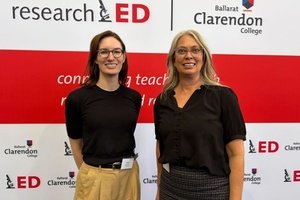


With 15 years’ experience leading schools, Knight says she’s learnt that enthusiasm and drive really need to be paired with a deep knowledge about how learning happens in order to shift the dial on student achievement.
“School improvement is really tricky unless you’ve got a level of knowledge yourself,” the principal at Ararat West Primary School in Victoria tells EducationHQ.
“It’s a bit like the ‘novice to expert’ continuum that we talk about with students – it actually applies to us as adults as well, and it applies in education.”
Early on Knight realised that the approach teachers were using to teach children to read simply wasn’t working. Embarking on a personal quest to find out why, the entire science of reading realm soon opened up before her.
“That led me to phonics, it led me to the reading panel reports, and then it led to that explicit teaching of phonics…
“Really, as a leader, I’ve realised how important it is to have a deep level of knowledge yourself around how children learn to read, how learning happens, the importance of memory and attention, the importance of getting things into long-term memory,” Knight says.
What started as a ‘moral drive’ to ensure no child left primary school unable to read has broadened into an all-encompassing focus on evidence-based practice and the leveraging of knowledge-rich curriculum across the board.
“Look at those really good instructional practices and pedagogy, which can apply to everything: to PE, to science, to humanities, and become an expert in those areas, because that’s a really quick way to lead improvement in your school,” Knight advises.
“But at the same time, you need a really good curriculum. Pedagogy doesn’t work unless you’ve got a really well-sequenced curriculum to teach.”
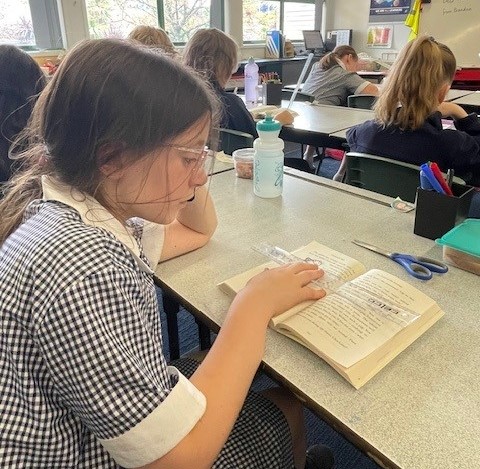
Breadth and depth of reading is a focus at Ararat West PS.
Focus on schema
A particularly incisive comment from a fellow principal has stayed with Knight as she goes about the business of school improvement.
“She said, ‘I tell my teachers their job is to develop student schema and to stop the forgetting curve’.
“And I just thought that was just the most amazingly short, succinct, accurate quote about what our role as teachers and therefore school leaders is, to make sure that happens for all of our students.”
Building schema, as it turns out, is at the forefront of Knight’s agenda at Ararat West PS.
“We want to build schema. It’s not about memorising random facts that aren’t linked together. We’re trying to build schema for our students so they develop really good general knowledge of the world, so they’re able to participate in democracy, have choice and freedom and opportunity.
“And the more we learn about learning, we know how dramatic that forgetting curve is and how important review and revision is at school and having that really well-sequenced curriculum.”
Taking on instructional modelling
For Knight, classroom teaching (and modelling quality instruction for staff while she’s at it) remains a great joy of the job.
“I still love jumping in and modelling for teachers, and also modelling not being perfect and not getting it right.
“[It’s about] modelling that reflection all the time – ‘I could have paused there’ or ‘I went too fast there’ or ‘those students didn’t quite get that concept’ or ‘I could have modelled that for them in a different way’.”
School leadership in today’s climate is not for the faint-hearted or those with tunnel vision, she cautions.
“The role is so comprehensive and so demanding now, it really is … [there’s research around] the decisions that teachers make and school leaders make, the breadth of those decisions, particularly for leaders in terms of human leadership, managing really complex events, looking after people’s with mental health, supporting families, managing OH&S, managing budgets, thinking about buildings.
“It’s demanding in a primary school, let alone a secondary context in today’s modern world with technology layered across the top of that.”
When it comes to shifting teachers’ practice to align with the science, Knight says she approaches any new initiative from a place of deep respect.
“I always try and do [implementation] really respectfully in terms of the level of granular knowledge you need about good pedagogy, because I know how long it’s taken me to develop that knowledge – a lot of time outside of school, and a lot of my own reading and research.
“I genuinely find it interesting and enjoyable. It is a passion and a hobby, as well as what I do, and lucky for me, that hobby has had such a positive impact on my ability to lead schools and to get really good data outcomes for children, which is ultimately what this is about, and to help teachers develop those high levels of self-efficacy, because teachers want to get good results, too.”
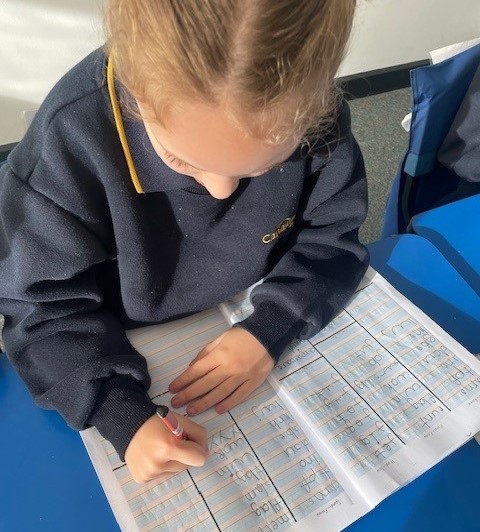
Phonics and spelling in motion.
Use data with fidelity
It’s easy to underestimate just how much knowledge teachers need in order to successfully shift practice in any one direction, Knight adds.
The ‘why’ here is critical, too, and then you can let your data do the talking, the principal suggests.
“It’s not just ‘this is the program we’re using right at the minute’, it’s [making clear the] research behind it and how the brain works and ‘this is why we’re doing daily reviews’ and,’this is why we need to be teaching in this particular way, because attention’s so fragile’.
“But I genuinely think teachers want their children to be successful, and we want our children to learn.
“And while there might be some approaches that appeal to us in certain ways because they’re familiar and they’re comfortable and they feel nice for us, when you get better data, teachers will run with that because that’s what they want, too.”
Take practising ‘fact fluency’ in maths, for example.
“If you’ve used your data, if what you’re doing is based on sound research and evidence, if you’re doing it with fidelity … we know we’re better to do short bursts of that every day, rather than one hour of practice on a Friday. The research shows us that.
“So if we implement things according to research and evidence, implement them with fidelity, do some data to monitor it, you can get that change, absolutely,” Knight says.
Talking improvement at scale
In October, Knight will be speaking as part of an expert panel at the Australian School Improvement Summit in Sydney.
“I’m so excited to be on that roundtable and to just hopefully bring some of my experience over the 15 years and across four schools where we’ve been able to get some really nice improvement in data in quite different contexts,” she says.
One point the leader would like to hit home with delegates is the importance of having a high quality curriculum that is carefully sequenced and enriched with domain-specific knowledge.
“When I first started and we really were focusing on reading in those early years, it wasn’t until we really added explicitly teaching knowledge to students that our writing data really improved.
“And that’s been an extraordinary thing to witness at my first and second school.”
Knight has previously helped to drive up literacy achievement at Canadian Lead Primary School in Ballarat, where she led something of a literacy overhaul.
“That school had 90 per cent of students in ‘strong’ and ‘exceeding’ in Year 3 writing.That’s extraordinary for a school whose more in the bottom third in terms of socioeconomic profile.
“And that is because those children are being very explicitly taught how to construct sentences, how the English language works and (there is) a brilliant phonics program.
“But the missing ingredient was teaching them knowledge, so they have information to write about.”
Knight is adamant that teaching students discipline-specific knowledge is the ‘greatest act of equity’ schools can undertake.
“That is really life changing for children who maybe are not able to access general knowledge, like the more privileged children are able to through holidays, visits to museums, books in the home.
“It’s incumbent on us to provide that for them. And it is the greatest act of equity to provide all Australian children with knowledge about the world, geography, history, civics and citizenship.
“It just enables them to participate in other areas of school in a much richer way because they know so much about the world.”
EducationHQ is a media partner of the Australian School Improvement Summit. View the program agenda and purchase tickets here.