
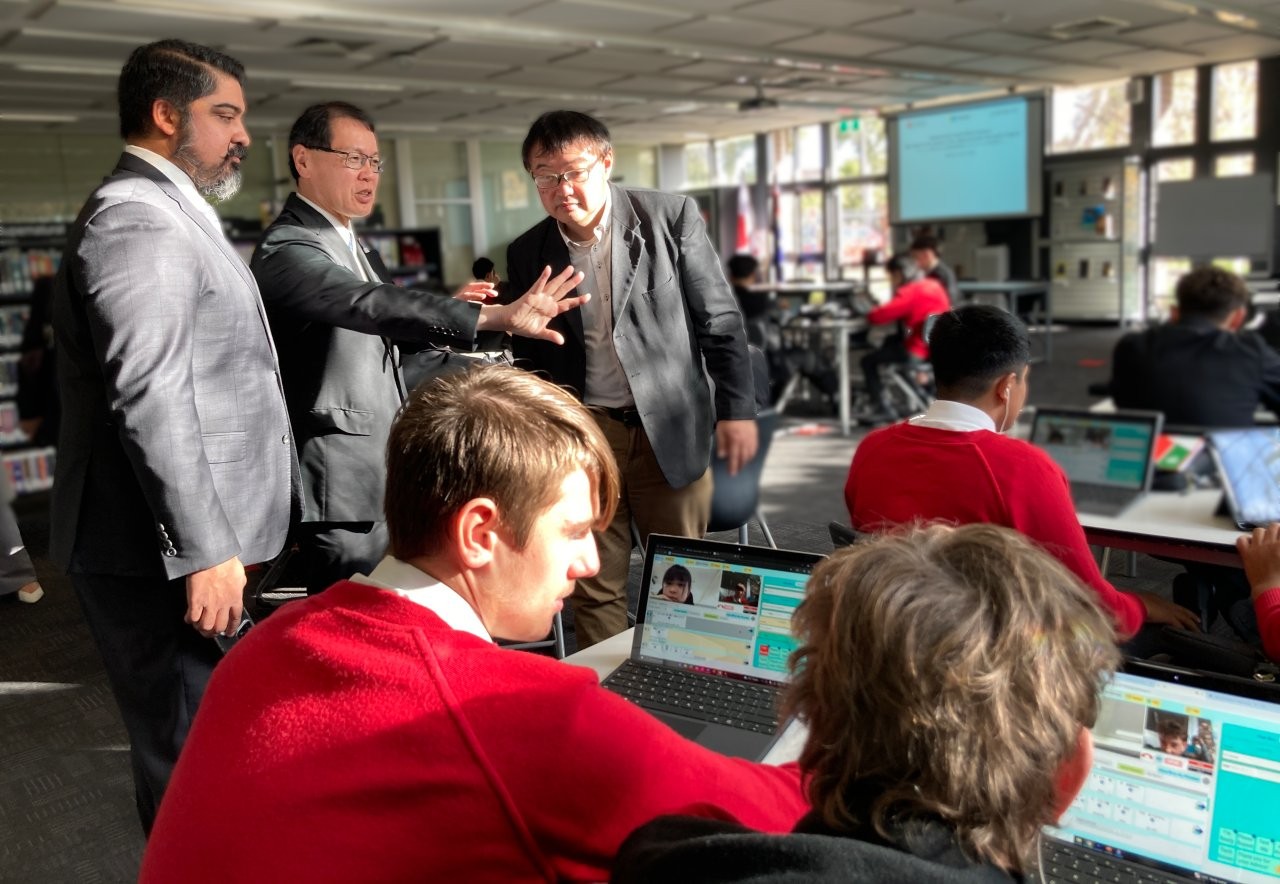
Linked to both Japanese and Australian school curricula, ‘Palaygo School’ is the first ever Japanese-Australian educational partnership project, and was launched at a special event in June at Caroline Chisholm Catholic College in Braybrook.
Developed in 2014 by Melbourne educational organisation Language Discovery Group to facilitate better learning of foreign languages among schoolchildren, Palaygo’s international language and culture exchange platform is set to transform languages education in schools by powerfully facilitating the research-backed adage that to effectively learn a language, the learner needs to practice speaking it, and preferably with a native speaker.
For the first time ever, primary and junior secondary students in both Australia and Japan are regularly engaging in effective, one-on-one conversations in real time in the classroom, Frank Noda, CEO of the Language Discovery Group, said at the launch.
“When students use the language they’ve learned in real-life situations with peers of a similar age, they become genuinely excited and engaged,” he said.
“They begin to see language not just as a subject, but as a fantastic tool for expressing their thoughts and interests.”

Consul General of Japan Tokuro Furuya told students their experiences of engaging with the real Japan are valuable not only for Japan-Australia relations but also for the future of the world.
Palaygo has been fully integrated into the language curriculum, Noda said.
“It’s incredibly heartwarming to see students immediately applying what they’ve learned in class.”
“They discover both commonalities and differences - sparking curiosity about other cultures and a desire to share about themselves.
“Through this process, they come to understand the purpose, potential, and joy of learning another language - often forming lasting international friendships along the way.”
At the launch, the Language Discovery Group welcomed the Consul General of Japan, Tokuro Furuya and local Maribyrnong City Council Mayor Cr Prideep Tiwari at the college.
The Japanese government has been closely following the development of the program, particularly due to the recent announcement that studying English is now compulsory for students in that country.
Furuya told students of his joy that many of them are learning Japanese and about Japanese culture, and in the process putting in place a strong foundation for future Japan-Australia relations.
“Your experiences of engaging with the real Japan are valuable not only for Japan-Australia relations but also for the future of the world,” he said.
Tiwari said it was particularly inspiring to see a project like this come to life in Braybrook – giving local students the chance to learn a new language while forming real connections with their Japanese peers.
“In a proudly diverse city like Maribyrnong, initiatives like the First Australia Japan School Educational Project play a powerful role in strengthening our community by promoting understanding, inclusion and friendship across cultures,” he said.
Caroline Chisholm Catholic College Head of Languages Mayumi Honzu said through the Palaygo program Australian students are more engaged in learning and discovering a new language.
“The program’s most innovative short-term benefit is that it enables active, real-time bilingual education to be practiced routinely in regular classrooms, rather than passively,” he said at the launch.
“In other words, it allows us to offer an environment comparable to that of bilingual or international schools, not only to a select few, in an easy and accessible way to a much broader audience, right within ordinary classrooms.”
Honzu said Palaygo has helped students test their abilities of what they learn in the classroom.
“They are also learning about students on the other side of the world enjoy doing, their fashion, what they like to eat.”
Also at the launch, Fletcher Bodman, a Year 9 student at Caroline Chisholm, said it was fun to interact with people from Japan and to learn about their culture.
Adrian De Abreu, a fellow Year 9 student, said he thinks technology generally makes it easier to learn and the Japanese students in the program help him and his classmates know how to pronounce words, giving them confidence and making it easier to communicate, especially as they have just started learning the language.
“We are able to build connection with native Japanese speakers talking to them daily across the world and this has helped to understand a lot more about their culture,” he said.
The experience also goes beyond online communication, with reciprocal in-person visits supported through the Palaygo Stay program.
Bodman and de Abreu said they were looking forward to meeting in person the friends they have made through their chats when Caroline Chisholm Catholic College hosts students from Osaka later in the year.
Palaygo has three levels: Palaygo Mail, a text-based chat program, Palaygo Talk, a real-time video calling platform, and Palaygo Tour, where students can travel to their online friends’ countries and homes to visit their schools.
Since the system does not require teacher support, many students can communicate simultaneously with their overseas peers during class time via Palaygo Talk and Palaygo Mail.
This is possible in part because Australia is uniquely positioned to conduct real-time exchanges both in the morning and afternoon school hours with Japan.
Plans are afoot to expand the number of languages offered, with Chinese to be added soon, and others such as Arabic to follow.