Rather than languish bored in classrooms, withdraw socially, or cruise though their schooling without ever quite realising their potential, gifted and talented children at the Melbourne school are given every chance to exceed and excel – both on the academic and wellbeing front.
Learning specialists Kim Holmes and Jason Mulder say before the school got serious about catering to high ability children, the data painted a concerning picture.
“Even though [those] students were achieving quite highly, when you looked into their data and what they were doing in classrooms, they didn’t always have expected growth – we expect students to achieve 12 months growth in 12 months’ time,” Holmes tells EducationHQ.
“And particularly our high-ability students weren’t always doing that because some of them were performing already at such a high level, [even] at Foundation…”
For Australia’s high achieving students, the latest PISA results have confirmed a clear trend since 2003: a decreasing number of high performers across all tested domains.
This finding is “just the tip of the iceberg” that signifies the continued systemic neglect of these children, according to Dr Michelle Ronksley-Pavia, an expert in gifted education from Griffith University.
There are clear systemic misunderstandings about who gifted students are and what gifted education actually is, the expert has warned.
“There are over 400,000 gifted students in Australia, and these learners can be found in all communities, from all socio-economic backgrounds, students with disability and neurodiverse learners (twice-exceptional students), First Nations students, and culturally and linguistically diverse students.
“These learners will not be okay just left on their own in classrooms to somehow nurture their own potential and talent development, or worse, be trapped in a lock-step education system, or be used as tutors for other students…”
Holmes says the first step is finding reliable tools and assessments to identify high-ability students in the classroom, as many can mask their talents and capability behind poor behaviours or quiet compliance.
“I’ve had teachers be a little bit surprised by, ‘oh, you’re putting that child forward for that test’.
“Because there’s different things in the classroom that you can look for.
“It’s not just all tests and what they can do on paper. It’s some of their behaviours, the way that they question and the way that they think.”
To this end Holmes and Mulder have worked with teachers on using enabling or extending prompts in their planning sessions.
“If you don’t have the opportunity to be extended in the classroom, you might not be able to ever really know what you can do. Our kids [can be] compliant, and some of them do fly under the radar and just sort of cruise,” Mulder explains.
“They go, ‘okay, I’m just going to do the bare minimum’. [But] you may be able to do so much more.”
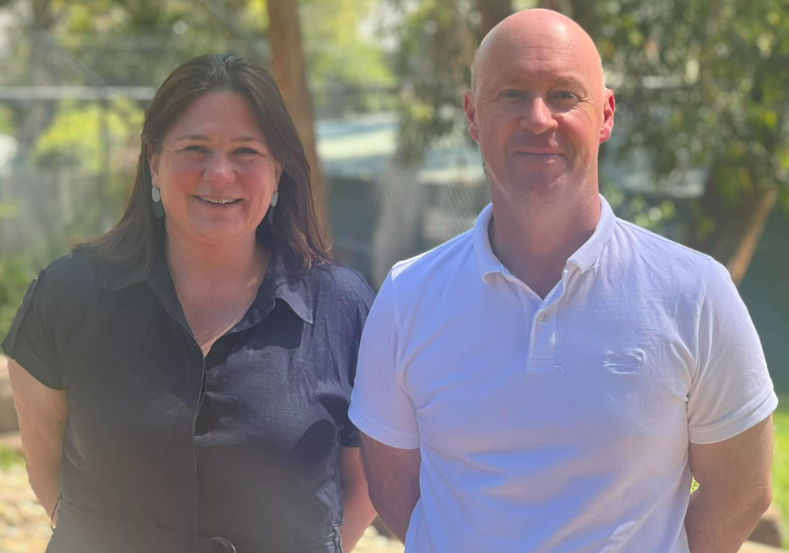
Kim Holmes and Jason Mulder are leading the charge to better extend and engage high ability students – a neglected cohort in schools, experts say.
Nailing teachers’ responsive teaching techniques has also been a focus of professional learning each week, with checking for understanding routines now a key feature of all teachers’ instruction.
“And in your questioning, how you question students and what kind of questions that you ask,” Holmes says.
“It’s done from work with formative assessment – we’ve focused a lot on speaking and listening.
“Because if you have a quiet classroom, you don’t always know what students are thinking.”
The change has meant students must now articulate their learning and ’actually give evidence for their thinking’, Mulder explains.
The pair say it’s important to look beyond just academic potential and allow students to show their strengths in areas that might not emerge in the average classroom.
Tracking is a big part of the approach at Heathmont East, Mulder adds, as is early identification, with the school using assessments conducted by Gifted Insights and Mensa.
“We know that they’re pretty clever kids, so we’ve engaged the school in an alliance with Mensa … they do testing with the students who are at least 10 years of age, and who are students that we’ve identified and tracked…
“A significant number, about two-thirds of those students, have been offered a position at Mensa.”
The school has made a mission out of implementing government initiatives for high-ability students and taking them to the next level, he adds.
Special masterclasses in Maths and English are delivered in partnership with a select number of other schools, while experts drawn from the community are brought in to grow and hone students’ talents and interests. Gifted education classes are scheduled weekly.
Dr Kate Barton, lead educator for gifted education at St Philip’s Christian College in Newcastle, has previously called out a curious contradiction in how gifted and talented children are thought to be best extended in the classroom.
While we know novice learners master new skills and knowledge most effectively via explicit instruction, the common thinking in gifted education is that inquiry learning is the way to go, Barton says.
“On the one hand, we’re encouraging an inquiry approach, and on the other hand, you’re looking at teaching students very explicitly and efficiently to manage the constraints of working memory.
“So, there seems to be a ‘never the twain shall meet’ with these two approaches to teaching.”
When working with gifted students, Barton says the idea is to ‘flip the triangle’ so that the amount of time spent on explicit instruction is a lot less.
“You can’t do away with the explicit instructions for gifted students. They still need teaching explicitly.
“However, they can move through it a lot faster. They need far fewer repetitions of things. You can commence fading, the reduction of prompts and support, much earlier and also fade at a much faster pace.
“You only need to tell them once or twice, and they’ve picked it up and then they can move straight into the application or problem-solving elements of learning.”
Last year Heathmont East took the Outstanding Provision for High-Ability Students award at the Victorian Education Excellence Awards.
The recognition landed as a surprise for Holmes.
“To be honest, for me it was a bit of a shock. I didn’t expect to win it.
“You always think that you’re doing what you can for the kids, and the best that you can … it was lovely recognition that what we’ve done has worked and helped other schools.”