As both a school leader and now CEO of Think Forward Educators (TFE), I know firsthand the immense pressures on teachers.
They face classrooms where students arrive with diverse needs and backgrounds. Traditionally, teachers have worked in silos - the thud of the classroom door signalling they must figure it all out alone.
My journey started with a small, persistent concern about how we taught, demonstrated by the following simple example.
Two students read: “The emu sat on the ute”. One begins at a disadvantage - not because they cannot decode the words, but because they lack the background knowledge to make sense of them.
If the student has never seen or heard of an emu (a large flightless bird) or a ute (a term that is not commonly used outside Australia), the sentence is unintelligible, failing to create the intended image.
As texts grow more complex, this gap in fundamental knowledge widens, showing why building both knowledge and skills matter.
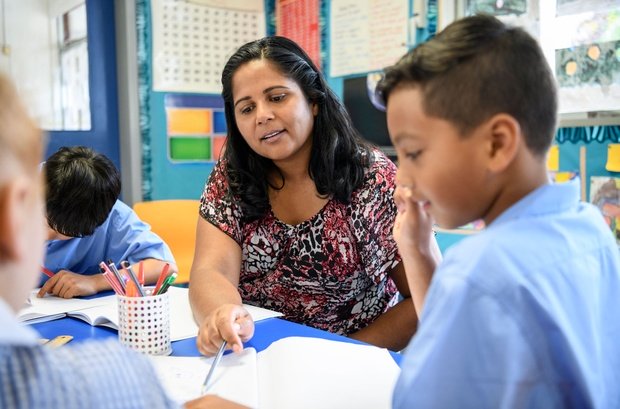
In one literacy classroom, children colour an emu and glue the sheet into a book. Engaging maybe, but is learning happening if they are not taught how to systematically decode and understand text?
In another, instruction is explicit. Even a word like “ute” is unpacked: explaining the u represents the long “oo” sound (as in use), showing how phonetic code enables reading independence.
Schools are expected to bridge wide gaps, encompassing behaviour management and complex social-emotional needs alongside reading, writing, and mathematics. This reality makes consistent, evidence-based teaching critical.
Expert-level skills - whether in reading, writing, maths, or sport - emerge when learning is scaffolded and practice is systematic.
When widely applied, teaching is professionalised: instruction becomes a discipline based on science, equity, and consistency, not intuition or “teacher magic.”
The curriculum that counts is what students remember. One child may recall the emu; the other will retain the phonetic code and strategies to tackle new text.
That is the power of explicit instruction.
Consider two Year 9 students. In science, reading about ecosystems and adaptation, one grasps concepts like food chains; the other struggles, not with words like biodiversity, but with the dynamic idea of interconnectedness.
In history, learning about the Federation of Australia in 1901, one understands self-governance and the Westminster system; the other struggles, not with decoding referendum, but with the complex idea that Federation fundamentally changed citizenship.
Without this foundational contextual knowledge in both subjects, the text remains largely inaccessible, regardless of students’ word decoding ability.
This isn't a reflection of innate intelligence; it's a gap in accumulated knowledge that schools must actively and explicitly fill.
Education writer Natalie Wexler (author of The Knowledge Gap), on her recent visit to speak to educators across Australia, highlighted how gaps in background knowledge most severely affect students who are already disadvantaged.
Every child deserves the best teacher, every day, in every classroom. Understanding the science behind how students acquire knowledge and skills changes everything.
It affirms that all human brains learn in fundamentally similar ways, whether they're mastering a new language, a complex scientific concept, or a musical instrument.
Tapping into this science is about designing instruction that respects how the brain learns. It acknowledges that all students, regardless of background, are more similar than they are different - proven time and again in disciplines where novices build to mastery.
Thankfully, many states are coming onboard, mandating phonics screening in the early years and driving explicit instruction as a key strategy for every classroom.
Think Forward Educators began as a grassroots movement promoting and sharing evidence-informed practices aligned with the science of learning well before this was common.
It has grown to over 30,000 teachers and continues to provide resources, professional learning, and networks to help every classroom achieve excellence.
Moving forward, TFE is focused on providing subject-specific knowledge for teachers and implementation strategies for school-wide change.
This means ensuring educators know how disciplinary knowledge happens - whether it’s concepts in Maths, Science, History, or The Arts - and how leaders can embed explicit instruction consistently and at scale.
Recently, I was named a Snow Entrepreneur by Snow Foundation. This once-in-a-lifetime opportunity will help us grow and reach more educators and more classrooms.
The science of learning can become the professional inheritance of every educator in Australia, as we continue to partner with schools to work from a base of strong evidence, backed by science.