

Be it the crowded curriculum, a lack of understanding in the broader community and in schools about the benefits of language learning, a dearth of language teachers, while a major priority in education systems everywhere else, in Australian schools language learning numbers are dropping at an alarming rate.
ACARA research from 2021, for example, revealed that while in 2006, 14 per cent of Australian students completing secondary school enrolled in languages at Year 12 level, this percentage fell to 10.9 per cent in 2011, and further still to only 8.6 per cent in 2021.
While universities search for answers, one has been trialling an exciting new collaboration model, where primary and secondary school learners are gaining weekly access a top-tier languages education.
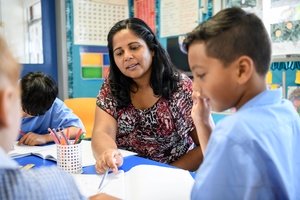
At Compass Independent School in Brisbane’s Kelvin Grove, University of Queensland associate lecturer Paola Tagini this year has been teaching regular Spanish classes to Year 1 to 6 students.
Tagini says she’s found the experience incredibly rewarding since the partnership began in January.
“I’m a junior teacher by trade so it has been wonderful to get back into a primary school classroom and pass on my passion for teaching Spanish.
“Learning a second language is very beneficial, especially to start at such a young age, so I am trying to bring energy and excitement to the students for that one hour a week.
“Hopefully they will continue to learn the language and one day I can teach them in a university setting.”
UQ’s Institute of Modern Languages (IML) has been coordinating the program and its Academics Program Manager Dr Claudia Vasquez Fernandez says the collaboration model is innovative and provides a practical response to the ever-growing need for comprehensive second language education in Australian schools.
“Being multilingual is the way of the world and learning a second language has never been more crucial,” she argues.
“We’re so much more interconnected these days, and communication with those who speak a different language and come from a different culture is always increasing.

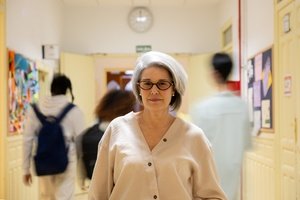
Associate lecturer Paola Tagini has been teaching regular Spanish classes to Year 1 to 6 students and says it has been wonderful to get back into a primary school classroom and pass on her passion for teaching Spanish.
Fernandez tells EducationHQ students learning Indigenous languages is also vitally important.
“It's all about being culturally competent and aware, so understanding that people see, feel and perceive the world differently - and especially from a young age, if we are able to see that there are people who experience the world differently to us, that actually can have really important repercussions in the future, a broader understanding, things like reconciliation and even peace, right?”
The researcher says studies have also proven other benefits such as improved flexibility in cognition and supporting their emotional intelligence and resilience.
Small schools are often limited to offering only one or two language classes, depending on the specialisation of the limited pool of teachers available to them, and it’s these schools the program is tailored to assisting.
The university at present has experienced teachers in 35 different languages available for schools to access.
Getting language experts at the university involved has not been hard, according to IML’s senior manager Pru Rolff.
“We reach out to them, basically. We present them with the idea and an opportunity that's come up and we ask them if they would be interested and able to fit this within their current schedules.”
Compass Independent School founder and principal, Alicia Gilbert, says the partnership has meant a highly skilled and engaging teacher has been made available to support students in real-world communication and cultural exploration.
“We are so excited to see our language program already sparking curiosity, confidence and a deeper connection with the world,” Gilbert says.
While the partnership has launched with a Spanish language program, Gilbert says the hope is an expansion of the partnership to include a range of languages in the schools secondary curriculum in 2026.
“This further collaboration will give our Year 7 to 10 students the opportunity to choose a language that interests them, rather than being limited to a single option,” she says.
Rolff says with the continued success of program, she’s hoping to see more schools signing on for the program.
“We know that Queensland schools are finding it hard to employ language teachers,” she says.
“So that's why we want to really reach out to them through this now and show them that this is actually working really well for schools and for the students.
“It's such a benefit for the students to learn from native speakers like Claudia and Paola. It's wonderful that they get to share the love of their culture and their history with these students.”
Rolff says it might be an opportunity for schools to consider languages they’ve never even thought of before.
“There might be a cohort in Far North Queensland that want to study Latin or maybe they want to learn Arabic or Italian - please, we want them to reach out to us and see what we can do to help them.”
“We are happy to work our curriculum to the audience that's reaching out to us and we come up with a package that suits them.”
For details about the the IML Bootcamp Language program for beginners, click here for information on the 2025 version of the program.