A pioneering partnership is marking a bold shift in how ethical development is addressed within Australian education, responding to a growing demand for schools to not only develop academic performance but also cultivate citizens capable of the critical thinking and moral courage required to navigate an uncertain, fractured and fast-moving world.
In a national first, Melbourne independent girls’ school, St Catherine’s School, is partnering with Cranlana Centre for Ethical Leadership to deliver a comprehensive ethics program to its Year 9 students.
Cranlana, previously called the ‘Cranlana Programme’, was first established in 1993 by the Myer and Fairfax families along with Monash University, joined by a shared passion to embed the practice of ethical leadership as a strategic and cultural asset within the more influential private and public institutions of Australia.
This groundbreaking program will see its executive-level ethics curriculum, which until now has only been rolled out to senior execs, judges and policymakers, embedded in the classroom.
Matt Finnis has been CEO of Cranlana for two-and-a-half years and brings rich career experience and expertise to the role.
Following his formative years as a commercial lawyer, Finnis was CEO of AFL club St Kilda for eight years, having previously led the AFL Players’ Association for nine years prior to that.
He believes teenagers face dilemmas now that most adults weren’t ready for until their 30s, and while as a society we cannot protect them from these challenges, we can give our future leaders the ethical framework to act on their values under pressure.

Cranlana CEO Matt Finnis says rather than a one-off seminar or values week, the program embeds ethical decision-making and leadership into a core part of students’ learning.
These ethical and psychological pressures young people face daily include everything from algorithmic decision-making and deepfakes, to the mental health toll of social media and the rise of generative AI tools such as ChatGPT and Google Gemini.
These have all raised questions about authenticity, academic integrity, and contributed to the erosion of critical thinking.
These are not just technological shifts, they are ethical dilemmas, and today’s adolescents are often left to navigate them without the language or frameworks to do so.
Finnis believes that if some of this thinking can be embedded in learners earlier on, then the lifelong impact could be hugely significant.
It’s not about telling them what to think or how to behave, it’s about helping them develop the tools to think ethically, under pressure, and with others in mind, he says.
“It’s this analogy of compound interest, which Einstein referred to as the eighth wonder of the world.
“This is an opportunity to compound ethics.
“If you give young people some of these skills, (such as) moral reasoning, an understanding of the value and role that virtues play in character development, then as it is that they then go into the world and deal with the complexities and challenges that they’ve no doubt going to encounter, then perhaps they can bring some more evolved muscles and ideas to the table.”
The program, which has been piloted this year, consists of an intensive two-week residential in Narmbool, an historic 2000 hectare pastoral property 30 minutes from Ballarat, along with bridging and capstone elements across the year that connect timeless philosophical wisdom with real-world application.
“It’s an immersive experience where the students are away from home for a fortnight,” Finnis explains.
“They’ve got no mobile devices, they’re left behind, so there’s a space for ethics, which is being deliberately curated.
“You’re opening their minds, but you’re doing it in the natural environment, which gives them space to walk and to talk and to think.
He says it’s removing some of the distractions of everyday life, which get in the way and can dull some of the thinking that’s required.
Finnis says the program starts with empowering the students with some ideas, some lenses, if you like, to start to evolve their approach to decision making.
“And to start to think about things like justice, and fairness, and power, so they can then have some capacity to then apply this critical thinking to a range of different challenges.
“And those challenges are things like climate change, they are things like the increased polarisation in society, and certainly the growth in AI.”
In many respects, Finnis says, it’s about trying to equip students with some skills and mindsets that allows them to combat the power of the algorithm.
“… because it’d be pretty easy as a young person these days to be a bit overawed by the number of challenges coming down the pipeline,” he explains.
“It can feel a bit existential, some of these things, so we want young people who are feeling aware to also feel empowered, in terms of … the concept of agency — what is my role in the world and how do I bring that to bear?”
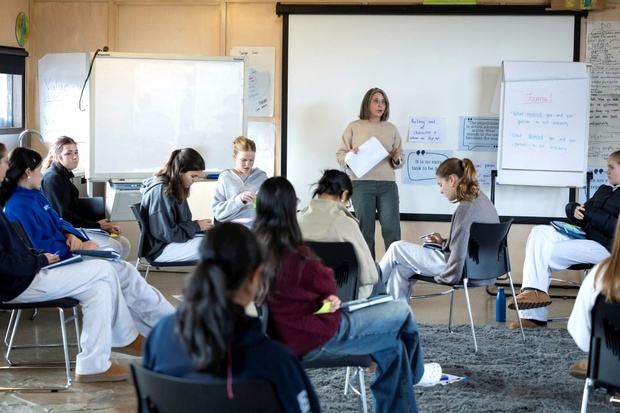
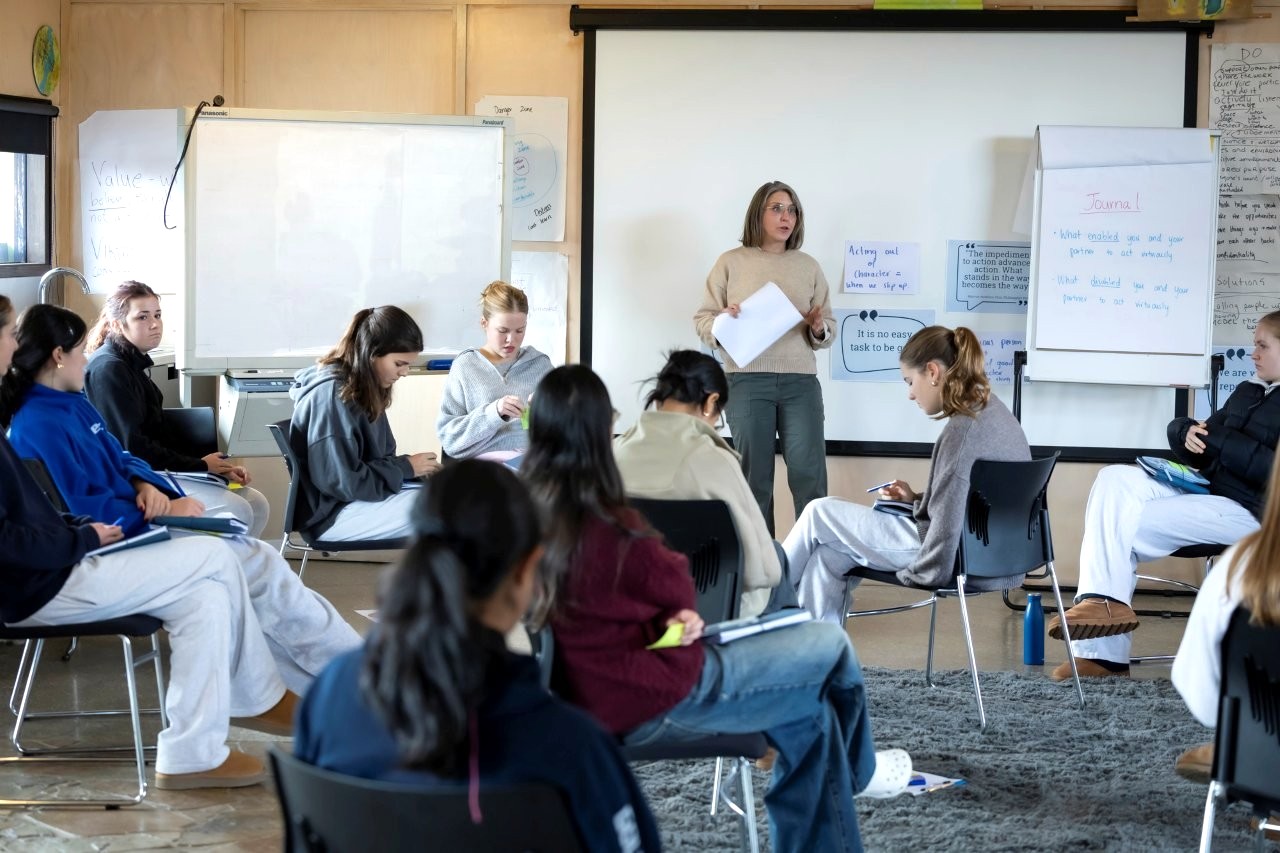
The program includes workshops spread over the two weeks — some in the classroom, some sitting around a fire, some are done through walking and talking, and a range of different provocations, which are put before the students to unpack.
“There’s also a significant journaling component, whereby you’re encouraging really active reflection, and recognising that knowledge in the age of AI is becoming a bit of a commodity, but knowledge plus reflection equals wisdom,” Finnis shares.
“If you can start to build some habits around the way in which they do some collective, but also personal reflective exercises, then we think that’s a muscle worth building and taking back into their time back in the real world, if you like.”
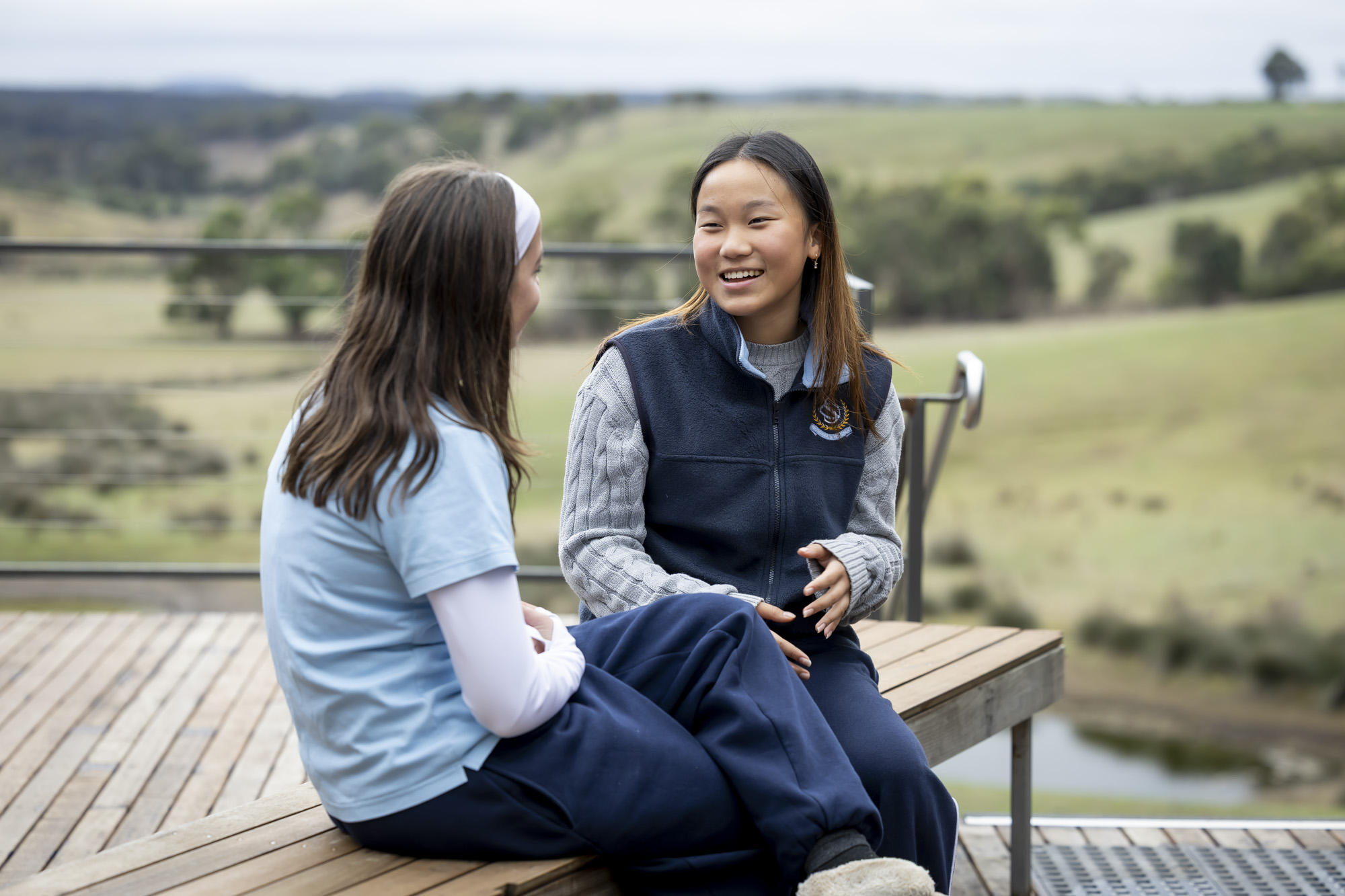
Students engaging in the two-week program must leave their mobile devices behind. In historic Narmbool's natural environment, they have space to walk and to talk and to think without the distractions of everyday life.
Drawing on everyone from Plato to modern-day economist and philosopher Amartya Sen, it’s developing students’ capacity for ethical thinking and moral reasoning at a crucial stage in their development
“Our role is to be able to translate some pretty timeless ideas through some contemporary measures that engage these young people and capture their interest and then promote the kind of critical thinking that we’re looking for,” Finnis explains.
St Catherine’s and Cranlana hope the partnership will serve as a model for other schools, proactively equipping the nation’s youth with moral courage and the ability to make ethical decisions.
“Our ambition is that the learnings from this program can be applied and transferred for the benefit of broader schools and a broader student base as well,” Finnis says.
“We think that the need has never been greater and we’ve learnt a lot in the process that gives us great confidence in how the program will be received.
“… we think that if you can spend the time to think deeply and creatively about how it is that we can introduce and then engage young people in these timeless concepts, that young people will really embrace that, if you create the space to do that.”
Principal of St Catherine’s, Natalie Charles, agrees that the program is ultimately about making space — physically and symbolically — for her students to engage with fundamental questions of individual and collective goodness, to explore deeper truths about themselves and their place in the world.
“We want our students to leave us feeling optimistic about the future and their capacity to contribute in ways that ultimately enrich the very fabric of society at a time when the pursuit of truth, beauty and goodness has never been more pressing,” she says.