


In 2025, despite almost four decades of societal evolution and advancements in equality, while things have improved, for many the quote’s accuracy remains.
A landmark new report released last week by The Men’s Project, confirms that many young people across Australia identify that significant pressure remains on boys to adhere to rigid, restrictive ideas about masculinity.
While most young people reject these pressures, a small but significant number of boys endorse these beliefs and are themselves more likely to get into fights, sexually harass others and engage in risk-taking behaviours such as alcohol use and gambling.
The Adolescent Man Box report, based on an Australian-first survey of 1400 adolescents of all genders aged 14 to 18, has found that young Australians overwhelmingly believe there is pressure on boys to appear strong, confident and tough at all times.
The study maps agreement with these and other statements that comprise the ‘Adolescent Man Box rules’ against life outcomes – including aggressive behaviour, mental health, bullying, pornography and image-based abuse, and risk-taking behaviours.
Among the boys who most strongly support the Adolescent Man Box rules, disturbingly, a third said they’d retaliate when faced with rejection, more than half said it’s OK to text or call a partner multiple times, or send their partner messages on social media when they don’t respond immediately – or when they’re frustrated with them.
It’s no surprise then, that the cycle of family and gendered violence rolls on.
Drew Hanger is Manager of Education at The Men’s Project.
Hanger was a secondary school teacher and a wellbeing coordinator before joining The Men’s Project and leads a team that is state government funded to work in 240 schools over the next four years, to deliver teacher professional development, work with students directly and also engage constructively with parents.
While he believes there is much reason for hope based on the report, ge says the challenge that we need to all confront as a community is that boys do feel an intense pressure to always appear tough and confident no matter what’s happening.
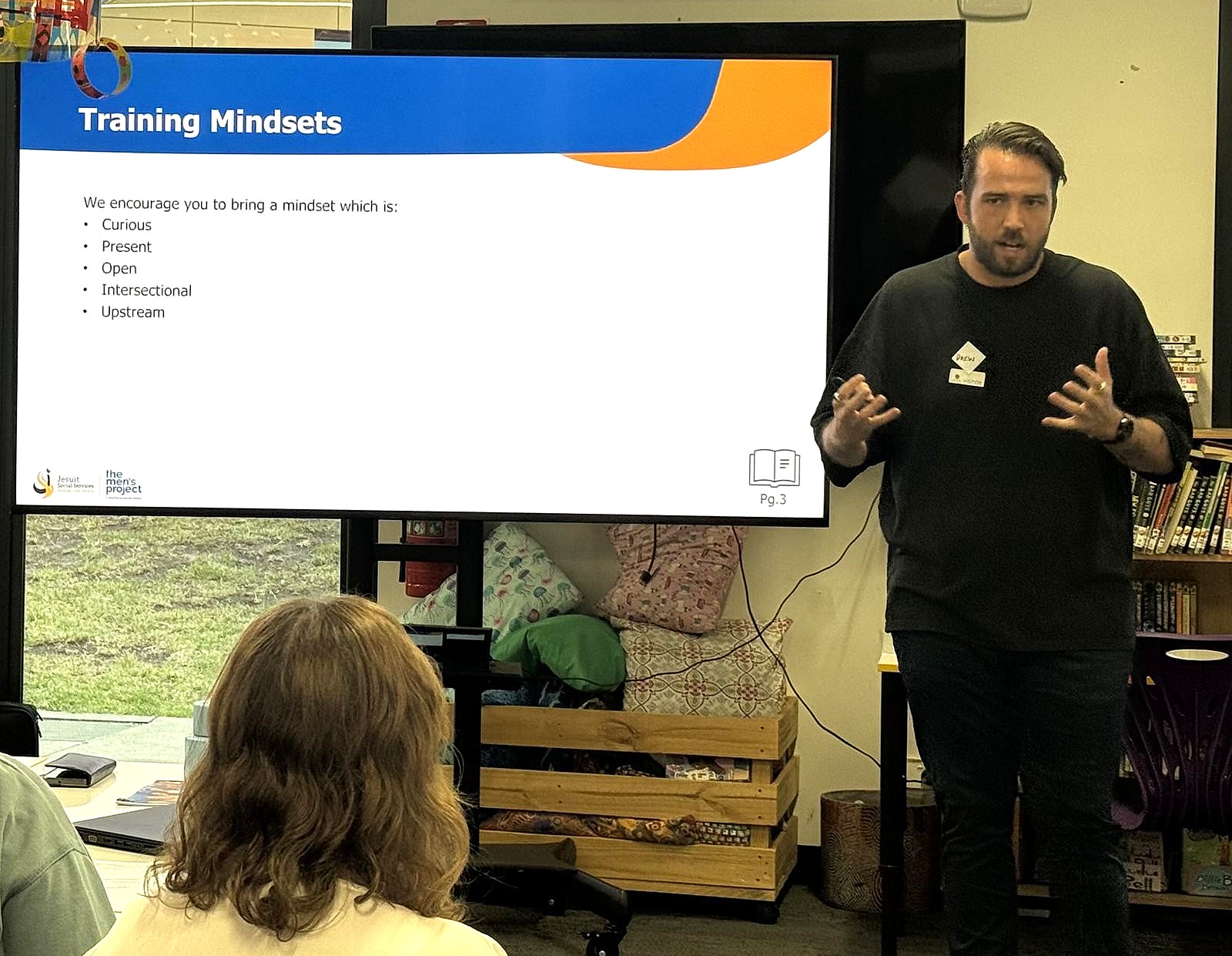
Drew Hanger, pictured above right, says The Men’s Project’s number one aim is to reduce violence and harm, by doing preventive work to stop those things from occurring to start off with.
“They really feel that they’ve got to perform or, or have this social pressure to always be strong, tough, all the time, regardless of what’s going on,” Hanger explains.
“A challenge that we need to confront is the small, troubling number of boys who also have violent supportive attitudes, or retaliate when they’re rejected, have engaged in physical violence, sexual harassment, and also see or engage with sexually explicit deep fake images.”
Many of these boys, Hanger says, are accessing pornography that also depicts unsafe and aggressive and non-consensual acts.
“Their mental health is also another concern. Many of those boys reported having poor mental health and never seeking support for personal or emotional problems.
“They are the things that we do really need to shine a light on, the realities of what it means to be a teenage boy in Australia and their critical challenges.
“But then at the same time, we also need to look at, despite the growing ... online influence (and) young people spending time online, they also rely on their real life relationships, like their parents for guidance or personal support and understanding of what it means to be a young teenage boy.”
Encouragingly, Hanger says boys in the survey feel more like they can show vulnerability, and remain optimistic about their future.
“Most boys actually reject the narrow and restrictive views of masculinity (encapsulated in the Adolescent Man Box), especially the one about needing to be emotionally stoic,” Hanger says.
“So that’s promising, that most boys reject these restrictive views, but the ones who do endorse or believe them, there are some challenges in there with their behaviours that we’re seeing.”

The report contains a range of recommendations with calls to action for government, service providers, schools, parents and digital technology companies such as social media and pornography sites.
Executive Director of The Men’s Project, Matt Tyler, says while the stats are alarming, he agrees there is reason for hope.
“Almost all boys told us they are disturbed by the harassment of women and girls,” he says.
“Across all respondents, 84 per cent indicated they feel mostly positive about their futures and many said they could be vulnerable with a family member or a friend.
“More adolescents reflected that parents had a bigger impact on their own ideas about how teenage boys should act than the media or other online influencers,” he says.
The report contains a range of recommendations with calls to action for schools, government, service providers, parents and digital technology companies such as social media and pornography sites.
These include calling on federal, state and territory governments to commit to targeted initiatives focused on addressing the issues raised in the research, drawing on the Adolescent Man Box to inform place-based youth violence prevention efforts, and the establishment of a dedicated National Action Plan for children and young people who have been victims of violence or abuse.
These involve a transformational investment in targeted, trauma-informed interventions and support services focused on healing.
Hanger says schools and teachers don’t get enough credit for their “heart and their care and concern for the young people in front of them” .
“Schools and teachers are doing a really good job,” he says.
“They’re trying to teach and deliver the curriculum and differentiate and do all those important things, and are trying their best with the situation and given the restrictions they’ve got.
“But while we’ve got really good up-to-date curriculum that reflects what we’re seeing, some of these things around image-based abuse or digital surveillance online, it takes a while for the curriculum to catch up with that.”
Hanger says it is critical that we’re responsive to what’s actually happening for young people.
“And just the space to be able to have these critical conversations, like having a dedicated time for respectful relationships or wellbeing and things like that are important, because then there is time to dive into these topics and also teachers having the right professional development and support to do so.”
Hanger believes it is imperative that teachers are “really curious” about what young people in their classes are talking about.
“Maybe what they’re watching, what some of their ideas are,” he says.
“I think finding out a bit about that and then just walking alongside them. It’s important that they’re accountable for their actions, but also that they know they’ve got someone there.”
The idea that some boys are not seeking help for any personal problem is concerning, he says.
“If they are worried about how they’re relating to their partner or their friends or their pornography use, for example, we want to know they’ve got a champion or adult they can turn to for that support as well.”
On top of their school programs, The Men’s Project has a Healthier Masculinities series available for any schools nationwide, scripted, co-produced and developed in conjunction with Clickview Education, which is all about Adolescent Man Box pressures.
It’s free for schools to use with a lesson and a teacher lesson pack for each video.
“Our number one aim is to reduce violence and harm, and so we’re always doing preventive work to be able to stop those things from occurring to start off with,” Hanger says.
So, for example, helping a young boy have a healthier sense of self when he does get a ‘no’ or he’s rejected, he suggests, and that his whole identity isn’t associated with getting the win, for example, in whatever context that might be.
“That’s a really big part of our work, like ‘how are we helping young boys with the skills and emotion development to go, ‘it’s OK that it was a ‘no’, or you were told you didn’t win or you didn’t make that team or whatever it might be, or she said she’s not interested.
“Like, how do we give them enough that there is a base value? They understand their values and their worth outside of that Man Box, so there isn’t that retaliation that will be there?
“Even if it’s a bit messy and it’s a bit hard, but I think we can’t shy away from those things like ‘a teenage boy has a girlfriend and he should know where she is all the time’ – that’s not appropriate, and having some of those conversations.
“Just don’t beat around the bush, I think is one of the things I would say.”