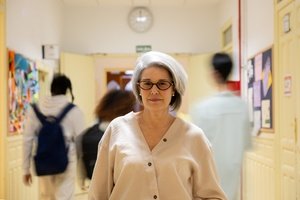


Former teacher Glenys Oberg can pin-point the precise moment she opted to quit the profession and make the switch into academia.
“We were having the same conversations in the staffroom all the time, talking about concerns we had, problems that teachers were having, why they were thinking about leaving, but nothing was ever getting done about it,” the researcher from the University of Queensland recalls.
“So, I just kind of thought, ‘it’s time for me to stop complaining and try and do something’.
“And rightly or wrongly, academia is one place that you can go into to amplify other people’s voices that aren’t being heard.”
A ‘sacrificial’ career
Acting on this mission, Oberg has recently canvassed the experiences and reflections of 57 teachers in a study that lays bare the significant ‘moral injury’ they endure in their roles.
Themes of leadership betrayal, ethical conflict, and compounding systemic pressures emerged from the teachers’ accounts.
A huge problem, the researcher argues, is that teaching has been framed as a career you sacrifice health and wellbeing to.
“Look at the teachers who are sitting on their couches at nine o’clock at night watching a movie, and they get a parent email come through, and they feel that they have to respond to it there and then, because that’s how their profession is set up.
“It’s not set up as a job – and it is more than just a job, not everybody can do it,” Oberg says.
The societal narrative has to shift here, she adds.
“At the end of the day, these are human beings who should have the right to disconnect. Not just that, but they’re going to need to disconnect for their own mental health and longevity in the profession.
“And I think that’s where that argument comes in, that ... not just society in general, it bleeds through the department, too, that there’s this feeling that teachers are expected to go above and beyond.”
She points to the EB negotiations currently underway in Queensland with the state’s education department, with teachers once again cast in an untenable predicament.
“Schools and teachers feel like they’re kind of cut off at the knees with how they can respond, because no one really wants to go on strike, because of the kids,” Oberg says.
“No-one wants to be the one saying, ‘no, I’m not going to do these extra meetings every week without getting paid’, because the kids are the ones that will benefit if I do go.”
Thus, many teachers simply put up with going without pay or acknowledgement of the work they undertake, Oberg says.
“And it’s not about money. It’s just about being treated as a professional. Acknowledged for what they have to offer.”
Make emotional resilience training part of ITE
While a dramatic shift in the broader expectations we have of teachers is urgently needed, initial teacher education (ITE) can’t ignore the complex emotional requirements that are now part and parcel of teaching, Oberg says.
Universities ought to explicitly train our preservice teachers in ethical decision-making, systemic analysis and emotional resilience, ensuring they can better navigate the moral complexity and demands of the job, she contends.
Her study found evidence of ‘role overload’ in teachers’ commentary, with participants reporting being ‘stretched thin’ in their attempts to balance responsibilities as educators, caregivers and administrators.
“We are told to balance being a carer, a social worker, and a teacher, but none of those roles are properly supported. It’s impossible to do them all well,” one teacher shared.
Another spoke of the emotional toll of their all-encompassing role:
“I feel like I’m drowning in trying to meet the demands of the system while actually helping my students. There’s no room to breathe.”
Another reported that “being a teacher is no longer just about teaching. It’s about being everything for everyone, and it’s unsustainable”.
Oberg suggests ITE needs to step up here.
“When you look at other professions, particularly helping professions, where they have a lot of interaction with client suffering, trauma - look at a social work degrees, every course in a social work degree includes some aspect of self-care.
“When you’re working with families experiencing domestic violence, for instance, ‘this is what you need to do from a professional realm and here’s how you then look after yourself after that’, because it can be really tough.
“I think teachers need something similar, where they’re being taught how to look after the kids but also how to look after themselves, because you can’t pour from an empty cup.”
Unhelpful divisions
Education seems to be riddled with a pervasive ‘us and them’ attitude too, Oberg flags.
“There’s a huge amount of ‘them versus us’ thinking: parents versus teachers, and teachers versus principals, and principals versus policymakers.”
And meanwhile, our kids “are not OK”, she adds.
“Why have we got so many kids who can’t go to school because of emotional and mental health concerns? Why have we got more kids than previously turning to substance abuse or crime?
“These are all symptoms, they’re not the problem – kids don’t want to go to school in record numbers, teachers are leaving in record numbers – maybe those two things are linked somehow.”
Instead of issuing blame, we ought to realise we’re all in education for the same reasons and have a conversation about what can be done to change teachers’ working lives for the better, Oberg suggests.
“Everyone knows that teachers are struggling.
“So instead of barrelling all this money into attracting new teachers, why don’t we look at what’s going on and start thinking about how we can retain some of the incredibly skilled teachers and principals that we’ve got?”