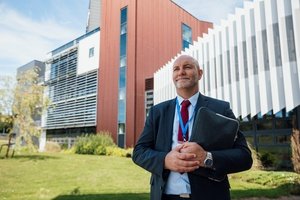


Sean Inman, wellbeing coordinator and head of soccer at St Peter’s College in Adelaide, says the school takes wellbeing so seriously that even half-time talks on the sports field are informed by positive psychology and a coaching mindset that values things beyond sporting prowess and runs on the board.
It’s a shift in focus that has, over the better part of a decade, come to ‘influence the whole culture’ of the place, the educator says.
“It was groundbreaking for me as a very experienced soccer coach.
“I suddenly started changing the way I did every team talk, because I’ve never talked about what was going well. You know, you always jump on what needs to be done better or what we’re doing badly.”
Inman says students’ participation and enjoyment in sport is just one area that’s benefited from the school’s mission to centre wellbeing at the heart of its operation.
“I think people miss an important part of this; we don’t understand that if you get the wellbeing culture right, everything else benefits as well, from on the sporting field to in the classroom, to just across the school, generally.
“I’m not saying we’re always the strongest teams. I think the way they enjoy sport is the key and that’s been, I suppose, a challenge for our parent community to grasp that.
“While sport has been measured in terms of ‘results only’ in the past, maybe through their generation, we like to measure it by the enjoyment of the experience.”
All sports staff are trained to coach students towards more than just winning on the day, Inman adds.
“And that might mean that we’re not always in front on the scoreboard, but are we looking out for our teammates? Are we playing the right way? Is the character development obviously on show?
“All those other things matter for us more.”
In fact, Inman says, Health and PE has proven the perfect faculty to house wellbeing as a standalone subject in its own right.
“I think that’s a really important part of our journey,” he explains.
“The problem with wellbeing teaching, is finding the passionate staff and being able to timetable them all the time to deliver wellbeing. It’s very difficult.
“We tried asking the mentors or the pastoral carers to teach it … it didn’t always work.
“Whereas now we’ve basically called our Health and PE faculty, ‘Wellbeing, Health and PE’, so now on the timetable, that’s the subject the boys go to.
“And that’s made for a real improvement in how we do it, I think. It’s been a very important development in the last two years.”
St Peter’s ‘wellbeing journey’ was ignited back in 2012, thanks to a visit from internationally esteemed psychologist Dr Martin Seligman whose efforts to scientifically explore human potential and the pursuit of happiness led to the development of his influential PERMA model of wellbeing.
The model is made up of five components that people pursue, all of which are intrinsically motivating and contribute to wellbeing.
The five elements include:
- Positive emotion
- Engagement
- Relationships
- Meaning
- Accomplishment
“[Our previous headmaster] invested in flying over Professor Seligman from America, who’s regarded as the ‘grandfather of modern wellbeing’,” Inman reflects.
“He came over with his entire team from ‘Penn’ University and lived here on-site at St. Peter’s College in Adelaide…
“He told us all about this new wellbeing concept that was being developed and basically trained all the staff in a week-long training camp, if you like, during the July holidays in what we called then ‘positive psychology’ or ‘positive education’.”
The effect on teachers was profound, Inman says, but when it came to practical implementation, resources to pick up and run with were somewhat thin on the ground.
“Every member of staff walked out at the end of this week of training, really struck by the potential of this new world of positive psychology, but not really knowing exactly what to do in the classroom.”
Armed with a ‘skeleton framework’ from their esteemed guest, the school went about introducing timetabled wellbeing lessons for Years 7,8 and 10 the following year.
But it was when Inman was promoted to the head of wellbeing role that things really started to shift.
“[My remit was to] oversee the curriculum but also oversee a wellbeing focus across the entire school, because we felt it was kind of isolated within the classroom until we made that development.
“And then it became, for example, how do you embrace wellbeing in a house area? How do you embrace it on the sports field?
“We started to give year-level talks, and I still give one each week to a different group about wellbeing and leadership, for instance.
“So, from that phase, it moved well beyond just the taught theory lesson in the classroom – it’s the backbone of everything that we do, to be quite honest,” Inman shares.
Across all subjects, teachers were upskilled in how to make wellbeing a cornerstone of their pedagogy.
“And that’s things like … having brain breaks, that connection with students on a deeper level than just academia,” Inman adds.
The school’s academic results have never been stronger, the educator reports.
“It’s influenced the whole culture of the school in the sense that it’s a more empathetic environment than it’s ever been before.
“There’s a clear demonstration of a high level of social intelligence that’s developed as a result of our positive psychology emphasis.
“I think boys get the importance of kindness and compassion and mindfulness and all those key concepts that ensure a good culture across the school.”
The environment is a ‘very different’ one to that which Inman experienced when he first arrived at St Peter’s in 2003.
“It’s now softened, necessarily so. That’s been a very obvious gain from our positive psychology focus.”