It’s a challenge many Australian secondary schools are grappling with, with research showing a significant number of children are entering Year 7 with literacy skills sitting well below what’s needed to access Tier 1 classroom learning.
At Hampton Park Secondary College in Melbourne’s outer suburbs, leading literacy teacher Teagan Spence has taken direct action on this front, designing a specialised literacy invention program that’s giving at-risk students foundational reading skills – minus any primary school flavour.
“I’m not sure if it’s a roll-on effect from COVID or not, but we are seeing more and more students coming into the school who are working at Foundation to Grade 3 in their reading ability,” Spence tells EducationHQ.
“And as secondary teachers, that’s obviously quite challenging because we are not trained to teach the junior curriculum.
“Our teachers are experts and have an additional degree in their methodology. And to have that additional challenge of ‘how do I teach science to a student who’s reading at a Prep level?’ (is tricky to navigate).”
Students that are EAL learners and others with sizeable gaps in their literacy skills are now funnelled into one of two interventions, both of which are aligned with the science of learning and grounded in explicit direct instruction and systemic synthetic phonics.
The first doubles down on phonics and the second drills down into granular reading comprehension skills.
“This targets our students who are working three years below their enrolled year level, however, they don’t need as much support in decoding…” Spence says.
“When we look at The Simple View of Reading, we have a very simple formula which looks at: decoding x language comprehension, equals reading with meaning…
“Oftentimes, this is where students have gaps in their learning or they don’t necessarily have first language literacy, so it’s lots of work around vocabulary, lots of work around explicitly teaching comprehension skills and strategies.
“And then we’re looking at text analysis and writing as we try to realign with [core English classes],” Spence says.
A key consideration is maintaining students’ sense of dignity throughout the intervention, she says.
Learning phonics at the secondary level need not be an infantilising experience, she suggests.
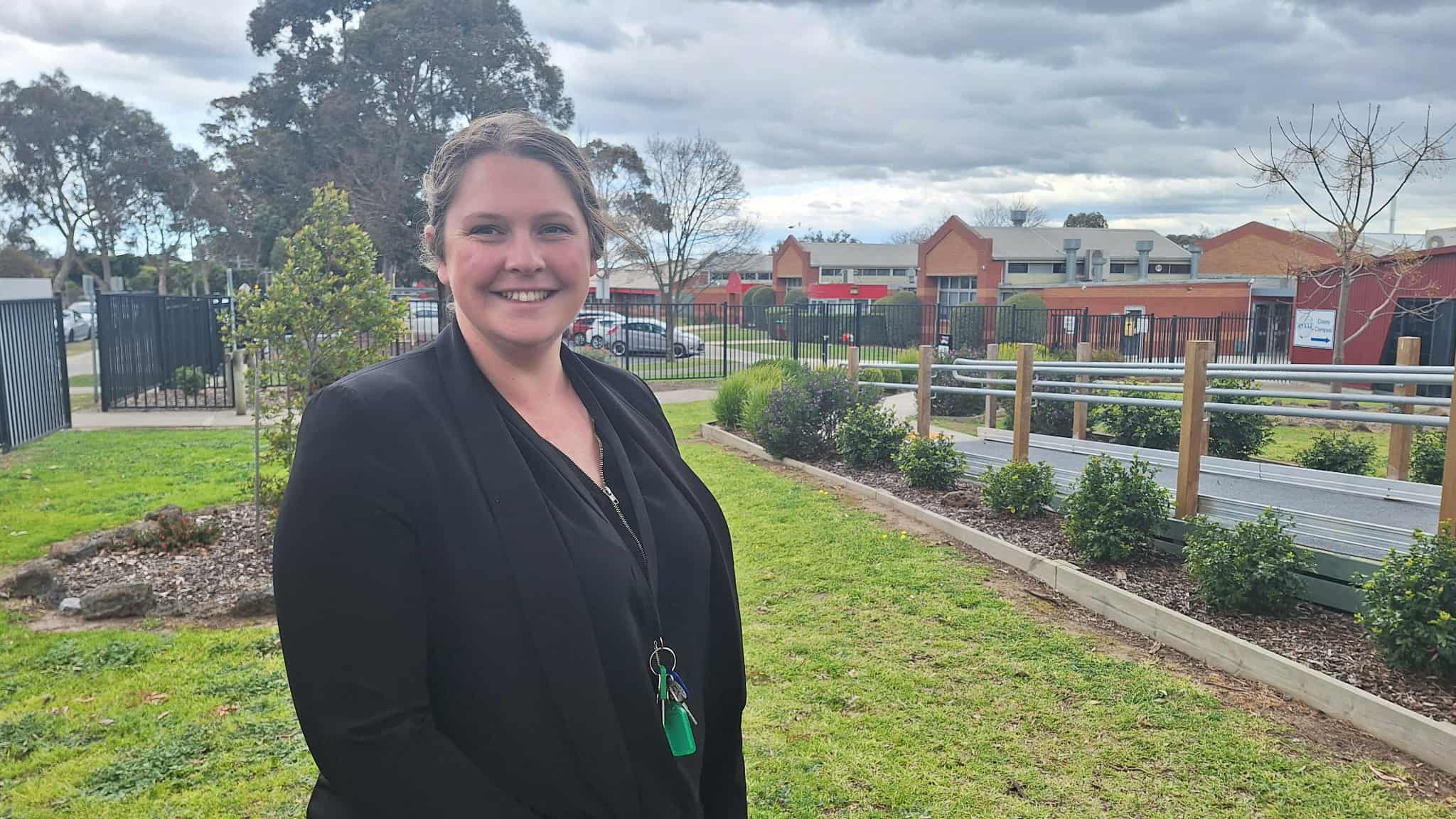
Leading literacy teacher Teagan Spence says the use of academic language is key to the program’s success with secondary students.
After scouring multiple programs, Spence settled on UFLI Foundations, an explicit and systematic program that follows a careful scope and sequence designed to ensure students can learn to apply each skill with automaticity and confidence.
“We run this program all the way up to Year 10 and we don’t have any students feeling like this is not something that they should be doing or it’s not something where they’re losing that dignity.
“We make sure that teaching staff use particular terminology so that it removes it from being, ‘we don’t have a silent E’ (like what might be said in primary school).”
The use of academic language is key to the program’s success here, Spence says.
“Our students are referring to things as ‘phonemes’ and ‘graphemes’, they can identify whether there’s ‘digraphs’, ‘trigraphs’.
“And so [this creates] that integrity for the program, but also provides another element of rigour, because now they know terms that their peers don’t know and it gives them that [extra] insight.”
Following an explicit direct instruction approach also ensures that students are challenged and engaged as they progress toward mastery, Spence says.
“We’re bringing in common strategies [such as] retrieval practices, questioning using mini whiteboards...
“We’re bringing in pair-shares and all of those things. So, it’s very fast paced, there’s constant teacher checking for understanding and constant feedback,” she notes.
What launched as a soft pilot in 2023 has now become a larger trial running across Years 7-10 at Hampton Park.
Results to date have been entirely encouraging, Spence reports.
Having tracked the same cohort from 2023-2025, the educator says the data speaks volumes.
“We’ve seen a substantial impact on the students’ literacy.
“In 2023, we had 25 per cent of this cohort reading below a Grade 3 level, and we’ve managed to decrease that to 18 per cent.
“It’s pretty cool because there’s the saying, ‘you learn to read until Grade 3 and then after Grade 3, you read to learn’. So those students are able to engage a little bit more.”
Some 53 per cent of students were reading below Grade 6 level before the soft pilot was launched. That’s now at 46 per cent.
“We’ve seen 32 per cent of students who are in literacy support move into mainstream English...
“When we look at their ACER PAT reading data, we’ve seen 28 per cent of students achieve two or more years’ reading growth in a single year that are in those literacy programs.”
This is a truly phenomenal outcome for these children, Spence says.
“It just shows what happens when you identify a gap and close that gap.”
The impact has spread out into the community, too.
“We spent a lot of time resourcing readers for the students that are at their level, but are also age-appropriate.
“A student can come in and find a decodable book at a foundation level that is targeting 13- to 17-year-old themes. And so they have that dignity in their reading,” Spence shares.
Students are now taking these resources home to help their families learn to read and speak English. For those that rely on their children to navigate the language barrier, this is a really important shift, the teacher says.
“The students are responsible for all of this administrative stuff [for their family], and their families are heavily relying on students who also are struggling in their literacy.
“And so (this is about) trying to give that power back to those parents, but also allow children to be children, and not have that responsibility of [say] filling out visa forms on behalf of their families.”