
The mystery intensifies for those who have never actually met a scientist, which is often the reality for many who live outside Australia’s capital cities.
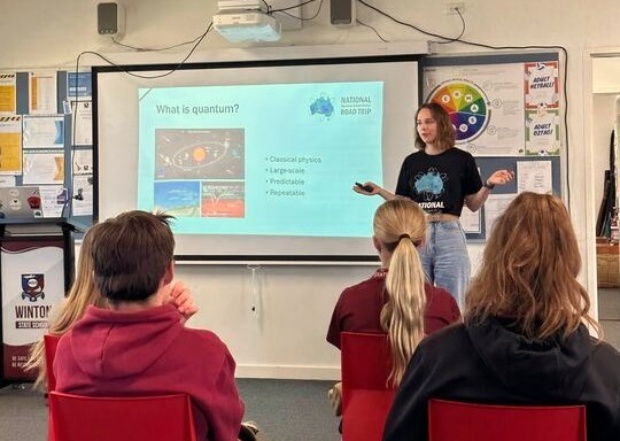
The National Quantum & Dark Matter Road Trip was created to change that in the shape of a team of young scientists and science communicators traveling across the country to expose regional and remote communities to the cutting-edge science happening in Australia.
Over time, we learned something surprising: students might be interested in quantum and dark matter, but they are also really curious about the scientists themselves.
In Q&A sessions, one question has consistently popped up: What’s it like to be a scientist?
As a result, we have shaped our sessions to enable this informal discussion of life as a scientist tackling the great mysteries of the Universe – what we actually do on a day-to-day basis, which paths have we taken to get here and who are the different kinds of people who work in science?
These conversations help demystify the field and make it feel more accessible.
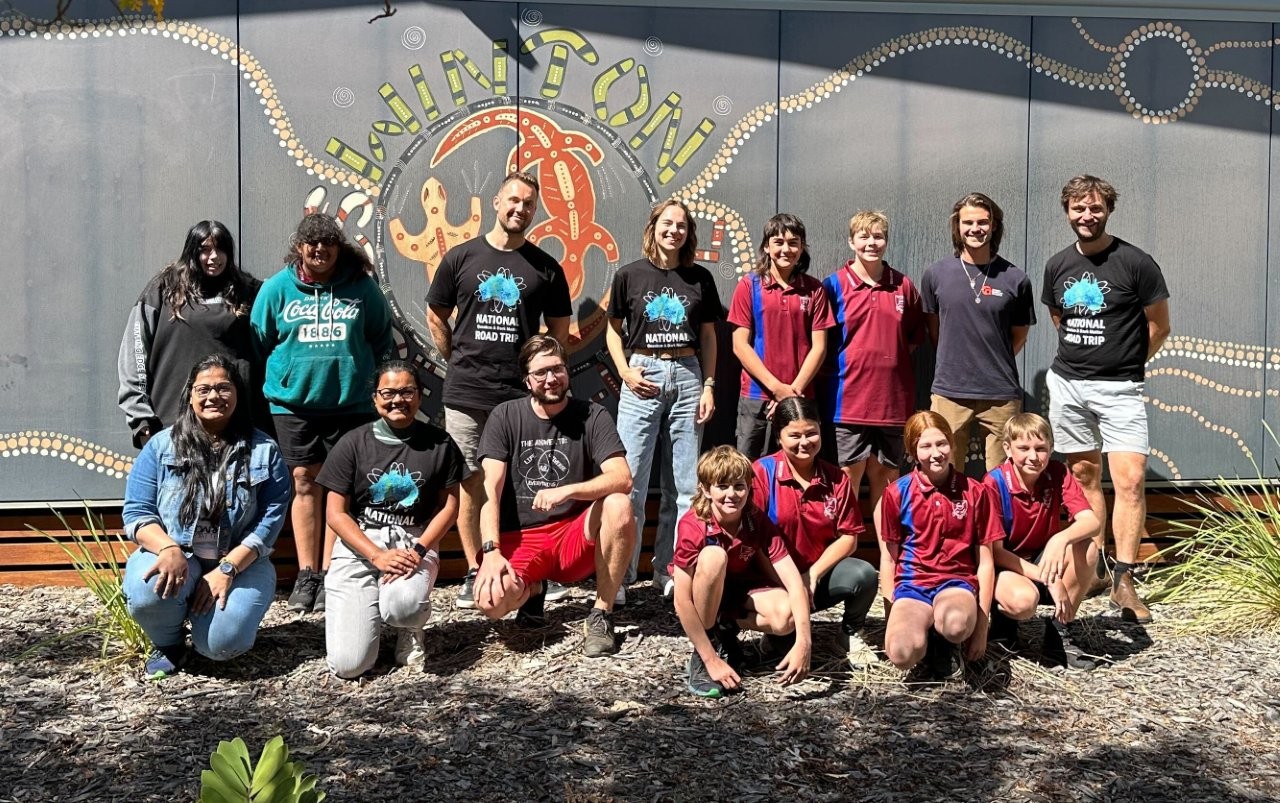
Kerstin, back middle, and her fellow road trippers enjoyed a drop-in with students from Winton State School, north-west of Longreach in outback Queensland, during their 2024 trip.
But why is this so important?
Science still has a diversity problem when it comes to both gender and geography.
According to the 2021 Youth in STEM report for the Department of Industry, Science, Energy and Resources, students growing up in country locations are less likely than their city counterparts to consider studying science at a tertiary level.
While 33 per cent of Year 11 and 12 students living in metropolitan areas were considering a career in a STEM field, that proportion dropped to 26 per cent for those living in regional or remote areas.
The numbers were even more skewed when it came to gender.
The Youth in STEM report revealed 42 per cent of boys/men, compared with 21 per cent of girls/women, were considering a STEM career.
These attitudes are reflected in career statistics, with the Australian Government’s STEM Equity Monitor reporting women make up only 15 per cent of Australia’s STEM workforce.
Aside from gender, parental engagement in STEM education or career was a key factor in determining STEM study at a tertiary level.
University students with parents who are educated in STEM are significantly more likely to be studying STEM overall (36 per cent vs 27 per cent), as are university students with parents who are employed in a STEM-related field (46 per cent vs 30 per cent).
Clearly, exposure to a scientific career makes a big difference to a student’s inclination to choose that particular pathway.
For me, it was a curious and enthusiastic maths teacher who noticed my interest and challenged me with additional problems.
That encouragement sparked my curiosity and set me on a path that eventually led to a career in science. Sometimes, just one connection like that can open up a whole new world of possibility.

Kerstin’s interest in a science career was sparked by a curious and enthusiastic maths teacher who noticed her interest in STEM and challenged her with additional problems.
Importantly, the diversity problem has a far broader impact than individual students and their career trajectories.
In an article in the Sydney Morning Herald earlier this year, Strathcona Girls Grammar principal Lorna Beegan highlighted the consequences of a lack of diversity in STEM fields.
“Crucially, roles marked by strong gender imbalances are more likely to face chronic shortages than those with a balanced workforce; highlighting how failing to attract and retain women is not just an equity issue, but an economic one,” she explained.
It is clear that the scientific – and wider – community in Australia would benefit from the diverse perspectives and experience of men and women, and those living in country and metropolitan locations.
A team of scientists is now preparing to take part in the annual National Quantum & Dark Matter Road Trip as part of National Science Week, which in the past has travelled to regional and remote communities across the country, including the Northern Territory, the Nullarbor, and rural Western Australia.
Taking place between August 4 and 21, this year’s trip coincides with the International Year of Quantum Science and Technology.
In many places, we might be the first scientists these students meet. By sharing not only our science but our stories, we hope to show that being a scientist isn’t out of reach – it’s a path open to anyone.
When students see scientists who look like them, who grew up in similar communities, who followed diverse paths into science, we hope they begin to see a place for themselves in this world, too.
To learn more about the 2025 National Quantum & Dark Matter Road Trip, likely to travel across Australia from Broome to Perth and Adelaide to Sydney, click here.